

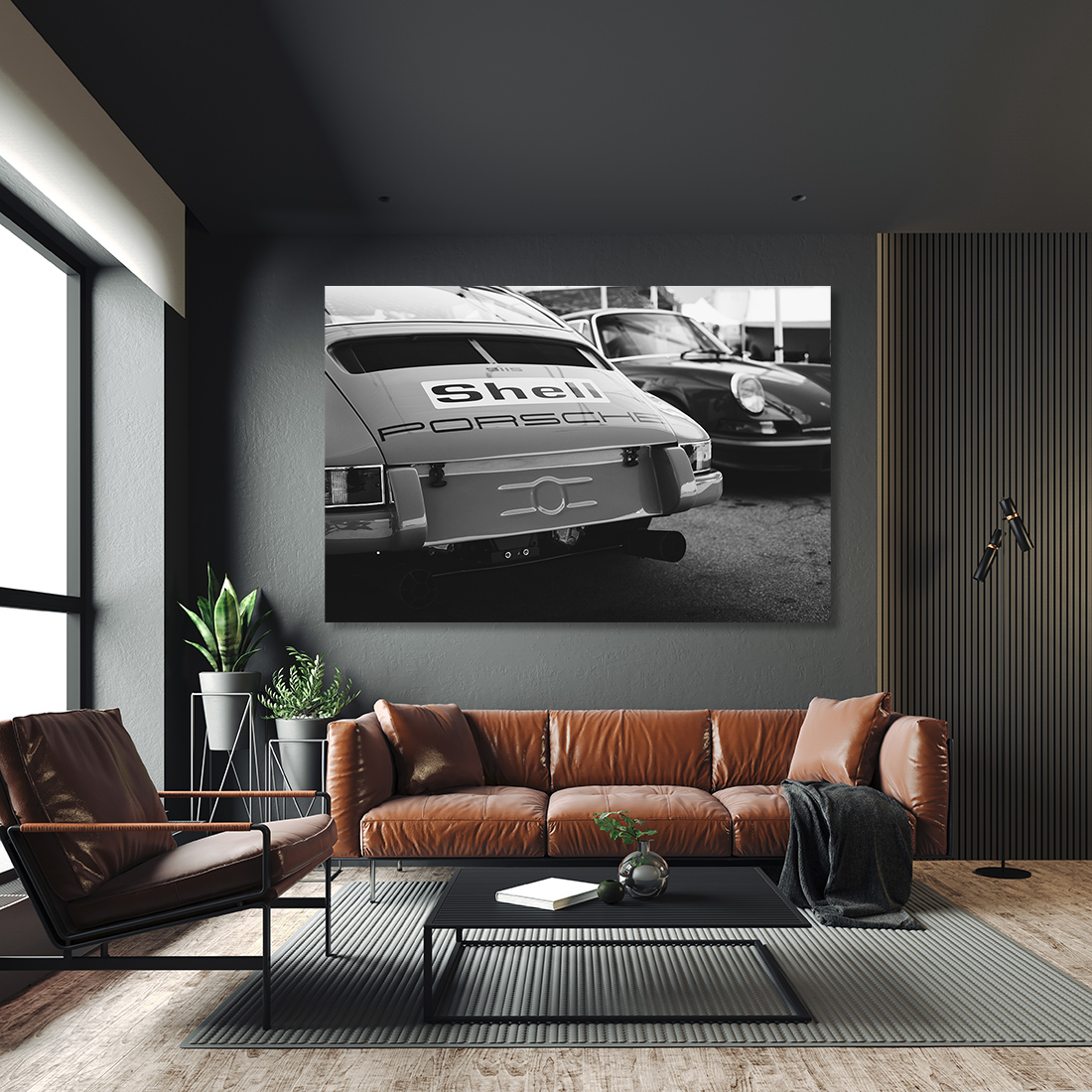
Black and white car photography is not a trend. It is a language in its own right — one of pure form, sculpted light, and raw emotion stripped of colour. A language that, from the earliest races of the last century to today’s fine art prints, has never stopped speaking to those who truly love cars.
In this article
Why black and white elevates car photography
There is a reason why the greatest automotive photographs in history are black and white. It is not a question of technology or era — it is a question of truth. By removing colour, you remove the noise. What remains is the essential: the body lines that embrace the air, the reflections that sculpt the forms, the tension of an engine at rest that seems ready to leap.
Black and white car photography works a particular alchemy. It transforms a machine into an archetype. A Ferrari 250 GTO is no longer just a red car — it becomes the Ferrari, the one that embodies the very idea of automotive beauty. Black and white universalises. It makes timeless what might have aged with the fashions and colour palettes of a given era.
The automotive photographers who shaped history — Jesse Alexander, Bernard Cahier, Nigel Snowdon — all understood this truth. Their shots from the great races of the 1950s and 60s have not aged precisely because they captured the essence, not the appearance. This principle holds true today for anyone seeking to create an image that stands the test of time.
What the absence of colour reveals — form, texture and light

Photographing a car in colour means photographing its paint. Photographing a car in black and white means photographing its structure. This fundamental distinction explains why certain models — those whose bodywork is genuine sculpture — lend themselves so naturally to this treatment.
The curves of a Jaguar E-Type, the muscular flanks of a Ford GT40, the sloping roofline of a Porsche 356: in black and white, these elements become pure volumes that the eye reads like contours on a topographic map. Light contrasts reveal every fold of metal, every tension between two surfaces. The photograph becomes almost tactile.
The handling of light is, in black and white, even more decisive than in colour. Raking side light across a body panel creates cast shadows that bring out volume. Backlight transforms the silhouette of a car into a graphic outline, instantly recognisable. This is why fine art photographers work their lighting with absolute precision before even pressing the shutter.
The most photographed cars in black and white
Not every car lends itself equally well to black and white photography. The vehicles that reveal themselves most powerfully in this medium share a common thread: their design is built on clear lines, worked surfaces, and a silhouette recognisable within a split second.
The Porsche 911 is arguably the most photographed car in black and white in the world. Its continuous roofline, rear arches and compactness make it an ideal subject — there is not a flat surface to be found; everything is movement. The Porsche 356, its direct ancestor, offers an even more organic roundness that recalls the sculpture of Brancusi.
In the world of racing cars, the Ford GT40 and the Ferrari 250 GTO dominate fine art collections. These machines have something unique in black and white: their dynamic aggression — low stance, air intakes, wire wheels — translates into raw contrast on paper, resulting in compositions that are simultaneously graphic and dramatic. At the other end of the spectrum, a Rolls-Royce or a Bentley Continental GT in black and white projects a cold, sovereign elegance that fills a room differently.
From shot to fine art print — a question of mastery

A successful black and white car photograph is not simply a colour photo with the saturation removed. It is an image conceived from the moment of capture to work without colour — and processed in post-production using the same tools that the masters of the darkroom once wielded.
The conversion to black and white begins with the channel mixer: by boosting the red channel, light bodywork is brightened and skies are deepened. Pushing the blue channel dramatises chrome and metalwork. Work on tonal curves then refines deep blacks without blocking the shadows, and highlights without blowing out reflections. This level of precision is what separates an automatic conversion from a fine art print.
At Cars and Roses, each black and white car photograph is processed individually and printed as a giclée fine art print on baryta paper or Dibond aluminium. The result: a depth of blacks, a richness of greys and a precision of detail impossible to achieve with a standard poster. This is the care that makes a fine art print stand out on a wall — and that you appreciate more with time.
Styling your home with black and white car photography
Black and white car photography is one of the few decorative subjects that works in almost any context: a contemporary living room, a director’s office, a masculine bedroom, a minimalist entrance hall. This versatility comes from its very nature — without a dominant colour, it does not clash with the tones of a wall or furniture; it complements them.
In terms of format, large horizontal prints (80×60 cm or 120×80 cm) work beautifully for a three-quarter view of a car, with enough breathing room around the subject. For an office or corridor, a square or vertical format of a car silhouette in backlight creates a strong graphic impact on a smaller surface. Our photo print size guide covers these criteria in detail if you are unsure about format.
For a gallery wall, black and white photographs have the advantage of combining naturally. They create visual coherence even when the cars depicted are wildly different. A Porsche next to a Ford GT40 next to a Lamborghini — in colour, that could be contentious; in black and white, it is a collection.
Frequently asked questions
Why are classic cars so often photographed in black and white?
Classic cars were designed at a time when form mattered more than colour. In black and white, their sculptural lines emerge fully, without the body colour distracting the eye. It is also a tribute to the period photographs that made these cars iconic in the first place.
What is the difference between a black and white photo and a fine art black and white print?
A fine art black and white print is an image conceived and processed to maximise tonal richness — deep blacks, varied mid-tones, precise highlights. It is printed as a giclée on baryta paper or Dibond aluminium, using pigment inks that guarantee a lifespan of over 100 years. A standard black and white poster cannot achieve this depth or permanence.
What size black and white car print should I choose for my living room?
For a standard wall (3–4 m wide), 80×60 cm is an excellent starting point. For a feature wall or main living area, go up to 100×70 cm or 120×80 cm. Black and white prints forgive large sizes — the bigger the image, the more detail in the bodywork becomes visible and the more presence it commands.
Does black and white car photography work in a feminine interior?
Absolutely. Automotive photography in black and white is first and foremost about design and elegance, not gender. The clean lines of a classic car integrate just as naturally into a refined, feminine interior as they do in a masculine study. Many of our clients specifically choose black and white for its restraint and absence of colour conflict.
Black & White Car Photography Fine Art
From €78
Giclée Fine Art Prints · Limited Edition · Certificate of Authenticity
Read also