

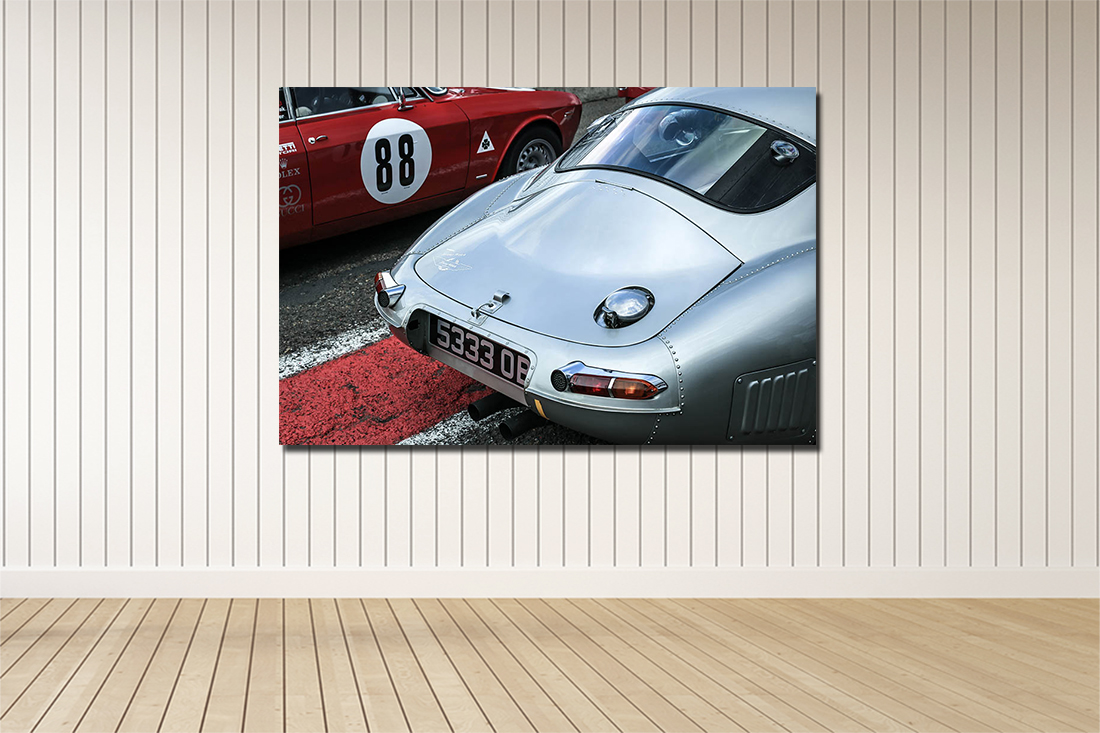
The Jaguar E-Type is far more than an automobile — it is a sculpture in motion, an absolute declaration of beauty born at the dawn of the 1960s. Captured through the lens of a fine art automotive photographer, it reveals the full depth of its lines, the elegance of its bodywork, and the silent tension of a design that has crossed the decades without ageing a single day.
Contents
- The Jaguar E-Type: Birth of an Icon
- The Photographer’s Eye on the E-Type
- The Lines That Captivate the Lens
- Fine Art and Automotive Photography: A Natural Alliance
- Gifting a Jaguar E-Type Photograph
The Jaguar E-Type: Birth of an Icon
Unveiled at the Geneva Motor Show in March 1961, the Jaguar E-Type caused an immediate sensation in the automotive world. Enzo Ferrari himself is said to have called it “the most beautiful car ever made” — a statement that captures the car’s visual impact better than any technical analysis. Designed by Malcolm Sayer, an aerodynamicist by training, the E-Type is the result of scientific equations translated into steel and aluminium with a grace rarely equalled.
Its long streamlined bonnet, organic curves, glass bubble cockpit, and covered wheels make for a silhouette that is instantly recognisable. The Series 1 E-Type — produced from 1961 to 1968 — remains the purest of all versions, with its Plexiglas-covered headlights and stripped-back interior. It is this purity that makes it a subject of choice for fine art automotive photography: every detail deserves to be elevated.
The Photographer’s Eye on the E-Type
Photographing a Jaguar E-Type means entering into a dialogue between light and matter. The fine art automotive photographer is not looking to document the car — they are looking to reveal its soul. The reflections on the aluminium bonnet, the perfect curve of the front wing, the depth of the open cockpit: every angle tells a different story.
The finest E-Type Jaguar photographs play on contrasts between shadow and light to bring out the body’s curves. A black-and-white treatment accentuates the sculptural character of the machine, while a colour image magnifies the original paintwork — British Racing Red, ivory white, or Opalescent Blue. The photographer chooses their moment, their angle, their light to transform an automobile into a work of art.
The Lines That Captivate the Lens
Very few automobiles offer photographic compositions in every single detail. The E-Type is one of them. The tapered nose, finished with a small circular grille, recalls the torpedoes and aircraft fuselages of the era — a direct legacy of Malcolm Sayer’s aerodynamic studies. Photographed from a slight downward angle, the long bonnet becomes a vanishing line, an invitation to journey.
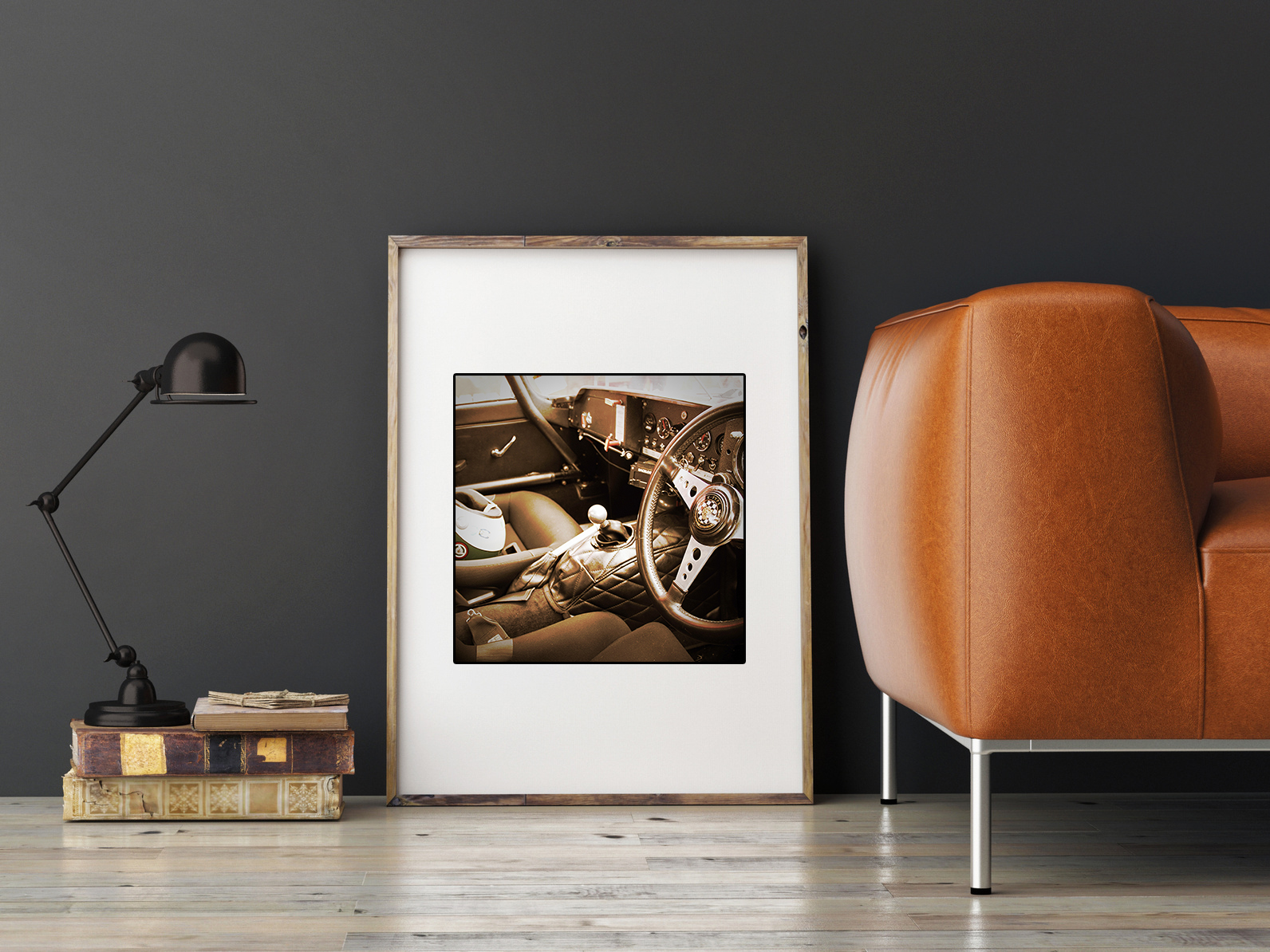
The interior of the E-Type is equally cinematic: the small wooden steering wheel, analogue instruments, the short gear lever planted at the centre of the tunnel — a world of leather and brushed steel that evokes the racing drivers of the sixties. Every detail is a frame within a frame, a story waiting to be told through the photographer’s eye.
Fine Art and Automotive Photography: A Natural Alliance
Fine art automotive photography was born of a conviction that certain machines deserve to be treated with the same respect and artistic rigour as any gallery subject. The Jaguar E-Type is one such machine. Displayed at the Museum of Modern Art in New York as early as 1996 as an example of industrial sculpture, it officially crossed the boundary between object and artwork.
A fine art E-Type print on Dibond aluminium or plexiglas brings an interior a simultaneously visual and narrative dimension. It is not simply a car image — it is a window onto an era, a design philosophy, a particular idea of beauty. In a contemporary living room, such a work creates an immediate focal point, a talking point, a lasting emotion.
Gifting a Jaguar E-Type Photograph
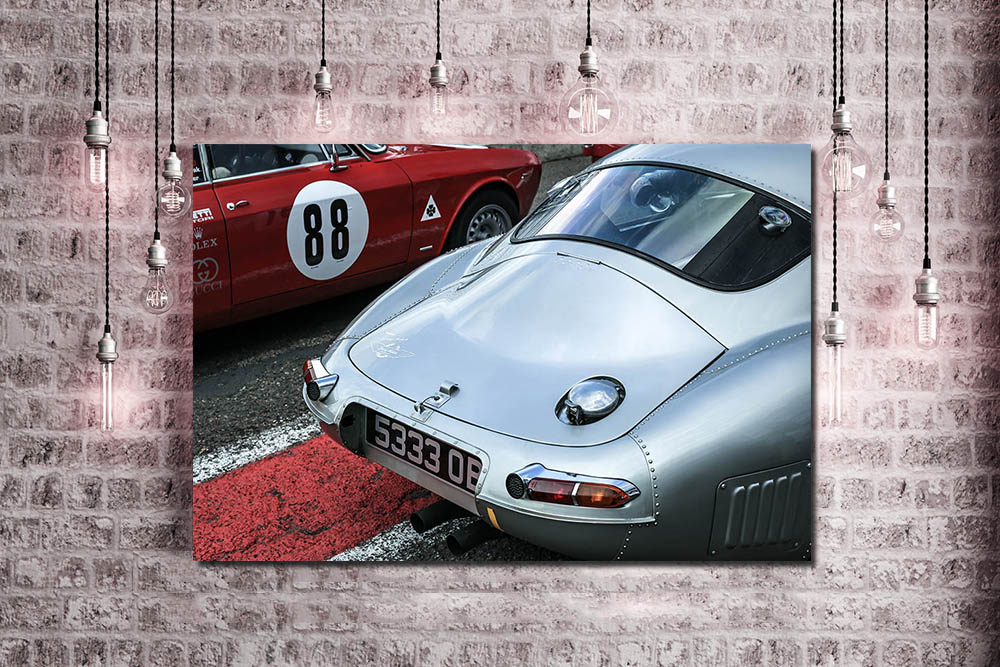
Gifting a fine art Jaguar E-Type photograph means offering a unique piece to a classic car enthusiast. Numbered, certified, and printed in limited edition, each work comes with a certificate of authenticity guaranteeing its value and origin. Available formats adapt to any space: from a small 30×20cm format for a desk to a large 120×80cm for a living room wall or hallway.
Supports also vary according to use and desired ambiance: Dibond aluminium offers a contemporary finish with metallic reflections; plexiglas adds depth and luxury gloss; canvas brings a warmer, more traditional feel. Whatever the format or support chosen, a fine art Jaguar E-Type photograph permanently transforms the space it inhabits.
What makes the Jaguar E-Type unique as a photographic subject?
The Jaguar E-Type has lines so pure and a silhouette so recognisable that it lends itself naturally to artistic photography. Every angle reveals a new facet of its design: the long bonnet, the bubble cockpit, the covered wheels. Malcolm Sayer designed it using aerodynamic equations that give it a unique sculptural grace, making it one of the favourite subjects of fine art automotive photography.
What support should I choose for a Jaguar E-Type photo print?
For a Jaguar E-Type photograph, Dibond aluminium is the most popular support: its metallic reflections resonate with the car’s bodywork. Plexiglas offers additional depth and luxurious gloss. Canvas suits warmer or more classic interiors. All our prints are available in these three supports, in limited and numbered editions.
Is the Jaguar E-Type considered a work of art?
Yes. The 1963 Jaguar E-Type Series 1 was displayed at the Museum of Modern Art (MoMA) in New York in 1996 as an example of industrial sculpture. It is one of the very few automobiles to have officially crossed the boundary between design object and artwork recognised by cultural institutions.