

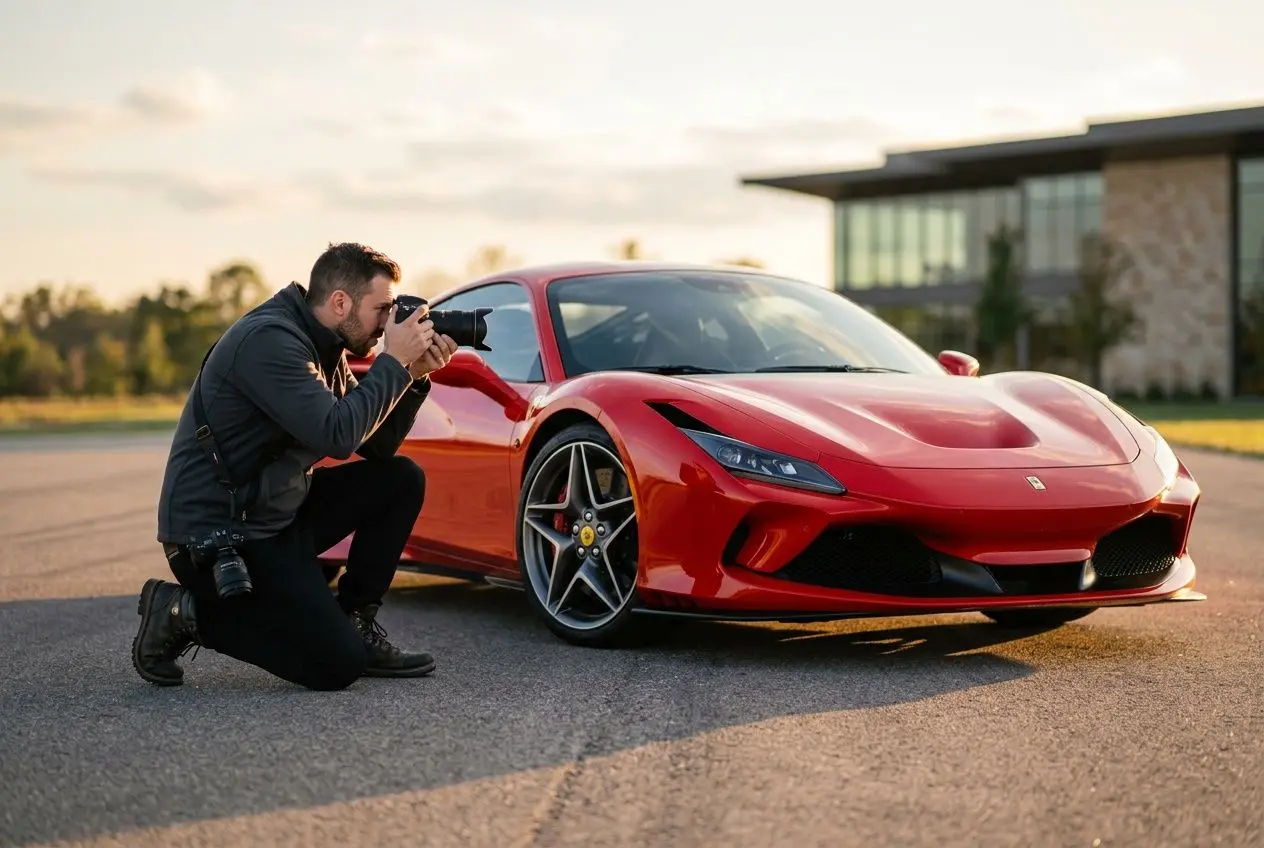
The camera body gets all the attention, but the lens is what actually shapes your car photograph — its perspective, its depth, its mood. Choose the wrong focal length and even the most beautiful classic car will look flat or awkward. Here’s how to pick the right glass for every situation.
Table of Contents
- Why Your Lens Matters More Than Your Camera Body
- Wide-Angle Lenses (16–35mm): Environmental and Dynamic Shots
- The Standard Zoom (24–70mm): The Versatile All-Rounder
- Telephoto Lenses (70–200mm and Beyond): Compression and Isolation
- Macro and Detail Lenses: Badges, Interiors, and Textures
- Prime vs. Zoom: Which Should You Choose?
- Practical Tips: Glass Reflections, Track Days, and Low Light
Why Your Lens Matters More Than Your Camera Body
Two photographers can shoot the same car, side by side, with two different lenses, and come away with images that feel like they belong to different genres entirely. A wide-angle lens exaggerates proportions and pulls the viewer into the scene; a telephoto compresses distance and isolates the subject against a soft background. The camera body records light — the lens decides what that light looks like once it reaches the sensor. This is exactly why, when we select which of our own fine art car photography prints to shoot for a given collection, the lens choice is discussed before the camera settings.
Before buying anything, it helps to think in terms of the story you want the photograph to tell. Do you want the car to dominate the frame and feel monumental? Do you want to isolate one detail — a badge, a headlight, a stitched seam — and treat it almost like a portrait? Each answer points toward a different focal length, and most car photographers eventually build a small kit of two or three lenses that cover these distinct needs rather than searching for one “do everything” lens.
Wide-Angle Lenses (16–35mm): Environmental and Dynamic Shots
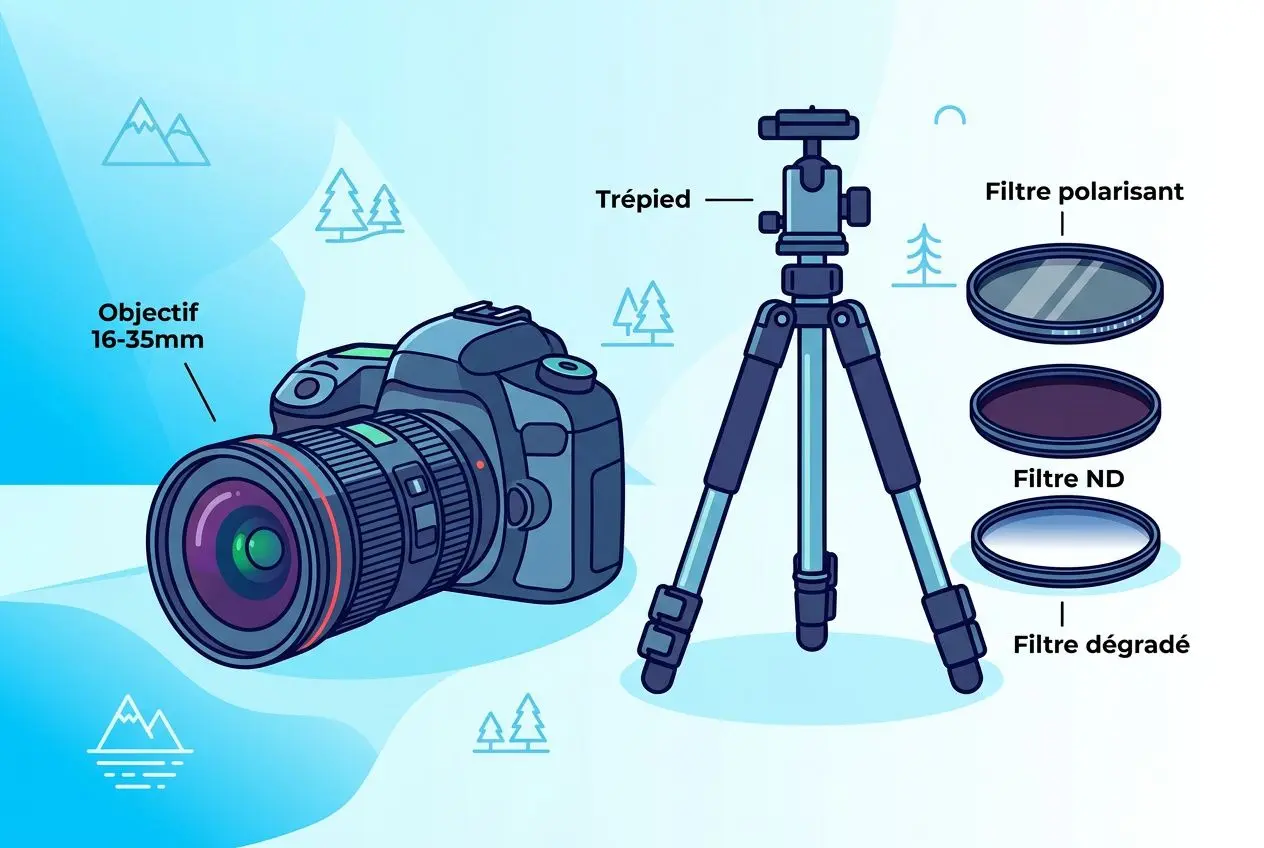
A wide-angle lens, typically in the 16–35mm range on a full-frame camera, is the tool for placing a car firmly inside its environment — a coastal road, a garage, a city street at dusk. It exaggerates the size of whatever is closest to the lens, which is precisely why a low, close angle on the front fender of a car can make it look aggressive and imposing. This is the lens most often used for hero shots: three-quarter angles that show the full silhouette of the car along with a generous slice of its surroundings.
The trade-off is distortion. Get too close to the edges of the frame with an ultra-wide lens and wheels can stretch into ovals, straight lines can bow outward. The fix isn’t to avoid wide angles — it’s to keep the car reasonably centered, or to embrace the distortion deliberately for a more dramatic, editorial look. Wide lenses also let far more of the background stay in focus, which is ideal for a landscape or architectural backdrop you actually want visible, but a liability if that background is cluttered.
The Standard Zoom (24–70mm): The Versatile All-Rounder
If a photographer could only own one lens for car photography, most would choose something in the 24–70mm range. It covers a natural, undistorted perspective close to what the human eye perceives, which makes it the safest choice for three-quarter shots, side profiles, and interior details without the exaggeration of a wide angle or the compression of a telephoto. It’s also the lens that adapts fastest to a changing shoot — a car meet, a garage session, a spontaneous roadside stop — because you can zoom rather than physically repositioning yourself around the car.
The standard zoom is, in a sense, the least exciting lens on this list — and that’s exactly its strength. It won’t produce the most dramatic image, but it will almost never produce a wrong one. For anyone starting out in car photography, or shooting a full gallery wall series that needs visual consistency across many images, this focal range is the dependable backbone of the kit.
Telephoto Lenses (70–200mm and Beyond): Compression and Isolation
Step back and reach for a 70–200mm telephoto, and the physics of the image change completely. Compression brings the background visually closer to the car, flattening depth and making distant elements — mountains, a line of trees, a row of buildings — appear larger and closer than they really are. Combined with a wide aperture like f/2.8, a telephoto lens can melt a busy background into a soft wash of color while keeping the car itself crisp, which is one of the reasons so many of the most striking automotive portraits in magazines and galleries are shot at 135mm or 200mm rather than wide.
Telephoto lenses are also the natural choice for action and track photography, where physical distance from the car is a safety requirement rather than a creative decision. Panning shots — where the car stays sharp while the background streaks with motion blur — are almost always shot in this range, since it lets the photographer stand safely trackside while still filling the frame.
Macro and Detail Lenses: Badges, Interiors, and Textures
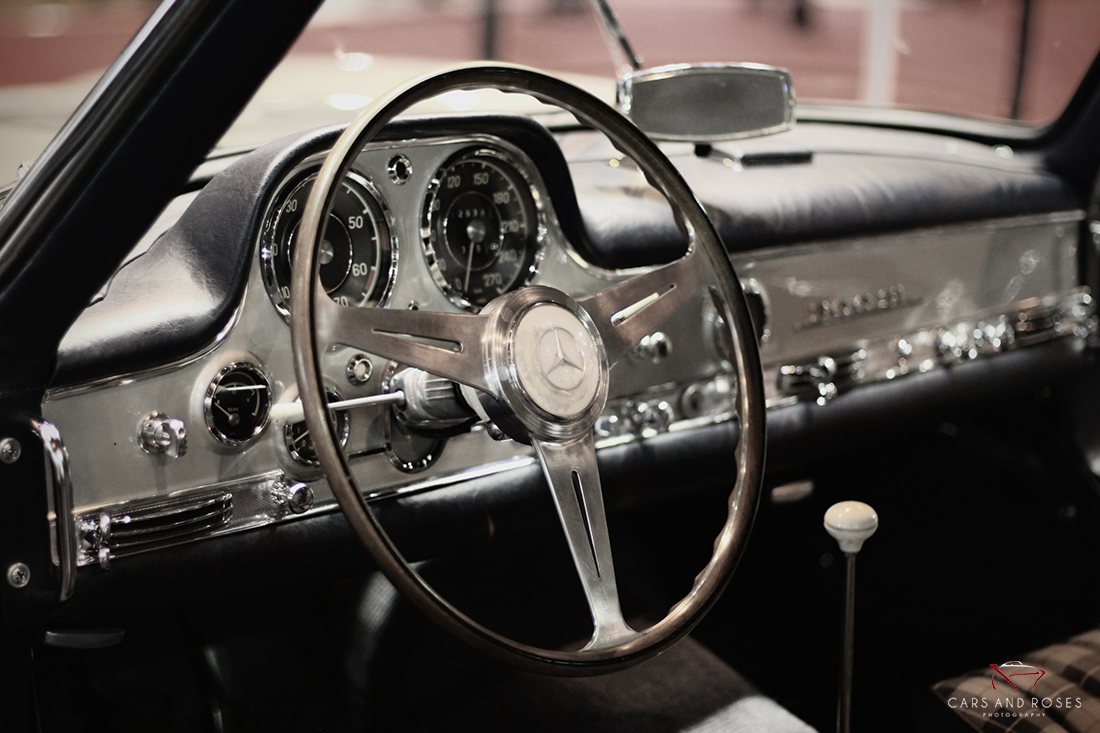
Some of the most compelling car photographs never show the whole vehicle at all. A macro or close-focusing lens — often in the 90–105mm range — lets you fill the frame with a badge, a stitched leather seat, the grain of a wood dashboard, or the reflection curling across a freshly polished panel. These detail shots rely on a shallow depth of field to isolate texture from its surroundings, and they’re what give a photo series its sense of craftsmanship and intimacy rather than just documentation.
You don’t necessarily need a dedicated macro lens to start — a standard zoom with a close minimum focusing distance, or a telephoto zoomed to its longest setting from a few feet away, can achieve a similar effect. But a true macro lens rewards anyone who wants to go further, revealing texture and reflection detail that a general-purpose lens simply can’t resolve at close range.
Prime vs. Zoom: Which Should You Choose?
Prime lenses — fixed focal lengths like 35mm, 50mm, or 85mm — are typically sharper, lighter, and open to wider apertures than zooms at the same price point, which matters when you’re chasing shallow depth of field or shooting in low light at dawn or dusk, the two most flattering times of day for car photography. Their limitation is obvious: you move your feet instead of your zoom ring, which can be genuinely restrictive at a crowded car show or a tight garage.
Zoom lenses trade a little optical performance for flexibility, letting you reframe instantly as the light, the crowd, or the car itself changes position. For most car photographers, the practical answer is a hybrid kit: a versatile zoom as the default choice, with one or two primes reserved for the shots — a low-light portrait of the car, an intimate detail — where their extra sharpness and wider aperture genuinely make a difference.
Practical Tips: Glass Reflections, Track Days, and Low Light
Shooting through a windshield or side window for an interior shot almost always introduces reflections. A polarizing filter, rotated to the right angle, can cut most of that glare — it’s a cheap addition to any lens and one of the few filters that’s genuinely difficult to replicate convincingly in post-production. At track days, a telephoto with image stabilization or a fast shutter speed is non-negotiable, since panning a moving car by hand at 1/250s or slower takes practice most photographers only build after a few missed shots.
For low light — golden hour, blue hour, or an evening garage session — a lens with a wide maximum aperture (f/1.8, f/2.8) becomes far more valuable than extra zoom range, since it lets you keep a lower ISO and a fast enough shutter speed to avoid blur without adding artificial light. If you’re planning to photograph a car at night, this is the single upgrade that will make the biggest visible difference in your results.
Prints from the collection
To see what a good lens choice looks like once printed, these limited edition fine art prints, numbered and signed, are a good place to start:
Frequently Asked Questions
What is the best all-around lens for car photography?
A 24–70mm standard zoom is the most commonly recommended starting point. It covers three-quarter shots, side profiles, and basic interior details without the distortion of an ultra-wide or the physical distance required by a telephoto.
Do I need a full-frame camera to get good results?
No. Crop-sensor cameras produce excellent car photography — you’ll just need to account for the crop factor when thinking in focal length terms (a 16mm lens on a crop sensor behaves closer to 24mm on full-frame).
Why do professional car photos have such a blurred background?
That effect, called bokeh, comes from a combination of a wide aperture (low f-number) and a longer focal length, typically 85mm and above. The wider the aperture and the longer the lens, the softer and more compressed the background becomes.
What focal length is best for interior detail shots?
Something in the 90–105mm macro range works best for badges, stitching, and dashboard textures, since it lets you focus closely without distorting the subject the way a wide-angle lens would at the same distance.
Is a polarizing filter really necessary?
For interior and glass reflection shots, yes — it’s one of the only filter effects that can’t be accurately recreated in editing software afterward. For most other car photography, it’s optional but useful for deepening sky color and reducing glare on paintwork.