

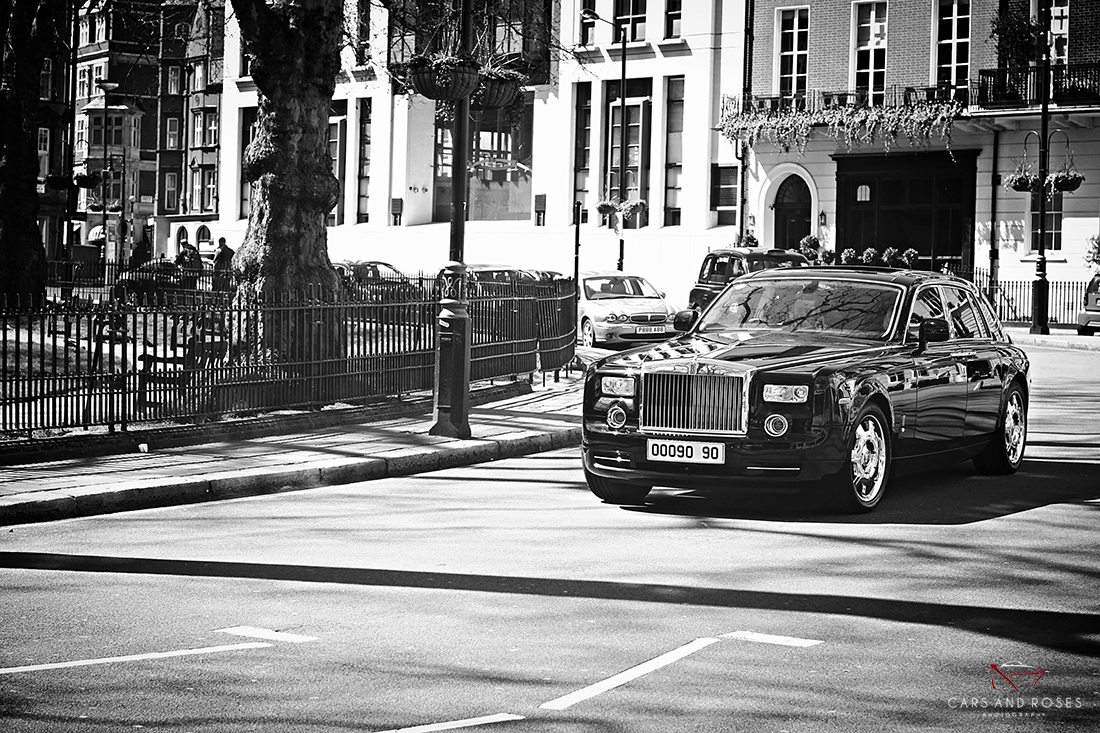
Some cars are meant to be driven. Others are meant to be admired. And a rare few — the truly exceptional ones — are meant to be contemplated. The Rolls-Royce belongs to this last category. Photographed in fine art, it becomes the most eloquent decorative statement an interior can make.
Contents
- Rolls-Royce: a natural subject for fine art photography
- Phantom, Ghost, Wraith and Silver Shadow: the unmissable models
- The Spirit of Ecstasy and the details that make a great photograph
- Which finish for a Rolls-Royce photograph
- Integrating a Rolls-Royce photograph into your interior
Rolls-Royce: a natural subject for fine art photography
Fine art photography demands a subject with inherent aesthetic power — something strong enough to fill a frame, anchor a wall, and withstand sustained attention. The Rolls-Royce meets these requirements better than almost any other man-made object.
Every Rolls-Royce is hand-built at the Goodwood atelier in West Sussex. Proportions are calibrated to fractions of a millimetre. The Pantheon grille, the coachwork lines that extend with an almost architectural serenity, the lacquered surfaces in which the surrounding world reflects — all of this creates a photographic image of exceptional density. A skilled automotive photographer only needs to frame the scene and wait for the right light. The car does the rest.
Just as a Ferrari 250 GTO in fine art photography transcends the image of a car to become a cultural artefact, the Rolls-Royce adds a further dimension: it photographs civilisation itself, at the apex of its refinement.
Phantom, Ghost, Wraith and Silver Shadow: the unmissable models
The Rolls-Royce range offers several distinct visual personalities, each with its own photographic character.
The Phantom is the purest expression of the marque. Its commanding silhouette, coach doors that open against the direction of travel, its long, low profile — the Phantom imposes an immediate visual order. In fine art photography, it works particularly well in black and white: the contrast between chromework and deep lacquer produces a tonal richness that few automotive subjects can match.
The Ghost — whose name deliberately evokes the discretion of true luxury — offers a more contemporary, more airy line. Its modernity makes it accessible to current architectural interiors. The Wraith, a fastback coupé with tensed shoulders, is the most dynamic model in the range: its flowing lines create a visual tension absent in the others, perfect for a more aggressive photographic composition.
Among the classics, the Silver Shadow (1965–1980) remains one of the most photographed Rolls-Royces in history. Its Pininfarina-influenced lines, its presence in cinema and late-twentieth-century popular culture make it an immediately evocative subject. For modern car wall art that speaks across generations, the Silver Shadow offers precisely the temporal ambiguity that interior designers seek — timeless yet instantly recognisable.
The Spirit of Ecstasy and the details that make a great photograph
What distinguishes a fine art Rolls-Royce photograph from a mere snapshot is often the photographer’s ability to isolate the details that concentrate the essence of the marque. And on a Rolls-Royce, such details are everywhere.
The Spirit of Ecstasy — the winged figure adorning the bonnet since 1911 — is the world’s most recognised automotive mascot. Photographed from a low angle against the sky, it becomes an abstract sculpture of considerable symbolic power. Several fine art prints show nothing but this figurine: a tight crop, raking light, a blurred urban background — and the entire history of the marque is told in a single frame.
The Pantheon grille, with its hand-polished vertical vanes, is another subject in its own right. Seen head-on, it generates an almost architectural symmetry. The forged alloys, the RR medallion, the Bespoke stitching visible through tinted glass — each of these elements can constitute the sole subject of a medium-format fine art print, perfect for a gallery wall composition alongside a larger centrepiece.
Which finish for a Rolls-Royce photograph
The choice of medium matters as much as the image itself. For a Rolls-Royce, certain finishes assert themselves more naturally.
Aluminium dibond is the reference support for fine art automotive photography. Its smooth, slightly reflective surface creates a depth that amplifies paintwork naturally. Chrome becomes more vibrant, blacks deepen, Bespoke colours (Midnight Sapphire, Black Diamond, Andalusian White) glow with remarkable fidelity. It is the medium used by the leading automotive art galleries in London and Los Angeles.
Acrylic (plexiglas) — a face-mounted print behind clear acrylic — offers an even more luminous result, almost backlit. It suits very contemporary interiors: loft apartments, open-plan spaces with indirect lighting. For warmer or more traditional spaces, fine art canvas brings a texture that recalls painting, softening the subject visually.
For a gallery wall arrangement that includes a Rolls-Royce centrepiece, consider harmonising the media: aluminium for the large central piece, canvas for smaller satellite works.
Integrating a Rolls-Royce photograph into your interior
A Rolls-Royce photograph is not a neutral decorative element. It makes a statement — one of formed taste, of sensitivity to authentic luxury, of a culture of exceptional objects. Its integration into an interior therefore requires thought about context.
In a dark-toned interior — anthracite or midnight blue walls, natural leather furniture, dark woodwork — a black-and-white Rolls-Royce print on aluminium creates a private gallery effect of absolute coherence. The Pantheon grille in large format (100×150 cm) on an entire wall is enough to define the whole space.
In a light contemporary interior — polished concrete, Scandinavian furniture, open volumes — opt for a Bespoke-colour Rolls-Royce photographed outdoors, with a luminous sky as backdrop. The contrast between the lightness of the décor and the commanding presence of the car creates a visual tension that animates the room.
For a home office or workspace, a medium format (60×90 cm) is sufficient: the Rolls-Royce plays the role of a value signal — discreet but immediately legible to anyone who shares your references. This is precisely why this type of fine art print finds its place in the offices of corporate lawyers, management consultancies, and art galleries.
Fine Art Automotive Photography
Rolls-Royce, Ferrari, Porsche — Limited Editions
Numbered prints on aluminium dibond and canvas — Whitewall printing. From $78.
Discover the automotive collectionFAQ — Rolls-Royce Photography
Which Rolls-Royce model is best for a fine art photograph?
The Phantom in black and white for maximum prestige and timelessness. The Silver Shadow for a vintage, cultural dimension. The Wraith for more contemporary interiors. The Ghost for a clean, universal line that adapts to any décor style.
What is the best medium for printing a Rolls-Royce photograph?
Aluminium dibond is the reference choice: it renders chrome and lacquer with a depth and fidelity impossible on paper or canvas. Acrylic suits very contemporary spaces. Fine art canvas softens the subject for more traditional interiors.
What size should a Rolls-Royce wall print be?
60×90 cm for an office or secondary space. 80×120 cm for a standard living room. 100×150 cm or larger for a grand wall or a strong design statement. Below 60 cm in width, the bodywork details and surface finishes lose most of their impact.
Does a Rolls-Royce photograph work in a non-luxury interior?
Yes — and it is often most effective there. Like a piece of art in a spare space, it creates a contrast that sets it apart. The interior doesn’t need to be luxurious: the print itself carries the full aesthetic weight.
What is the difference between a fine art Rolls-Royce print and a standard poster?
A fine art print is produced on a noble support (aluminium, acrylic, canvas), numbered, certified, and printed with pigment inks guaranteed for 70 to 100 years. A standard poster is an inkjet print on thin paper that yellows within a few years. They are entirely different objects — one is a collectible, the other a temporary decorative reproduction.