

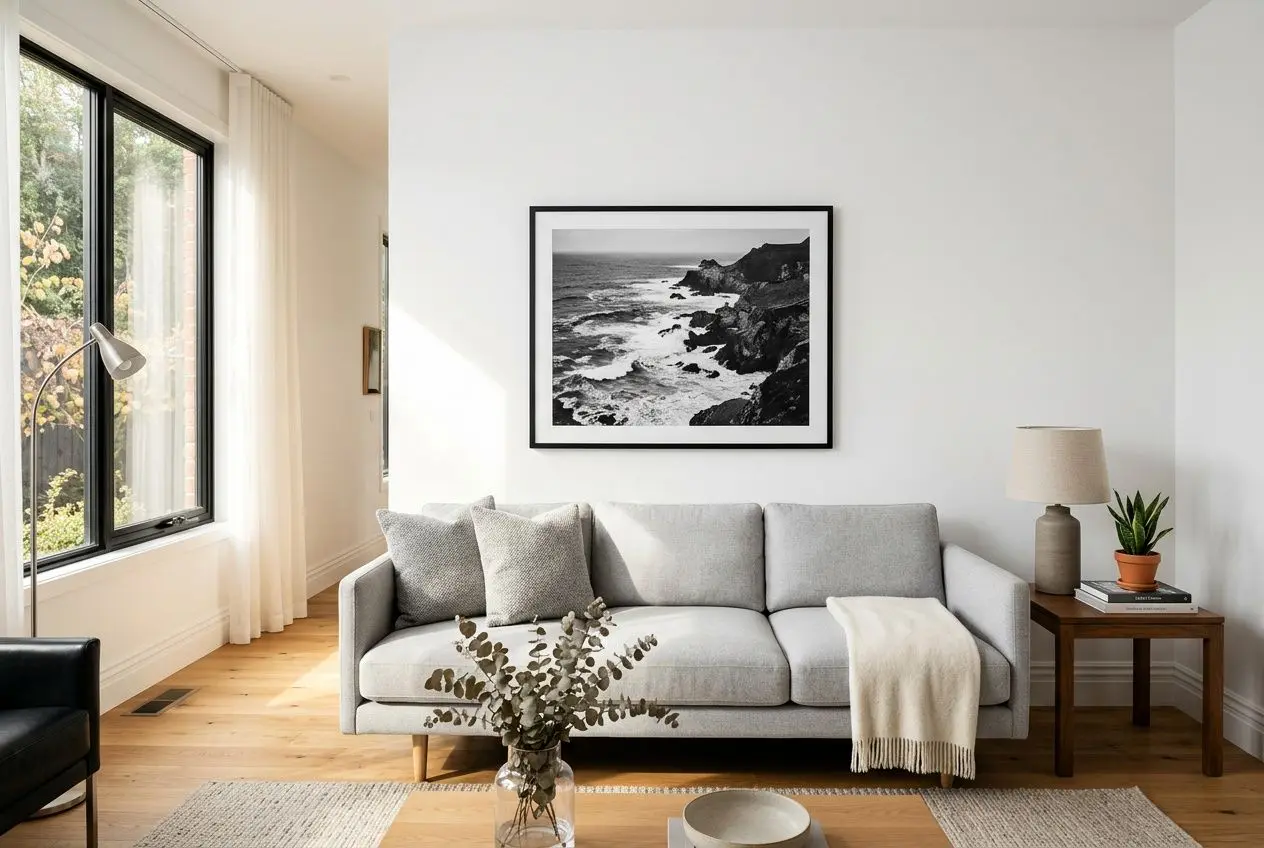
Where to place wall art in your living room
Placing living room wall art begins with the room itself. Architecture sets the outer limits, but furniture positions on each wall establish the true reference points for centering and proportion.
From there, hanging artwork should follow a clear structure rather than instinct alone. A gallery wall guide helps when planning a gallery wall or other multiple pieces, yet the first decision remains the same: establish the center at eye level before choosing any layout.
The 57-inch rule explained
A dependable baseline makes arranging wall art decisions far easier. The 57-inch rule places the visual center of a picture at 57 inches, or about 145 cm, from the floor: a standard tied to average eye level and widely used for hanging height in galleries and residential interiors alike.
That measurement becomes the anchor for the entire composition. Mark the wall at 57 inches, then calculate upward or downward according to the frame size and hardware position; across multiple pieces, this consistency creates order and improves the overall balance of the display.
LIMITED EDITION — NUMBERED — CERTIFIED
Wall Art Prints — Cars and Roses Collection
Ferrari, Porsche, Lamborghini and Nordic landscapes — fine art prints on aluminium, plexiglass and canvas. Gallery quality for your walls.
From €78 — Canvas 30×20cm
Adjusting height for seated living rooms
Once the 57-inch rule is understood, the room’s actual use refines it. Because a living room is often experienced while seated, lowering the visual center to roughly 45 inches, or 114 cm, better suits the natural sightline from a sofa, a meaningful adjustment in rooms used primarily while seated.
Ceiling height also affects the final hanging height. In taller rooms, art may sit slightly higher to avoid looking lost on a broad wall; by contrast, in lower rooms, a lower placement keeps the relationship between artwork, furniture, and ceiling in proportion.
Centering art with furniture, not the wall
The difference lies in centering the work over the furniture below, not over the wall’s total width, so the composition feels grounded rather than arbitrary.
Above a sofa, console, bed, or mantle, leave 6 to 10 inches between the top edge of the furniture and the bottom of the frame.
Before fixing the final position, lean the piece in place and study it under changing light for a day or two. Once installed, a photograph taken from the doorway reveals proportion issues quickly, especially with wall art of larger scale such as a lake wall art print intended to anchor a gallery wall or stand alone on a main wall.
How to arrange wall art above a sofa
The sofa wall is usually the most prominent wall space in a living room.
Applying the two-thirds rule to your sofa
That proportion starts with the two-thirds rule. To arrange wall art above a sofa, the overall width should cover about 65% of the sofa: enough to anchor the furniture, restrained enough to keep the wall from feeling crowded.
On a 2.20-metre sofa, that usually means a piece around 100 × 150 cm. At that scale, the print reads as connected to the sofa rather than floating above it.
The same logic applies to multiple pieces. Treat the full arrangement as one visual unit, measuring the combined width rather than each frame on its own.
A Porsche wall art print in aluminum Dibond at 100 × 150 cm, for example, fits this ratio cleanly for many standard sofas.
Correct spacing between sofa and frame
Once width is established, spacing takes over. Leave 6–8 inches, or 15–20 cm, between the sofa back and the lower edge of the frame so the artwork remains visually tied to the furniture without pressing down on it.
LIMITED EDITION — NUMBERED — CERTIFIED
Landscape & Automotive Photography — Fine Art Prints
Iceland, Palm Springs, Arctic Fjords — each print is numbered and comes with a certificate of authenticity.
From €78 — Canvas 30×20cm
A well-chosen wall art size can still feel misplaced if the gap above the sofa is too narrow or too loose.
Ceiling height then refines the placement. With a standard 2.4-metre ceiling, keep closer to 15 cm above the sofa; in taller rooms, the piece can sit slightly higher while still maintaining that visual link to the seating below.
Beyond placement, the wall itself matters. For heavier works, especially above 20 pounds, Cars and Roses recommends French cleats anchored into studs before the piece is installed.
Sizing art for sectional sofas
That relationship shifts slightly with sectionals. Because the furniture stretches farther across the room, the artwork generally needs to span 48 to 60 inches, roughly 120 to 150 cm, to maintain the same proportional anchor established by the two-thirds rule.
Centering changes as well. Center the composition over the longest section of the sectional rather than the architectural midpoint of the wall: the furniture line, not the architecture, governs the visual anchor.
From there, test the footprint before making holes. Use painter’s tape to mark the proposed dimensions on the wall, then view the outline from the main entry point and at different times of day to judge whether the chosen wall art size holds the room properly.
Gallery wall layout styles and how to choose one
A gallery wall can be exacting or deliberately loose. The right format depends on the scale of the room, the collection on display, and the level of structure needed to keep the décor in harmony.
Grid, salon, and linear gallery wall formats
That need for structure usually decides the layout first. Choosing it before buying hardware brings clarity, and often reveals the detail that changes everything: how the art should relate to the furniture and the wall itself.
- Grid gallery wall: Matching frame sizes, spaced evenly at 5–6 cm, create a controlled and clearly ordered result suited to minimalist or contemporary rooms. A 3×3 grid suits a square wall; a 2×4 grid works better in a narrow vertical space.
- Salon-style gallery wall: Mixed frame dimensions allow the collection to expand more freely, provided the works share a consistent color temperature. This format suits eclectic interiors where different periods or genres must coexist without a rigid framework.
- Symmetrical gallery wall: A larger central frame can anchor smaller surrounding works, or two larger pieces can sit side by side with smaller works arranged around them. The effect is formal balance, with enough variation to avoid stiffness.
By contrast, a linear gallery wall follows an implied horizontal axis. It extends the eye across the room, aligns naturally with furniture lines, and is worth considering when a full composition would feel too dense: above a console, for instance, or in a long narrow living room.
Organic and layered gallery wall approaches
Once the more structured formats are defined, the alternative becomes clearer. An organic gallery wall grows from a few anchor pieces rather than a fixed plan, making it well suited to interiors where art arrangements develop over time instead of arriving in a single installation.
A strong anchor matters here. A serene large-scale print, such as the lake wall art canvas reproduced with archival inks, establishes a central point from which other works can be added gradually without disturbing the overall harmony.
Slight overlaps, combined with photography, illustration, and three-dimensional objects, soften the flatness of a strictly two-dimensional gallery wall.
Control is the deciding factor. Frame profiles and mediums may vary freely, provided one color temperature remains consistent across the group.
How to measure and space pictures on a wall
In art arrangements, whether the goal is a strict grid or a looser gallery wall, consistent spacing and dependable alignment create the balance that makes a collection feel intentional rather than improvised.
Spacing rules for consistent gallery walls
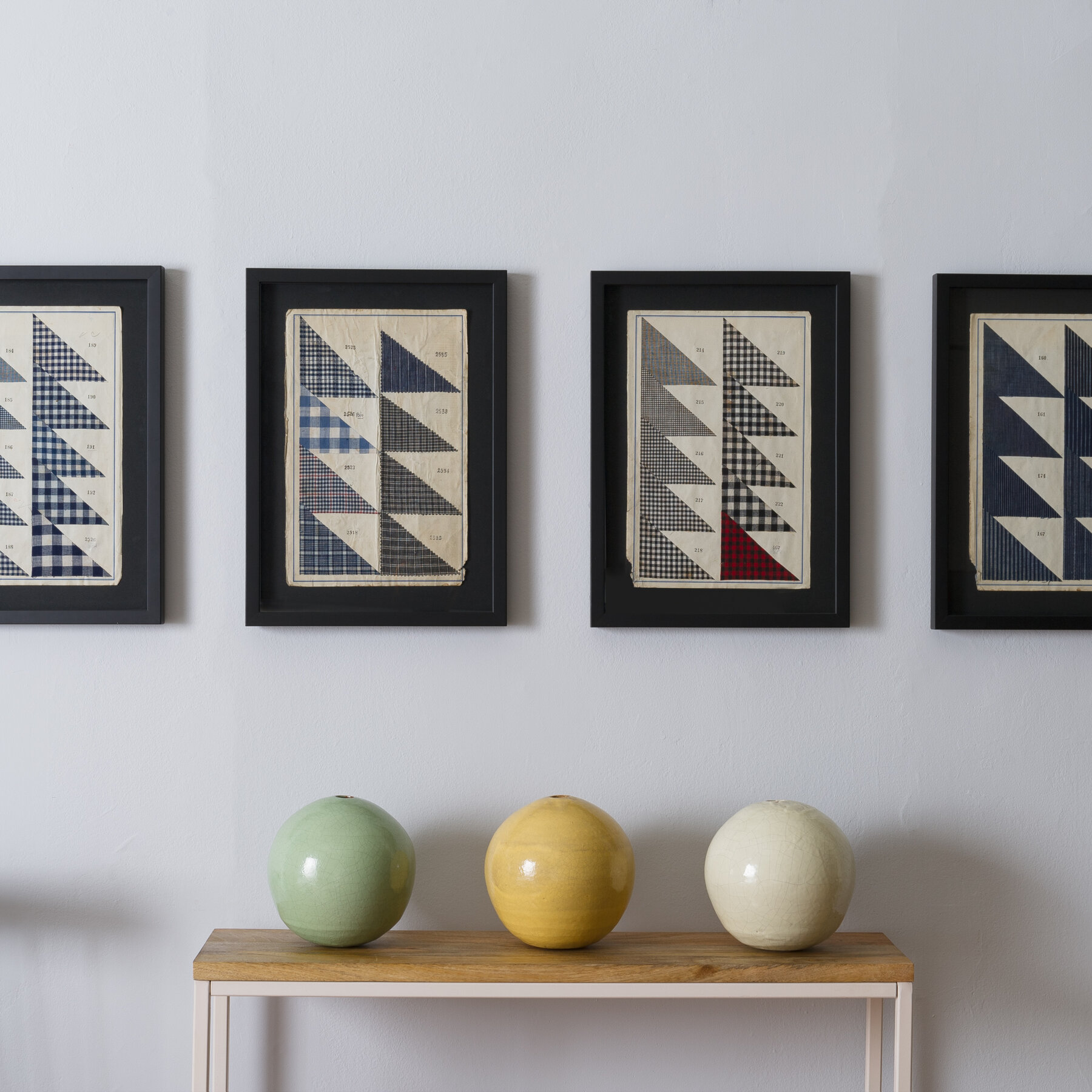
That structure begins with spacing. For anyone learning how to arrange pictures of different sizes on a wall, the most visible mistake is an uneven gap between frames: even a variation of a few centimetres can disrupt the reading of the whole arrangement from across the room.
- Standard gap: Maintain 5–6 cm between all frames in a gallery wall for a clean, coherent result in both grid and mixed-format layouts.
- Smaller pieces: Allow 7–15 cm between frames when works are small enough to need more visual separation.
- Rectangular vs. square formats: Rectangular prints benefit from slightly wider vertical gaps, while square formats hold their balance with equal spacing on all sides.
- Anchoring sequence: Place the largest piece slightly off-centre or on an outer corner first, then position the second-largest diagonally opposite before adding the smaller works.
Changing the interval mid-installation weakens the visual logic of the entire composition: set the gap once, then apply it without exception.
| Frame format | Recommended gap | Notes |
| Matching sizes (grid) | 5–6 cm | Consistent on all four sides |
| Mixed sizes (salon) | 5–6 cm minimum | Apply to total arrangement width |
| Small pieces | 7–15 cm | Prevents visual merging |
| Rectangular prints | Wider vertical gap | Compensates for optical elongation |
| Square prints | Equal on all sides | Naturally self-balancing format |
Floor layout and paper template methods
Once the spacing has been defined, planning methods make arranging wall art far more reliable. The floor layout method works especially well for mixed-size hanging artwork: outline the wall area on the floor with painter’s tape, place the frames inside that boundary with consistent 3-inch gaps, then photograph the layout before moving to the wall.
By contrast, brown paper templates are useful when frame relationships are harder to judge at floor level. Trace each frame, cut the shapes, mark each nail point, and tape the templates to the wall first; this gives a full-scale preview and helps maintain consistent hanging height across the installation.
Using a laser level for precise alignment
Once the layout has been established, precise alignment depends on a stable reference line. Mark both ends of the projected line with painter’s tape as soon as it is set.
Then measure from the top of each frame to its hardware individually: that measurement determines nail placement, not the outer frame height.
The difference lies in the hardware. D-rings provide greater torsional stability than traditional wire, especially on heavier pieces.
For collections that include large-format aluminium or acrylic glass prints, D-rings are the preferred hardware: they reduce lateral drift and preserve the alignment of a carefully considered installation over time.
Statement wall art ideas for a modern living room
A single, well-chosen print can define the visual character of a room on its own. In a modern interior, scale, format, and placement determine whether a work becomes a true focal point or merely fills wall space.
Large modern wall art as a focal point
For living room wall art, one oversized photograph can do more than any cluster of smaller works. A large piece up to 180×120 cm establishes a central presence above a sofa or across a clear wall, allowing the image, its color temperature, and its finish to carry the full visual weight.
- Acrylic glass: Gloss finish with permanently elastic silicone backing and an aluminum Dibond panel; maximum luminosity for high-contrast black-and-white photography or vivid landscape subjects.
- Aluminum Dibond: Matte surface with a polyethylene core using Kodak Pro Endura technology; precise color accuracy for detailed landscape or automotive imagery in natural light.
- Canvas: Premium linen texture with a museum-style matte finish; a warmer, tactile surface suited to elegant or more traditional interiors.
- Limited editions: Available only in acrylic glass and aluminum formats; each edition is numbered and issued in a fixed print run.
Once installed, a singular work is most convincing when it stands alone. Clear wall space around it creates a cohesive result and gives the eye room to settle, the detail that changes everything when a photograph is expected to command the room.
What to put behind sofa in living room
That principle also clarifies the area behind a sofa. When a single image feels too severe, Cars and Roses recommends a measured composition: one larger anchor piece with two smaller works at its sides, with the total width held to roughly two-thirds of the furniture below for proper balance.
The difference lies in giving one work clear authority, while the surrounding pieces support rather than compete. This structure accommodates mixed sizes and formats without allowing the wall to feel fragmented.
Varying formats to avoid visual repetition
A statement canvas on one wall, a gallery wall on another, and dimensional wall décor on a third will arrange art more effectively than repeating the same format on every surface. By contrast, identical arrangements across each wall flatten the experience of the room.
- Shape variety: Round, square, and rectangular formats introduce movement and prevent monotony.
- Three-dimensional elements: Clocks, sconces, or sculptural wall décor add depth and relieve the flatness of purely two-dimensional work.
- Odd-number groupings: Three-piece clusters suit tighter wall space, especially where a full gallery wall would feel forced.
A consistent palette keeps the room cohesive even as scale, orientation, and medium shift from wall to wall. The same logic applies to finish choice, since surface treatment affects how color and contrast read once the work is in place.
The right finish depends on the light: matte aluminum suits a bright south-facing wall because it controls reflection more effectively than acrylic glass. Because finish affects how color and contrast read under direct sun, it should be confirmed alongside furniture placement before the final arrangement is set.
Frequently asked questions
What is the two-thirds rule for wall art?
The two-thirds rule sets the scale between art and the furniture beneath it. In practice, the artwork should span about 65% of the width of the piece below: above a 2.20-metre sofa, that usually means a print around 100–150 cm wide.
When the composition includes multiple pieces, the same proportion applies to the full arrangement rather than to each frame. The difference lies in the overall silhouette: a grouping that spans 65% of the furniture below reads as a deliberate anchor rather than an afterthought.
What is the 57-inch rule for hanging art?
The 57-inch rule defines standard hanging height for those who hang art professionally. It places the visual center of the picture at 57 inches from the floor, or about 145 cm, which corresponds to average standing eye level.
In a living room, that measurement is often lowered to about 45 inches to suit a seated sightline. The same logic applies whether the wall holds one piece or a gallery wall: the center of the entire grouping is treated as a single unit.
How do you hang art in a gallery wall without making mistakes?
Before installation, lay out the arrangement on the floor, mark the wall area with painter’s tape, keep spacing consistent at 3 inches or 5–6 cm, and photograph the result for reference.
Another precise method uses paper templates: trace each frame onto brown paper, mark the hardware positions, then tape the templates to the wall before drilling. From there, a laser level establishes a continuous horizontal baseline, the single step most likely to determine whether a gallery wall reads as intentional or haphazard.