

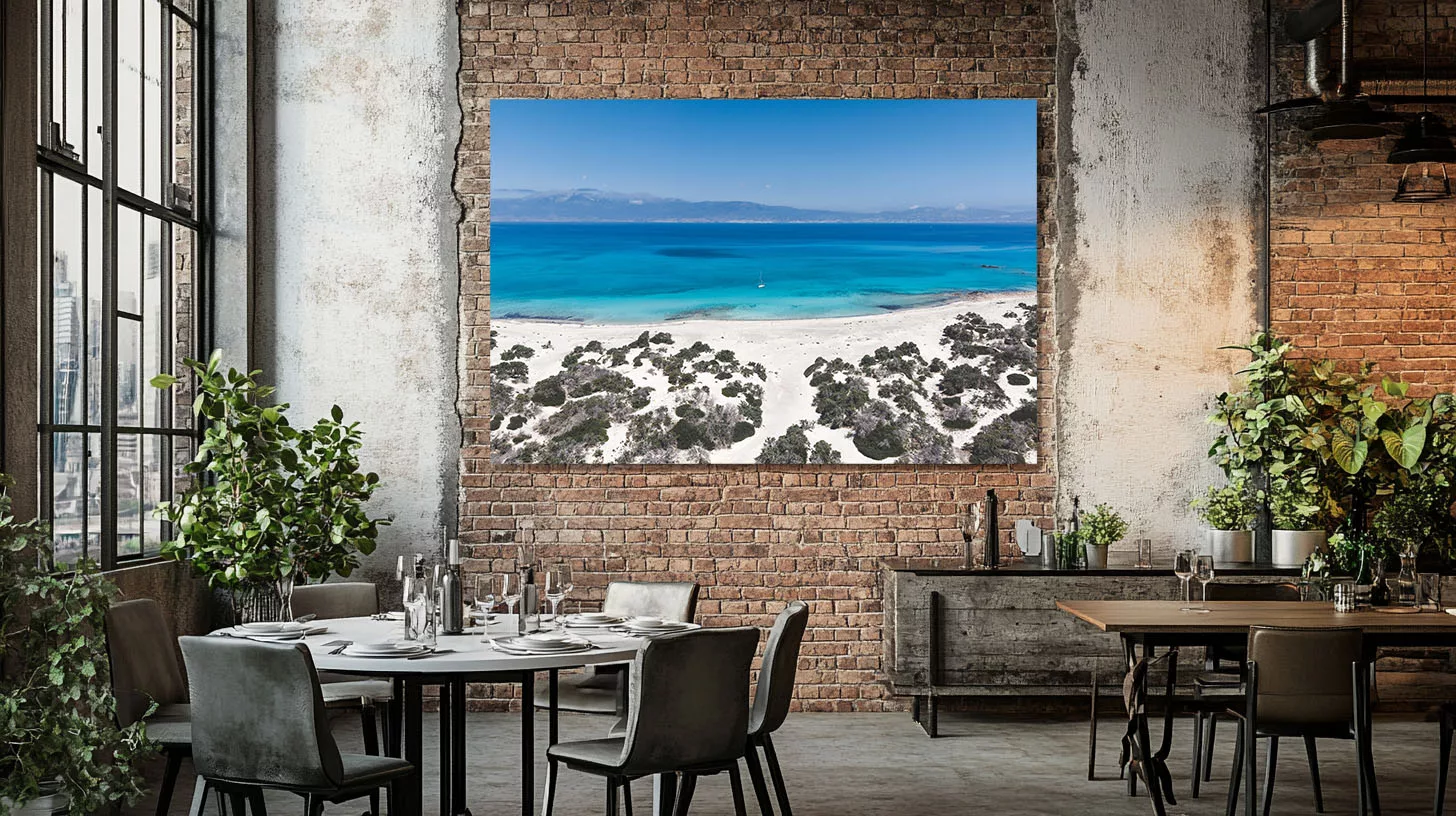
Choosing the size of a photo print seems straightforward — until you hang a 16×24″ piece on a wall that swallows it whole, or order a 40×60″ only to find it overwhelming a modest room. This guide gives you the practical rules to get it right every time.
Table of Contents
- Standard sizes: from 16×24″ to 60×40″ and beyond
- The golden rule: match the size to the wall
- What size for each room — living room, bedroom, office
- Single statement piece vs. gallery wall: two different logics
- How the subject shapes the format: car, landscape, portrait
- Print medium and finish: how they affect perceived size
Standard sizes: from 16×24″ to 60×40″ and beyond
Fine art photography tends to gravitate toward a handful of key formats. Each has its own visual logic, its natural use case, and its impact on a space.
The 16×24″ (40×60 cm) is the entry-level format. It works well in bedrooms, narrow hallways, or as part of a multi-print gallery wall. On its own against a large wall, it risks getting lost. The 24×36″ (60×90 cm) hits the sweet spot for most interiors: present enough to register, contained enough to coexist with the room. It is consistently the most-ordered format in fine art photography.
At 32×48″ (80×120 cm), a print starts to make a real visual statement. It works beautifully in rooms with high ceilings or above a wide sofa. Beyond that, 40×60″ (100×150 cm) and larger enters museum-scale territory: a single piece that defines the entire room rather than decorating it.
The golden rule: match the size to the wall
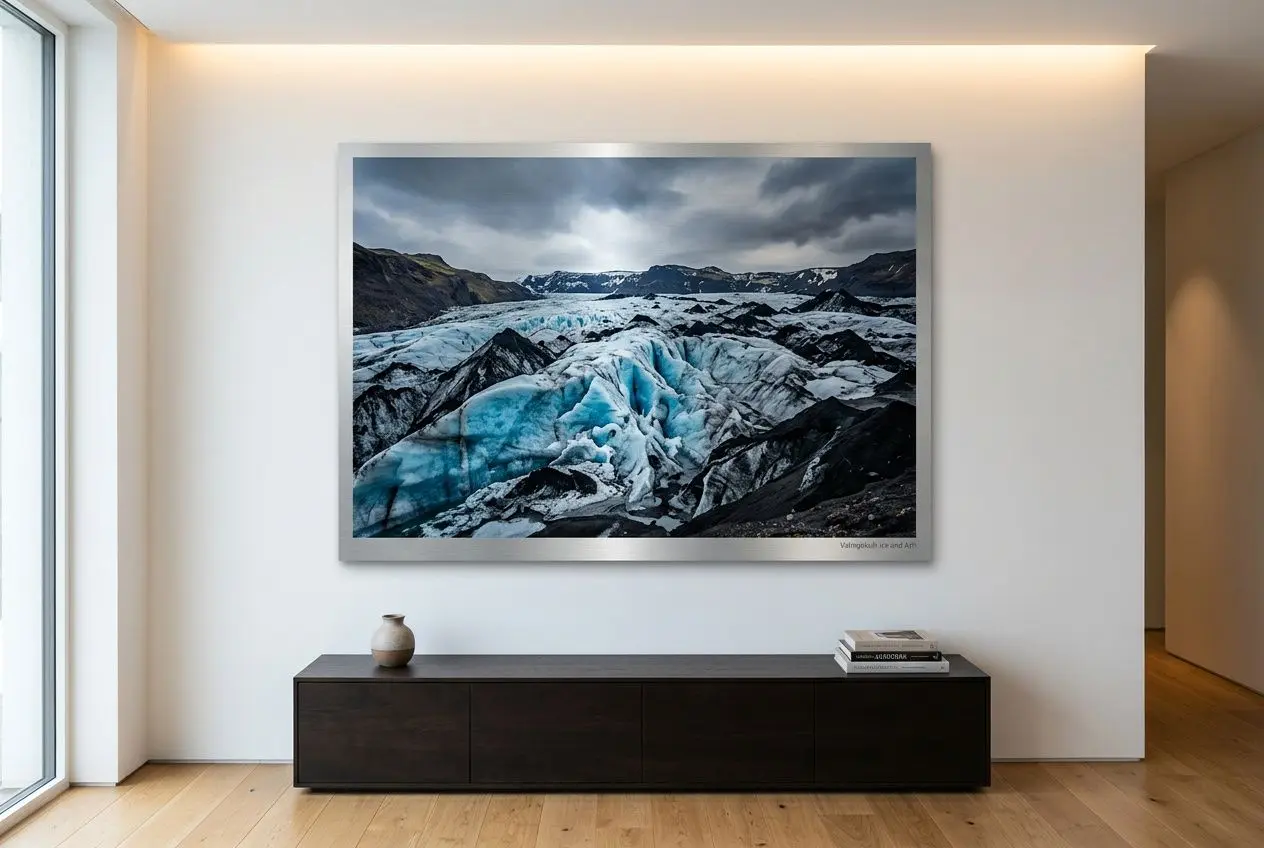
Interior designers apply this consistently: your artwork should cover between 50% and 75% of the wall width — or the width of the furniture it hangs above. Below that, it floats. Above it, it crowds.
Before ordering, measure. Then cut a piece of brown paper or use painter’s tape directly on the wall to simulate the planned size. Two minutes of prep prevents months of regret. On a 10-foot wall, a 24×36″ will feel modest; a 48×32″ will feel balanced; a 60×40″ will feel commanding.
For large wall art in a living room, resist the instinct to go smaller than feels right. Our brains systematically underestimate artwork size in imagined spaces — and tend to overestimate once it is on the wall. Simulate first, then order.
What size for each room — living room, bedroom, office
Each room has its proportions and its natural viewing distance. These are not arbitrary recommendations — they follow the way people actually stand and move in a space.
In the living room, you stand back. The natural viewing distance is 6 to 12 feet. At this distance, anything smaller than 24×36″ loses its impact. The details that make fine art photography exceptional — texture, depth of field, the gloss of a car body, the grain of an arctic sky — only read at proper scale. A car photo for your living room wall almost always benefits from 32×48″ or larger.
In the bedroom, distances are shorter. A 24×36″ above a headboard creates a strong focal point. The 16×24″ format works well on side walls or alcoves. Above a queen or king bed (60–76″ wide), aim for at least 32″ of width to keep the proportion grounded.
In a home office, the logic flips: you are close. A 16×24″ on a shelf or the wall directly facing your desk creates an intimate daily presence. This is precisely why car wall art for a home office works so well in medium format — it accompanies focus without competing with it.
Single statement piece vs. gallery wall: two different logics
A single large-format print makes a clear declaration. A gallery wall — multiple prints arranged together — lets you cover more visual territory with smaller formats while creating rhythm and depth.
For a gallery wall, choose a lead format — say a 24×36″ at center — and build around it with 16×24″ pieces. Keep consistent spacing (2–3 inches between frames) and align along a shared axis, either the tops or the visual center. A well-arranged gallery wall looks intentional, not accumulated.
When building an automotive gallery, stay within a consistent visual palette: all black and white, or a single dominant color range. Coherence is what separates a collection from a cluster.
How the subject shapes the format: car, landscape, portrait
Not every subject works equally well at every size. Fine art photographers build their images knowing the format they are destined for — certain shots are made for large format, others gain intimacy at medium scale.
A car photograph — a Ferrari in a corner, a Porsche on a coastal road — deploys its full power from 32×48″ upward. It is at this size that reflections, body curves and the print’s depth of field take on a sculptural quality. At 16×24″, the detail is present but the physical impact disappears.
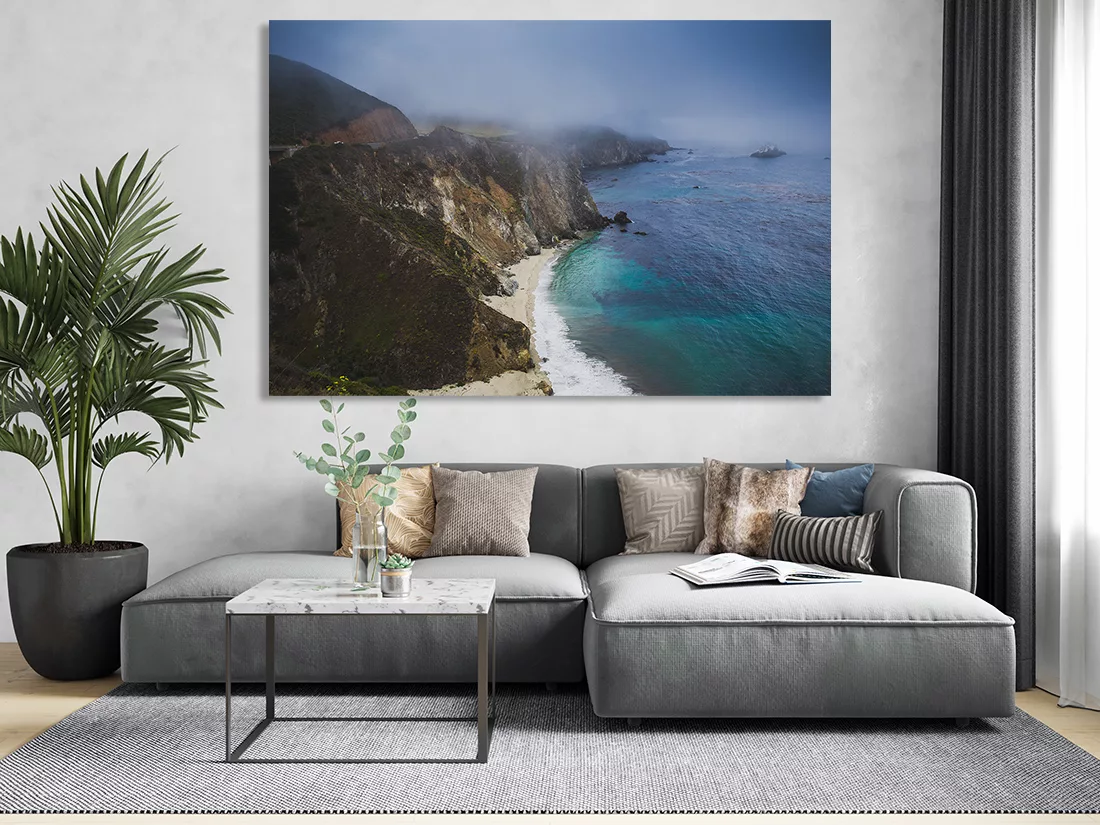
A wide landscape — Icelandic fjord, arctic tundra, open sea horizon — follows the same logic. Landscape photography prints for interior decoration should be chosen in the largest available format precisely because the subject is infinite. A 48×32″ nordic landscape creates a window onto the world — an experience, not merely a decoration.
Print medium and finish: how they affect perceived size
The same image printed on aluminum dibond versus canvas will not produce the same visual impression at identical dimensions. This is one of the most overlooked variables when selecting print size.
Aluminum dibond creates a sense of lightness and modernity. The smooth surface produces subtle reflections that animate the image. At the same nominal size, it reads larger than canvas because it occupies the full plane without a frame or wrapped edge. It is the ideal medium for graphic subjects — cars, architecture, black and white.
Canvas adds a texture that references painting. It softens the format visually and suits warmer interiors or natural subjects. At the same size, canvas reads slightly less imposing than aluminum — an advantage in more intimate spaces.
Practical rule: if you are torn between two sizes, go larger in aluminum for contemporary spaces, and choose the intermediate size in canvas for traditional settings. In either case, choose a fine art print — pigment-based inks ensure the colors stay true for decades, not years.
FAQ — Photo Print Size: Your Questions Answered
What size wall art for a 10-foot wall?
For a 10-foot wall, aim for a print between 48 and 60 inches wide as a centerpiece, or a gallery arrangement spanning 70–80 inches total. Under 36 inches, the piece will float and fail to anchor the space.
What size art above a sofa?
A standard sofa (80–88 inches wide) calls for artwork between 40 and 60 inches wide. The bottom of the frame should sit roughly 8 inches above the sofa back. For a gallery arrangement, aim to cover 70–80% of the sofa width.
Can you put large format art in a small room?
Yes — provided the subject is open: a wide landscape or a clean graphic composition. A large print in a small room expands the space visually rather than compressing it. An oversized “window” onto an open horizon pushes the walls back.
How do I simulate print size before buying?
Cut a rectangle of brown paper or use painter’s tape on the wall at the planned dimensions. Step back 8–10 feet and observe the proportion. Far more accurate than visualizing on a screen.
Fine art print vs. standard print in large format: what is the difference?
Fine art prints use pigment-based inks on baryta paper or aluminum dibond, with an archival lifespan of 70–100 years. Standard prints use dye-based inks that fade within 5–15 years. In large format the gap in quality is immediately visible: deep blacks, clean whites, smooth gradients — no banding.
Limited edition landscape photography
Numbered prints — From $78
Iceland, Svalbard, Greece, Scandinavia — printed by Whitewall, delivered framed
Read Also
- Large Wall Art for Living Room: How Fine Art Photography Transforms Your Space
- Landscape Photography Prints for Interior Decoration: Ideas and Expert Tips
- Car Photo Wall Art for Your Living Room: The Definitive Guide
Also Read
- Minimalist Decor with Fine Art Automotive Photography
- How to Care for Your Fine Art Print: Aluminium, Plexiglas & Canvas
Read also: