


A well-chosen landscape photograph can fundamentally transform a room. From Norwegian fjords to the beaches of Crete, through Iceland’s volcanic deserts, natural landscapes bring depth, serenity, and character to any interior — provided you know how to choose them.
Contents: Why landscape photography · Choosing your style · Size and placement · Finishes compared · Limited edition prints
Why choose a landscape photograph for interior decoration?
Landscape photography has become one of the strongest trends in contemporary interior design — and for good reason. Unlike abstract prints or mass-produced illustrations, a real landscape photograph captures a specific light, a precise texture, a moment that no longer exists and that nobody else owns in quite the same way.
In a minimalist living room, a single powerful landscape replaces an entire collection of small decorative objects. A Norwegian fjord in large format on a white wall creates a visual line toward the horizon that makes the room feel larger and more open. Environmental psychology research consistently shows that nature imagery — water, vegetation, open sky — reduces stress and improves the wellbeing of people in a space, more so than any other category of image.
Landscape photography also has the rare advantage of not aging. Where décor trends shift season to season, a beautiful image of sea or mountain remains relevant decade after decade. It is a long-term decorative investment.
Choosing the right landscape style for your interior
Before selecting a landscape photograph, ask yourself a simple question: what emotion do you want to feel in this room? The answer naturally guides the choice of subject and mood.
For a warm Mediterranean atmosphere: seascapes, beaches, and golden-hour light. Photographs from Crete, Greece, or the Atlantic coast work beautifully in bright interiors with white walls, natural wood, and sandy tones. Late afternoon light reflecting on water creates an immediate visual warmth that changes the feel of an entire room.
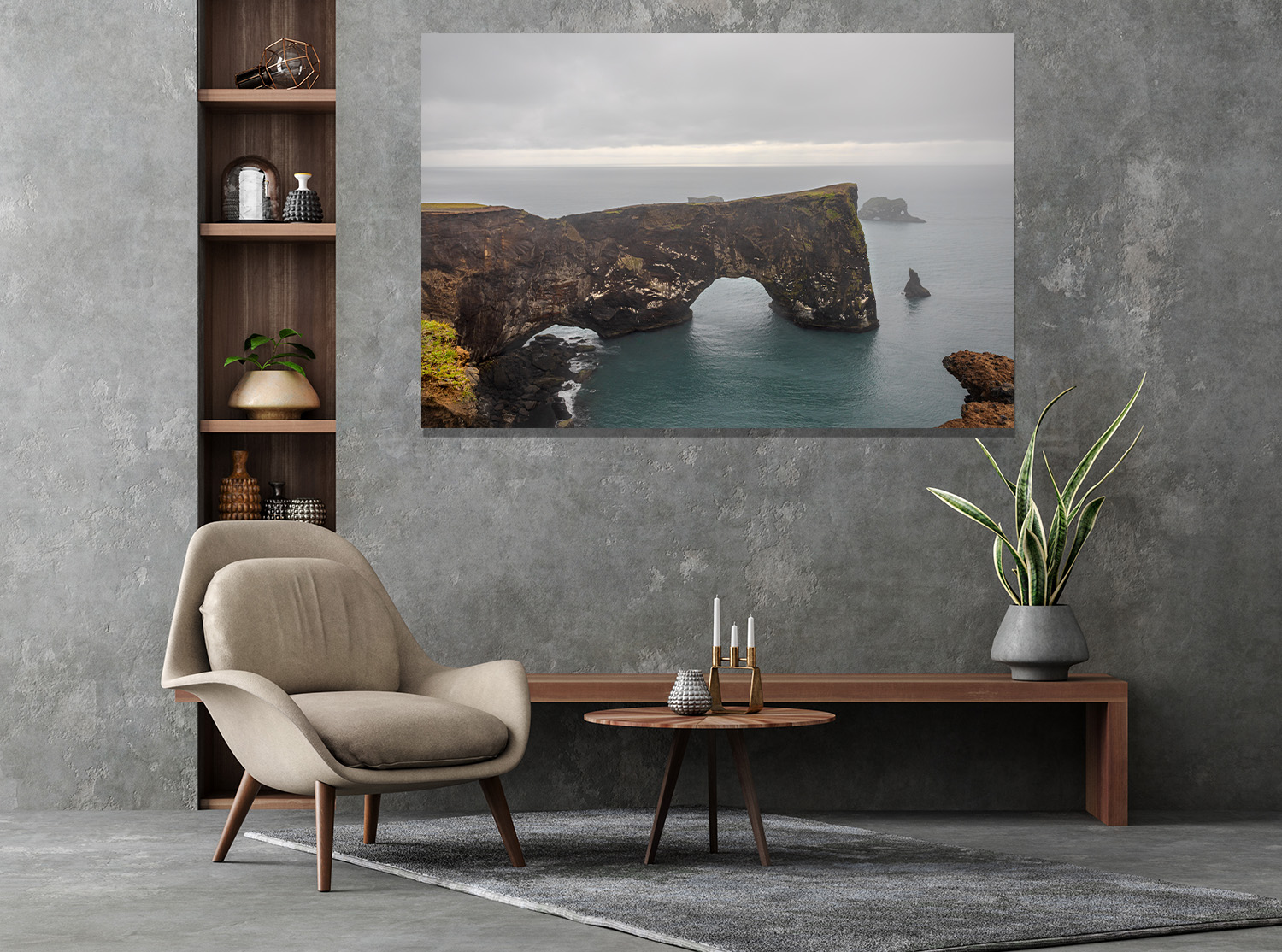
For a cool, contemporary atmosphere: Nordic landscapes. Iceland, Norway, Svalbard — the blue-grey tones, snowfields, and northern lights pair perfectly with black-and-white interiors, concrete, and metal finishes. A photograph of a glacier or an illuminated ice field transforms an industrial loft into something genuinely poetic.
For a moody, dramatic atmosphere: misty landscapes, fog-covered forests, or stormy shorelines work exceptionally well with dark natural materials — stained wood floors, leather, dark-tinted bookshelves. These images create a visual tension that makes the space memorable.
For a neutral, all-purpose interior: black and white landscapes are your safest choice. They integrate seamlessly into any colour palette and immediately give the room an artistic character without any risk of colour conflict.
Size and placement: getting the scale right
The most critical decision is often the size. A landscape photograph that is too small on a large wall disappears and loses all impact. Too large in a small bedroom, it overwhelms the space and creates a sense of claustrophobia.
The main living room wall is the most impactful placement for a landscape photograph. A panoramic format (35×16 in or 47×20 in) creates a cinematic effect that is genuinely remarkable. For more square walls, a 32×24 in or 40×30 in print is clearly legible from a distance and naturally establishes itself as the room’s focal point.
The bedroom calls for more restraint. A 24×16 in or 28×20 in format, placed at eye level above the bed, creates a visual horizon line that subtly expands the perceived space. Opt here for soothing tones — calm sea, summer forest, sunrise over a lake.
The entrance hallway can accommodate a vertical or square format. A strong image at the entry immediately sets the tone and personality of the entire apartment. A narrow hallway particularly benefits from an image with deep perspective.
Universal practical rule: the visual centre of the image should sit at approximately 57-60 inches (145-155 cm) from the floor, slightly below the eye level of a standing adult. For prints wider than 32 inches, two hanging points at least 16 inches apart ensure stability.

Finish options: fine art paper, aluminium, or canvas?
The choice of finish changes the look and feel of a landscape photograph as much as the subject itself.
Fine art paper (baryta or cotton rag) is the choice of serious collectors and discerning buyers. It renders contrast, tonal delicacy, and colour depth with remarkable fidelity. Printed with long-lasting pigment inks, a fine art print can last several decades without visible degradation. This is the ideal finish for landscapes rich in fine details — grass, waves, water reflections, rock textures.
Aluminium Dibond gives a contemporary, slightly luminous result. The photo mounted on a rigid panel creates the impression of floating off the wall. Resistant to moisture, it suits bathrooms and kitchens. It pairs particularly well with Nordic landscapes in cool, metallic tones.
Canvas is the most classic format. It gives a texture that evokes painting and integrates easily into warm or traditional interiors. Lighter than aluminium, it makes hanging large formats simpler.
For natural landscapes — particularly those with nuanced lighting and subtle tones — fine art paper remains the finish that does greatest justice to the image and the photographer’s vision.
Discover our limited edition landscape prints
Numbered fine art prints · From 16×24 in to 32×48 in · Mediterranean & Arctic collections
Why choose a limited edition landscape print?
A limited edition print is not simply a decorative object — it is a collectible piece. Each copy is numbered, signed by the photographer, and accompanied by a certificate of authenticity. Your print is unique within its edition — and its value is preserved over time.
For natural landscapes in particular, the conditions of the shoot are rarely reproducible. Sunrise light over a glacial lake, a perfect wave off a deserted coastline, a forest under its first snow of the season — these moments will never recur in exactly the same way. Owning one of these prints means owning a moment that is gone forever.
Limited editions also have a concrete decorative advantage: you will never find your print at a neighbour’s house, in a chain hotel, or on a cheap reproduction. In your interior, it brings a uniqueness and presence that mass-produced prints simply cannot offer.
FAQ — Landscape photography for interior decoration
What size landscape print should I choose for a living room?
For a standard living room, a print between 32×24 in and 48×32 in works well. For a truly impactful effect on a large wall, a panoramic format of 48×20 in or larger is recommended. The general rule: the print should span at least 60% of the width of the wall or furniture it is centred above.
Can I hang a landscape photograph in a bedroom?
Absolutely. The bedroom is one of the best placements for soothing landscape subjects — calm sea, summer forest, sunrise over a lake. A 24×16 in or 28×20 in format above the bed creates a beautiful visual horizon line and subtly expands the perceived space.
What finish is best for a landscape photograph?
Fine art paper (baryta or cotton rag) is the best option for natural landscapes: it faithfully renders tones, details, and nuanced lighting. Aluminium Dibond suits very contemporary interiors or damp rooms. Canvas brings a classic, painterly touch.
What landscape style suits a contemporary interior?
Nordic landscapes (Iceland, Norway, Svalbard) with their cool blue-grey tones pair perfectly with minimalist contemporary interiors. Black and white landscapes are also a safe choice — universally compatible, they suit any colour palette and give the space immediate artistic character.
At what height should I hang a landscape photograph?
The visual centre of the image should sit at approximately 57-60 inches (145-155 cm) from the floor, slightly below the eye level of a standing adult. For prints wider than 32 inches, use two hanging points at least 16 inches apart to ensure stability.