

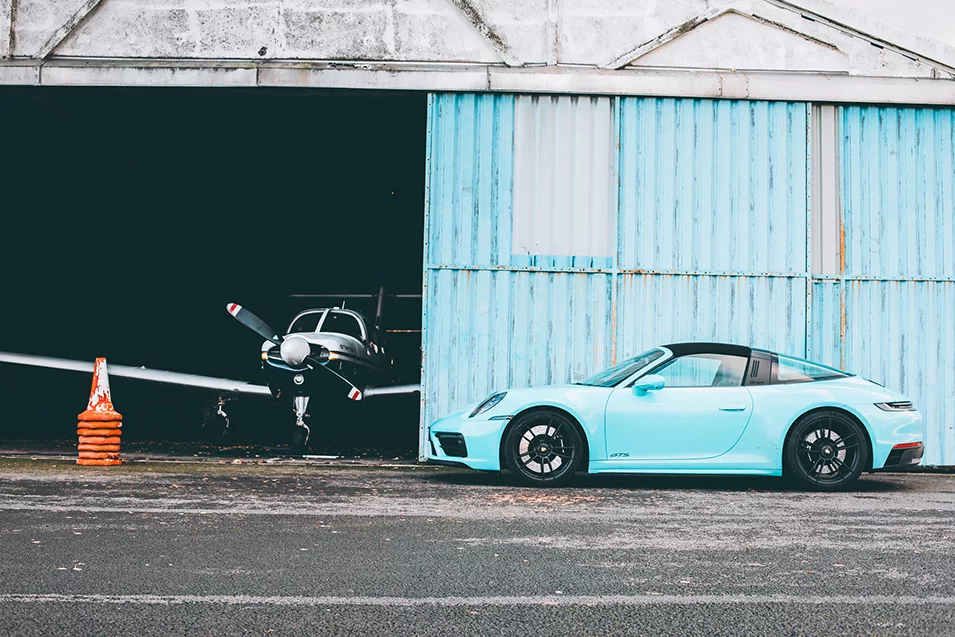
Some silhouettes from automotive history have never been surpassed. The Porsche 911 Targa is one of them: that gleaming chrome bar, the removable fabric roof, the curved glass rear window… A design born in 1965, invented by Porsche, and one no one has since dared to copy. In fine art photography, the Targa is an exceptional subject — an icon that transcends the automotive world to become a true work of wall art.
Table of Contents
- The Porsche 911 Targa: A Silhouette That Time Has Not Erased
- What Fine Art Photography Reveals About the Targa
- The Targa Models That Inspire the Greatest Photographers
- Choosing Your Porsche 911 Targa Photography for a Modern Interior
- Limited Edition: Why It Changes Everything
The Porsche 911 Targa: A Silhouette That Time Has Not Erased
The Porsche 911 Targa was born in 1965 at the Frankfurt Motor Show. The engineering team needed a response to new American safety regulations threatening open-top cars. Their solution was radical: a wide stainless steel protection bar behind the seats, a removable fabric roof, and a curved glass rear window. The Targa was born, and its name pays homage to the Targa Florio — the Sicilian race Porsche dominated for decades.
What strikes you, sixty years later, is the design’s coherence. The Targa bar — that chromed or black roll bar depending on the generation — is not a compromise: it’s a signature. The first generations (911, 912, Carrera 2.7, SC, 3.2) carry this motif with an elegance that defies fashion trends. The 964, 993, and 991 models revisit the concept with modern technical solutions, but the bar remains there, immovable — a marker of membership in a unique lineage.
In photography, this bar is a visual gift: it creates powerful horizontal lines that segment the silhouette, generates fascinating reflections, and gives the image a natural graphic tension. The Targa is photographed differently from a 911 coupe — it demands particular attention to side lighting to reveal the structure of that so-characteristic roof.
What Fine Art Photography Reveals About the Targa
Ordinary automotive photography shows the Targa from its most flattering angle: three-quarter front, neutral light, clean background. Effective, but predictable. Fine art photography seeks something else: the soul of the subject.
A fine art print of a Porsche 911 Targa chases light at golden hour — that magical moment after sunset when raking light caresses the curves, turns chrome to gold, and casts long shadows that reveal every muscle of the bodywork. It seeks context: a Californian coastal road, an aviation hangar, a mountain hairpin, a European cobblestone street. Context doesn’t overshadow the car — it amplifies it.
This work produces images that function like paintings: they tell a story, create an atmosphere, and integrate into an interior with the same authority as a canvas. This is precisely what distinguishes a Porsche 911 Targa fine art photograph in limited edition from a simple automotive poster.
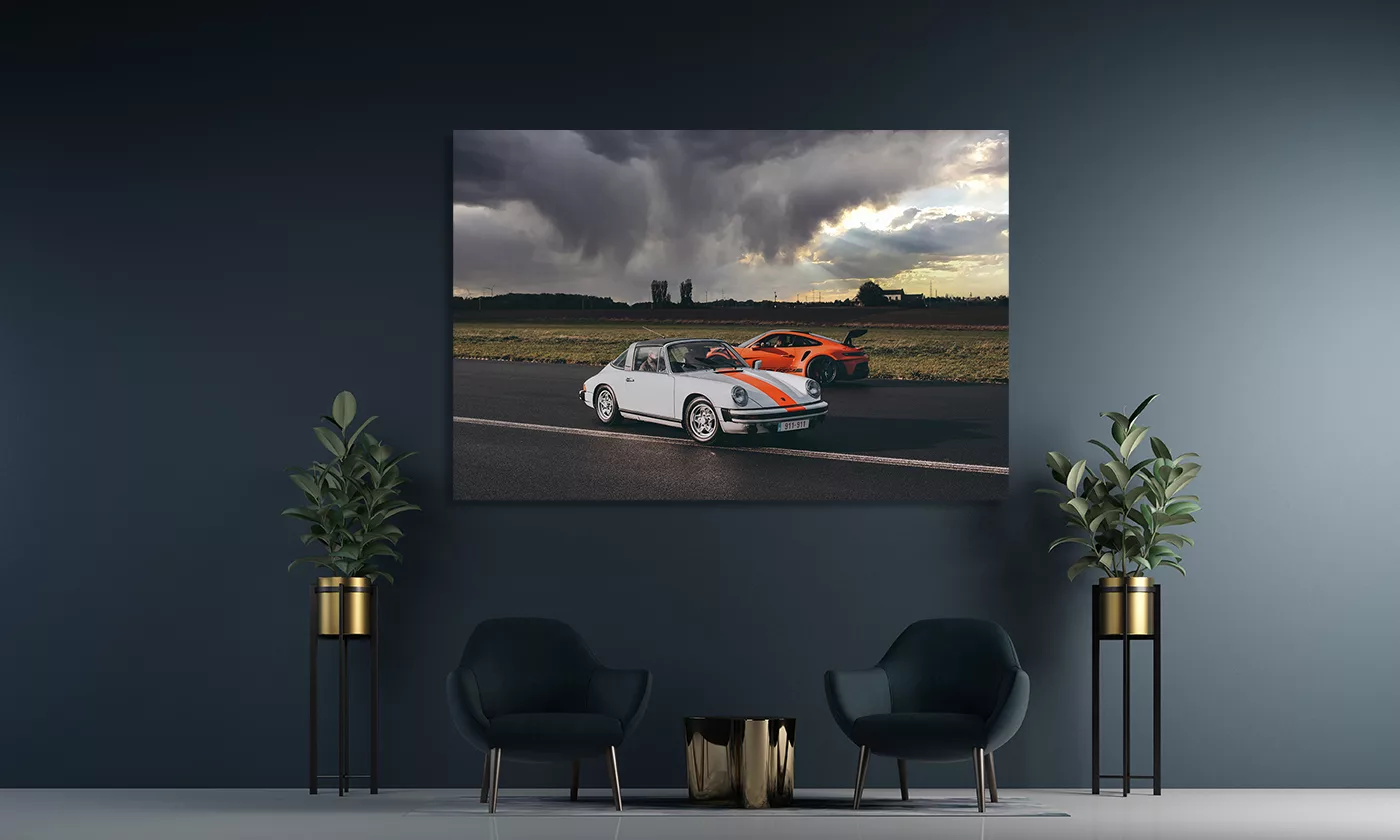
The Targa Models That Inspire the Greatest Photographers
Among all 911 Targa generations, certain models appear more frequently in the portfolios of the finest fine art automotive photographers.
The first-generation Targa (1965-1973) is perhaps the most photographed. Its rounded forms, protruding headlights, and absence of massive bumpers give it an incomparable graphic lightness. In black and white, a 1972 911 Targa 2.4 becomes a photographic sculpture with no equivalent in automotive history.
The 911 SC Targa (1978-1983) fascinates for a different reason: it carries the aesthetic of the 70s-80s — Fuchs wheels, vivid colors, bold character. It’s a Targa that claims its era with a sincerity that resonates with collectors.
The 993 Targa (1996-1998), the last air-cooled Targa, is the rarest and most sought after. It innovated with a sliding glass roof, abandoning the traditional removable fabric. Photographed in a contemporary context, it creates a fascinating tension between classicism and modernity. For admirers of Porsche fine art photography, the 993 Targa represents a photographic holy grail.
Choosing Your Porsche 911 Targa Photography for a Modern Interior
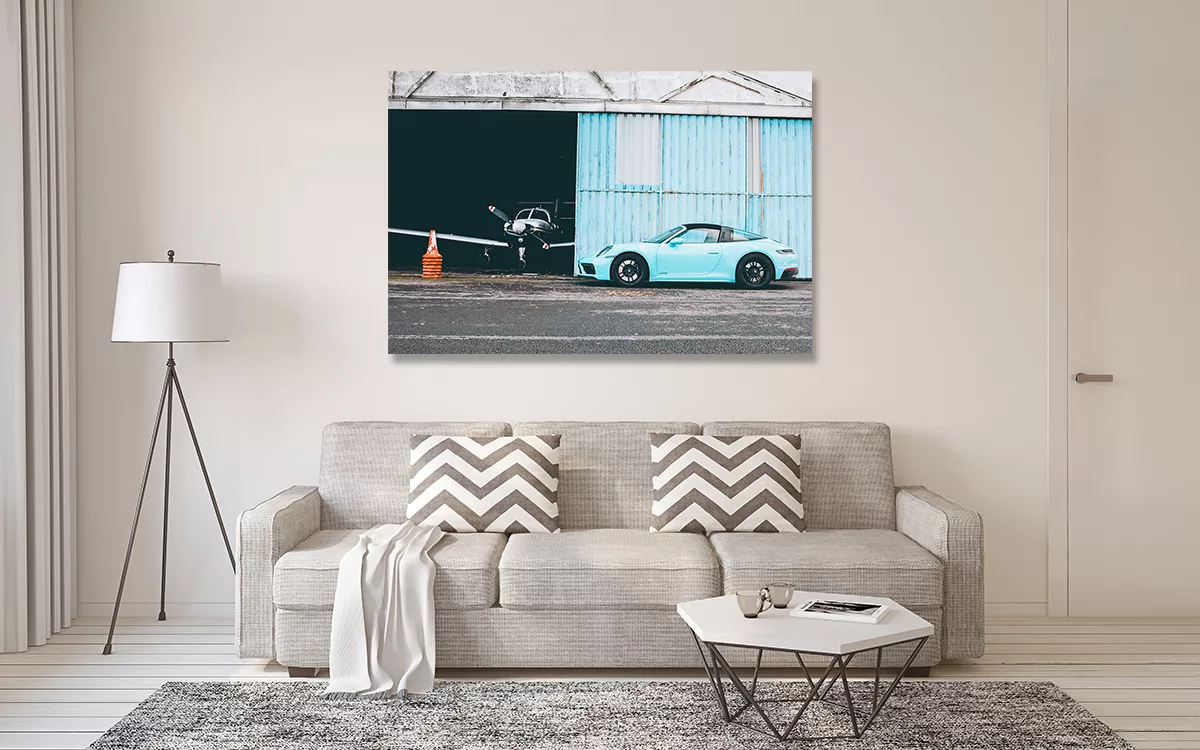
Choosing a Porsche 911 Targa photograph for a modern interior follows a few simple but decisive principles.
Color or black and white? Targas lend themselves magnificently to both treatments. A color print highlights chromatic richness — the electric blue of a 1973, the crimson red of an SC, the metallic silver of a 993. A black and white print, on the other hand, strips away color to preserve only form: ideal for interiors with neutral tones — grey, white, concrete, light wood.
Format is an architectural decision as much as an aesthetic one. A large format (100×70 cm or 120×80 cm) makes a strong visual statement. To choose the ideal format for your space, our practical guide to photo print sizes walks you through it step by step.
The medium changes everything at printing stage. An aluminium Dibond print delivers unrivaled depth and saturation, particularly suited to color images in warm light. A Fine Art Baryta paper print, matte and slightly textured, magnifies black and white prints with a remarkable painterly presence.
Limited Edition: Why It Changes Everything
A fine art Porsche 911 Targa photograph in limited edition is not a poster. It’s an original work, numbered, signed, with a limited print run that gives it both artistic and patrimonial value.
At Cars and Roses, each photograph is printed in a limited edition of 30 copies maximum across all formats. Each print is accompanied by a numbered certificate of authenticity. Once the last print is sold, the edition closes permanently — no further reproductions are possible.
This limitation isn’t a marketing argument: it’s an artistic stance. It guarantees that the work you hang at home won’t appear in a thousand other living rooms. For Porsche enthusiasts and automotive art collectors, a limited edition Targa photograph combines two dimensions: automotive passion and fine art. It’s a cultural object in its own right, passing through generations.
View the Collection →
FAQ — Porsche 911 Targa Photography
The first generation (1965-1973) is most sought after for its purity of line, closely followed by the 993 (1996-1998), the last air-cooled Targa. Both models stand out for their exceptional graphic tension in photography.
The Targa is identified by its rigid protection bar between the pillars — the Targa bar — absent on convertibles. This distinctive element creates the characteristic graphic lines that photographers exploit.
For a living room, a 100×70 cm format is ideal for creating strong visual impact without overwhelming the space. For a study or smaller room, a 60×40 cm integrates perfectly into a composite wall gallery.
A numbered limited edition photograph of an iconic car like the Porsche 911 Targa tends to increase in value as the edition closes. Some automotive fine art prints resell at two to three times their original purchase price.
Absolutely. Numbered, signed and delivered with its certificate of authenticity, a limited edition Targa photograph is one of the most memorable gifts for a car enthusiast. It combines automotive passion with the prestige of an authentic work of art.