

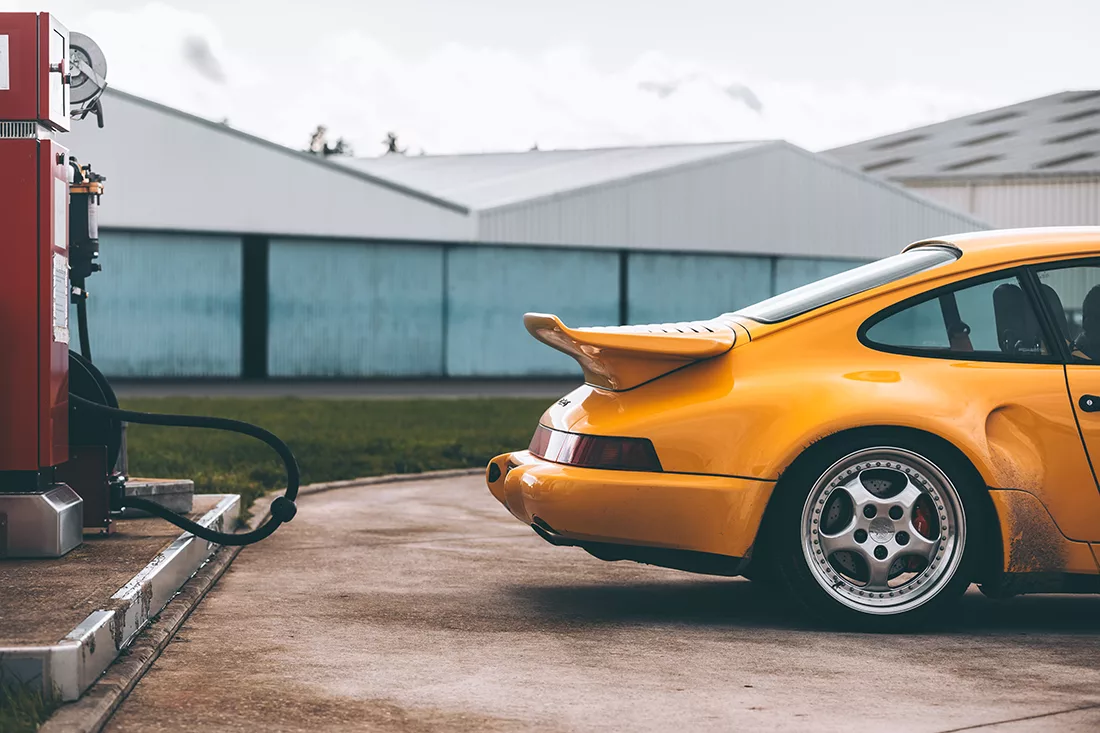
No car earned a nickname quite like the Porsche 930. Enthusiasts called it the Widowmaker — a rear-mounted turbocharged flat-six, a whale tail spoiler, and a lag that could catch out even seasoned drivers. In fine art photography, that danger and drama translate into pure visual tension: few silhouettes read as instantly, or as powerfully, as the 930 Turbo’s.
Table of Contents
- The Porsche 930: How Turbo Technology Reinvented the 911
- Whale Tail and Widowmaker: The Myth Behind the 930
- Inside the Cockpit: Turbo-Era Craftsmanship
- Why the 930 Turbo Belongs on Your Wall
- How to Choose Your Porsche 930 Turbo Print
The Porsche 930: How Turbo Technology Reinvented the 911
Launched in 1975, the Porsche 930 was the first production 911 to wear the name that would define an era: Turbo. A single KKK turbocharger bolted to the 3.0-litre (later 3.3-litre) air-cooled flat-six pushed output past 300 horsepower at a time when most sports cars struggled to reach half that figure. It was, for several years, the fastest production car sold in Germany.
What made the 930 significant wasn’t just the number on the spec sheet. It proved that forced induction could work in a road car without sacrificing the analog, mechanical character Porsche buyers expected. The result reshaped the entire 911 lineage — every Turbo model that followed, from the 964 to today’s 992, traces its lineage directly back to this car.
For photographers, that historical weight matters. Shooting a 930 isn’t just capturing a car — it’s capturing the moment forced induction went mainstream in the sports car world, a genuine inflection point in automotive engineering.
Whale Tail and Widowmaker: The Myth Behind the 930
Two things gave the 930 its outlaw reputation. The first is visual: the oversized rear spoiler, nicknamed the “whale tail” (and later the “tea tray” on updated models), was necessary to keep the rear axle planted at speed — but it also became the car’s defining silhouette, instantly recognisable even in shadow or silhouette photography.
The second is mechanical: significant turbo lag, a rearward weight bias, and a narrow power band meant that lifting off the throttle mid-corner could snap the tail around with little warning. Combined with modest brakes for the power on offer, the 930 earned its “Widowmaker” nickname in period road tests and paddock folklore — a reputation that only adds to its mystique today.
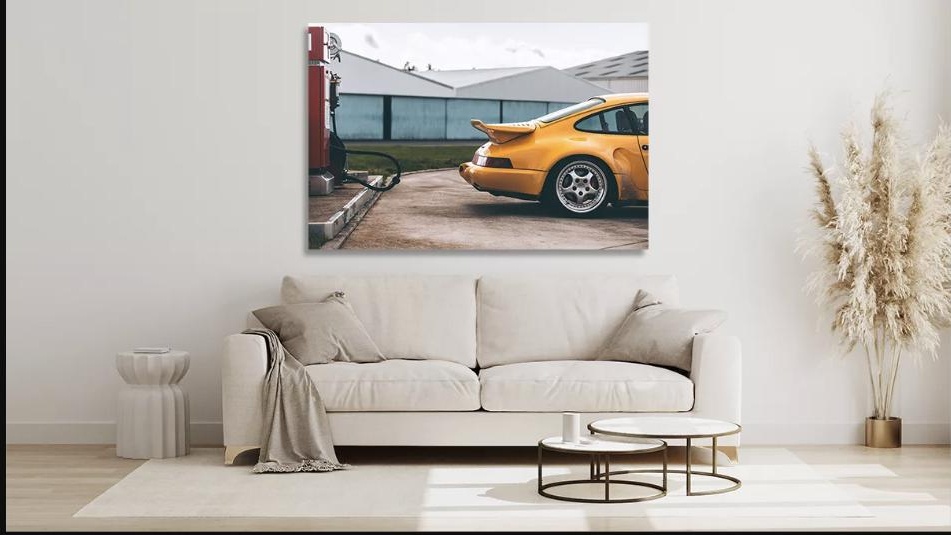
None of that danger shows up in a still photograph, of course — what remains is pure design: the flared arches, the whale tail, the crouched stance. It’s a car that photographs like it drives: aggressive, low, and unmistakably purposeful.
Inside the Cockpit: Turbo-Era Craftsmanship
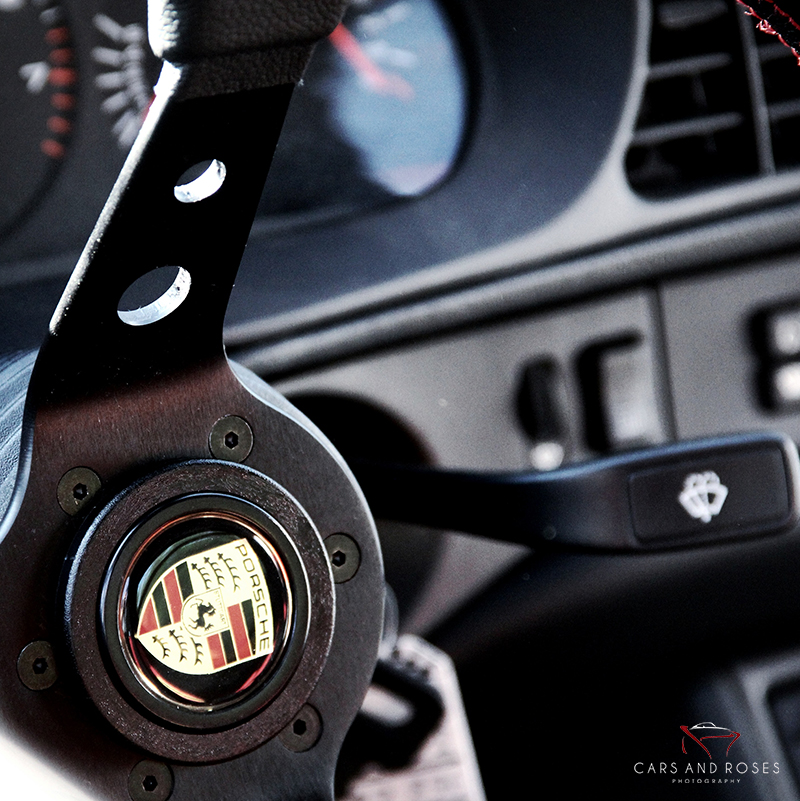
Step inside a 930 and the drama gives way to something more intimate. The thin-rimmed steering wheel, the row of toggle-style switches, the deeply recessed gauges dominated by a central tachometer redlined at 6,800 rpm — every detail speaks to a decade when analog engineering was at its peak, before airbags and touchscreens reshaped the cabin.
Macro and detail photography of the 930’s interior — a worn steering wheel, the shift pattern for its unique 4-speed gearbox, the boost gauge added to keep an eye on that turbocharger — makes for some of the most compelling fine art in the Cars and Roses catalogue. These images work differently from a full exterior shot: they invite the viewer to look closer, to imagine their hand on the wheel.
Why the 930 Turbo Belongs on Your Wall
The 930 occupies a rare position in automotive culture: respected by purists for its engineering, mythologised by enthusiasts for its temperament, and instantly recognisable even to people who have never sat behind the wheel. That combination is exactly what makes a subject work as fine art — it needs to be beautiful on its own terms, but it also needs a story.
A limited edition Porsche 930 Turbo fine art photograph brings that story into a room without shouting. Printed on aluminium, plexiglas or canvas, it reads as a bold graphic piece from across the room — the whale tail silhouette and saturated yellow bodywork carry the composition — while rewarding a closer look with the mechanical detail true enthusiasts appreciate.
Unlike a mass-produced poster, each print is numbered, signed and delivered with a certificate of authenticity — a collector’s object as much as a decorative one, built to anchor a study, garage lounge or living room gallery wall.
View the Collection →
How to Choose Your Porsche 930 Turbo Print
For a statement piece above a sofa or desk, a 100×70 cm aluminium print lets the whale tail silhouette and saturated yellow paintwork dominate the wall. For a smaller study, hallway or as part of a gallery wall alongside other automotive prints, a 60×40 or 30×20 cm canvas keeps the detail sharp without overwhelming the space.
Aluminium and plexiglas finishes suit a modern, minimalist interior and handle direct light well; canvas gives a warmer, more textured feel that pairs naturally with wood and leather furniture — a fitting complement to a car built entirely from analog, mechanical craftsmanship.
Turbo lag, a rearward weight bias and modest brakes relative to its power meant the 930 could snap into oversteer with little warning if the throttle was lifted mid-corner. Period road tests and enthusiast folklore cemented the Widowmaker nickname, which still defines the car’s reputation today.
The whale tail is the oversized rear spoiler fitted to the 930 Turbo to generate downforce and keep the rear axle stable at high speed. It became the car’s most recognisable design feature and a defining element in fine art photography of the model.
A 100×70 cm format creates strong visual impact as a standalone statement piece in a living room or office. Smaller formats like 60×40 or 30×20 cm work well within a composite gallery wall alongside other automotive prints.
The first 3.0-litre 930, launched in 1975, produced around 260 hp. The later 3.3-litre version introduced in 1978 raised output to roughly 300 hp, making the 930 the fastest production car sold in Germany at the time.
A numbered limited edition print of an iconic model like the 930 Turbo tends to appreciate as the edition sells out, much like the collector car market it depicts. Some limited runs have resold well above their original price once fully subscribed.