

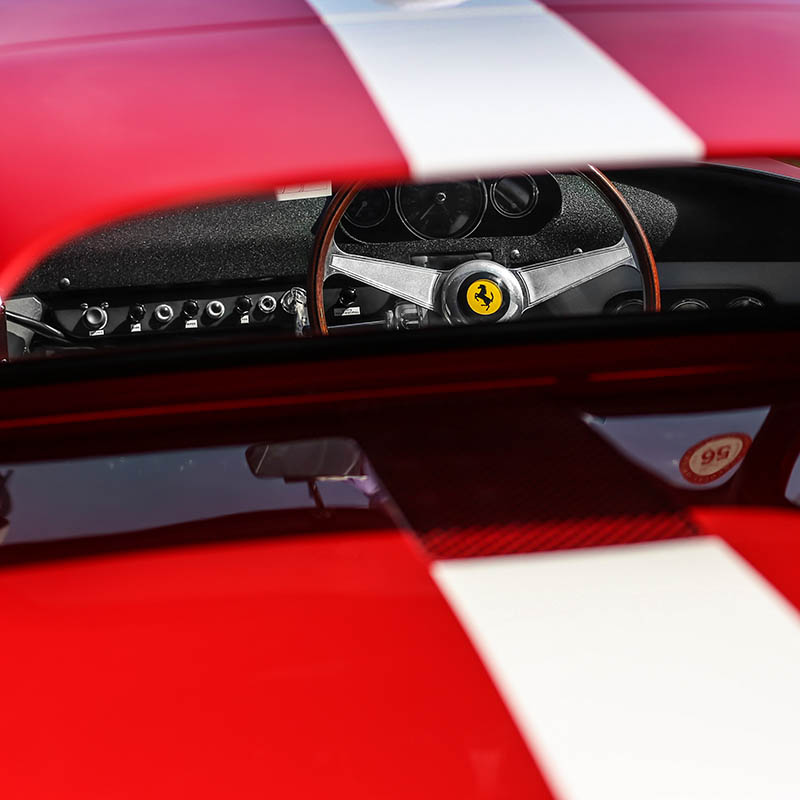
No prancing horse on the nose. No “Ferrari” script anywhere on the body. And yet, to countless designers and collectors, the Dino 246 GT is the single most beautiful car to ever leave Maranello. Its refusal to wear the badge became one of the automotive world’s great ironies — and its low, curvaceous silhouette became one of the most photographed shapes in classic car culture.
Table of Contents
- A Ferrari Without the Prancing Horse
- Pininfarina’s Masterpiece: Designing the Dino 246 GT
- The V6 Heart: Engineering a New Kind of Ferrari
- From Underdog to Icon: The Dino’s Market Reversal
- Why the Dino 246 GT Belongs on Your Wall
A Ferrari Without the Prancing Horse
The name comes from Alfredino “Dino” Ferrari, Enzo Ferrari’s son, who worked alongside company engineers on an ambitious new V6 engine before his death in 1956 at just 24 years old. Enzo never fully recovered from the loss, and naming this new line of cars after him was as much an act of memory as it was a marketing decision.
But the tribute came with a catch: the Dino wore no prancing horse shield and no “Ferrari” script anywhere on its body. Positioned as a smaller, more accessible V6 model beneath the V12 range, it was sold as its own marque — partly to protect the exclusivity (and pricing) of “real” Ferraris, partly because Enzo was famously resistant to putting his name on anything with fewer than twelve cylinders. In some markets, the Dino was even sold through Fiat dealerships alongside a badge-engineered Dino built by Lancia.
It is, today, widely accepted as a full-blooded Ferrari in every way that matters — engineered by the same team, built on the same production lines, and now firmly part of the marque’s official heritage.
Pininfarina’s Masterpiece: Designing the Dino 246 GT
Where the styling of most 1960s Ferraris announced their power with long, aggressive bonnets, the Dino 246 GT did the opposite. Pininfarina’s design team drew a low, curved body that wrapped around a mid-mounted engine — flowing haunches, a wraparound rear window with sculpted flying buttresses, and a beltline so low it made contemporaries look armored by comparison. Launched in 1969 as the production evolution of the aluminium-bodied 206 GT, it swapped to steel bodywork and a larger engine while keeping the silhouette intact.
It remains one of the earliest series-production road cars to place the engine behind the driver rather than in front — a layout borrowed directly from Ferrari’s sports-racing prototypes of the period. That single decision reshaped the entire proportions of the car, and with them, the entire visual language of what a small, elegant sports car could look like.
The V6 Heart: Engineering a New Kind of Ferrari
The “246” designation spells out the mechanical recipe: a 2.4-litre V6 with six cylinders, mounted transversely behind the cabin and sending roughly 195 horsepower to the rear wheels. That was modest next to Ferrari’s V12 flagships of the era, but the Dino was never built to win a horsepower contest. Its low weight and near-perfect mid-engine balance gave it a chassis often praised as the most playful and forgiving in Ferrari’s entire lineup — a car built around finesse rather than brute force.
Top speed hovered around 235 km/h (146 mph), enough to embarrass far more powerful machinery on a twisting road, where the Dino’s low centre of gravity and precise steering did the talking.
View the Collection →
From Underdog to Icon: The Dino’s Market Reversal
For decades, the absence of a prancing horse badge was a curse rather than a blessing. Collectors chasing V12 Ferraris of the same period routinely passed over the Dino, and it traded for a fraction of the price of contemporaries it now regularly outshines in design polls. That undervaluation is largely over: the classic car market has spent the last fifteen years recognising the Dino 246 GT as one of the most significant Ferraris of its era, and values have climbed accordingly.
The irony is complete. The car built specifically to not be called a Ferrari is now chased by collectors precisely because it is one — and because, badge or no badge, it may be the most beautiful shape the company ever put into production.
Why the Dino 246 GT Belongs on Your Wall
Few classic silhouettes photograph as cleanly as the Dino’s. The flying buttresses, the wraparound glass, the low, uninterrupted beltline — every angle reads as sculpture rather than machinery, which is exactly what makes it such a rewarding subject for fine art automotive photography. A single well-composed print carries the same quiet elegance the car was designed with, printed on aluminium, plexiglas or canvas and finished as a numbered, certified limited edition — a collector’s object as much as a decorative one.
Enzo Ferrari named the Dino line after his son Alfredino, who died in 1956, and chose to sell it as a separate marque without the prancing horse shield to protect the exclusivity of the V12-powered “true” Ferraris. It is now recognised as a full Ferrari model in the company’s official heritage.
A 2.4-litre, transversely mounted V6 producing around 195 horsepower, sent to the rear wheels through a mid-engine layout borrowed from Ferrari’s sports-racing prototypes.
Many designers and collectors rank it among the most beautiful cars Ferrari has ever produced, thanks to Pininfarina’s low, curved body and flying-buttress rear window — a shape widely credited with influencing sports car design well beyond Maranello.
For decades it sold for a fraction of contemporary V12 Ferraris simply because it lacked the badge. As collectors reassessed its design and engineering on their own merits, values climbed sharply, and it is now considered one of the most desirable classic Ferraris of its era.