

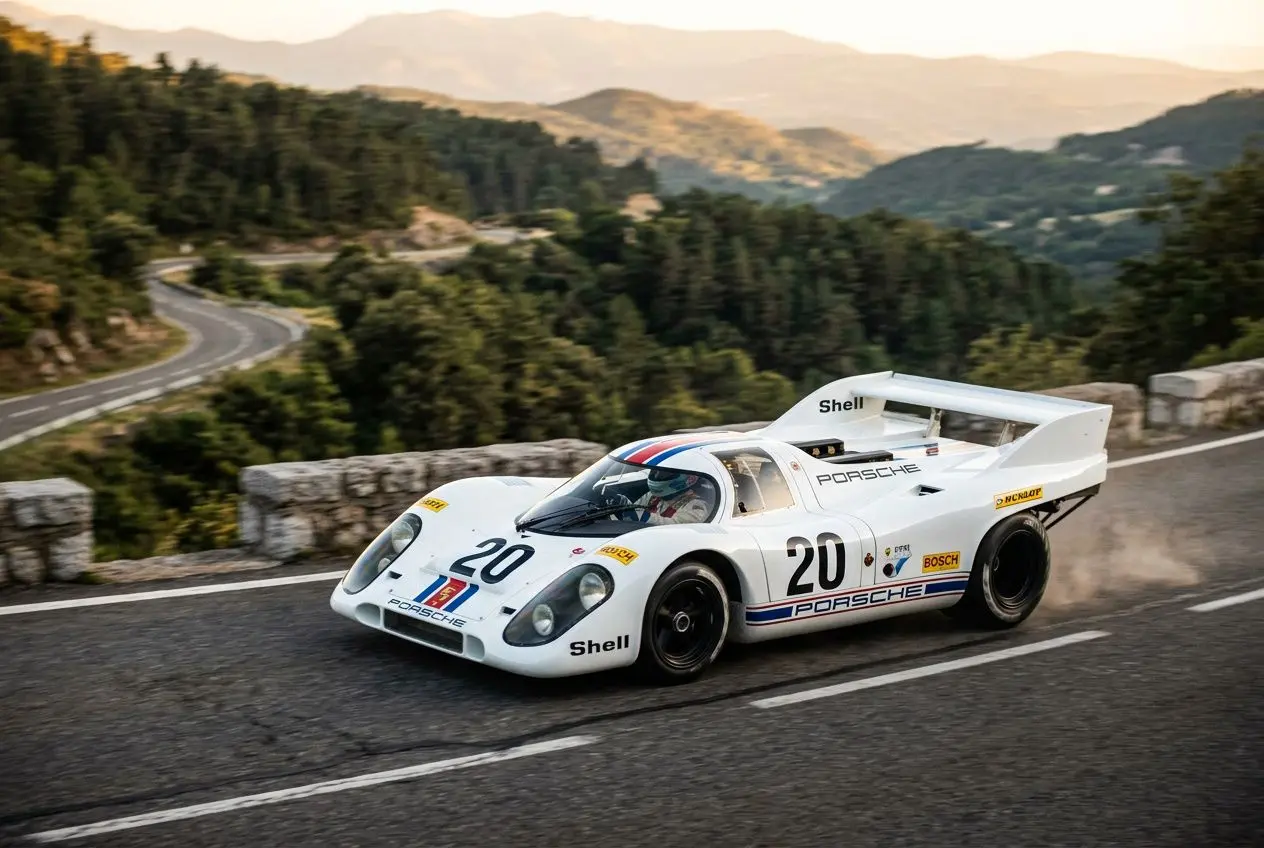
Some cars were never built for comfort or living-room elegance — their only purpose was to win. And yet, they often make the most striking race car photography. From the Mulsanne Straight to the pit lanes of the Nürburgring, here are ten race cars that shaped automotive history — and still inspire fine art photography today.
The Speed Pioneers (1920-1939)
Before closed circuits and modern pit lanes, motor racing was fought on open, often dusty roads, where only the most reliable machinery survived. Two cars dominate this heroic era.
The Bugatti Type 35 remains, to this day, the most successful race car in history, with more than 1,000 victories between 1924 and 1930. Its eight-cylinder engine and cast-aluminium wheels — a technical revolution at the time — made it the undisputed reference of Grand Prix racing.
The Alfa Romeo 8C 2900 dominated the Mille Miglia throughout the 1930s thanks to a supercharged engine and an aerodynamic shape well ahead of its time. Together, these two pre-war racers embody the raw elegance of an era when speed was conquered by hand.
The Golden Age of Le Mans (1950-1970)
The 1950s to 1970s mark the golden age of endurance racing, fuelled by fierce rivalry between European and American manufacturers on the Circuit de la Sarthe.
The Jaguar D-Type won Le Mans three times between 1955 and 1957, thanks to its aluminium monocoque body and its signature dorsal fin — a design cue later echoed by countless automotive designers.
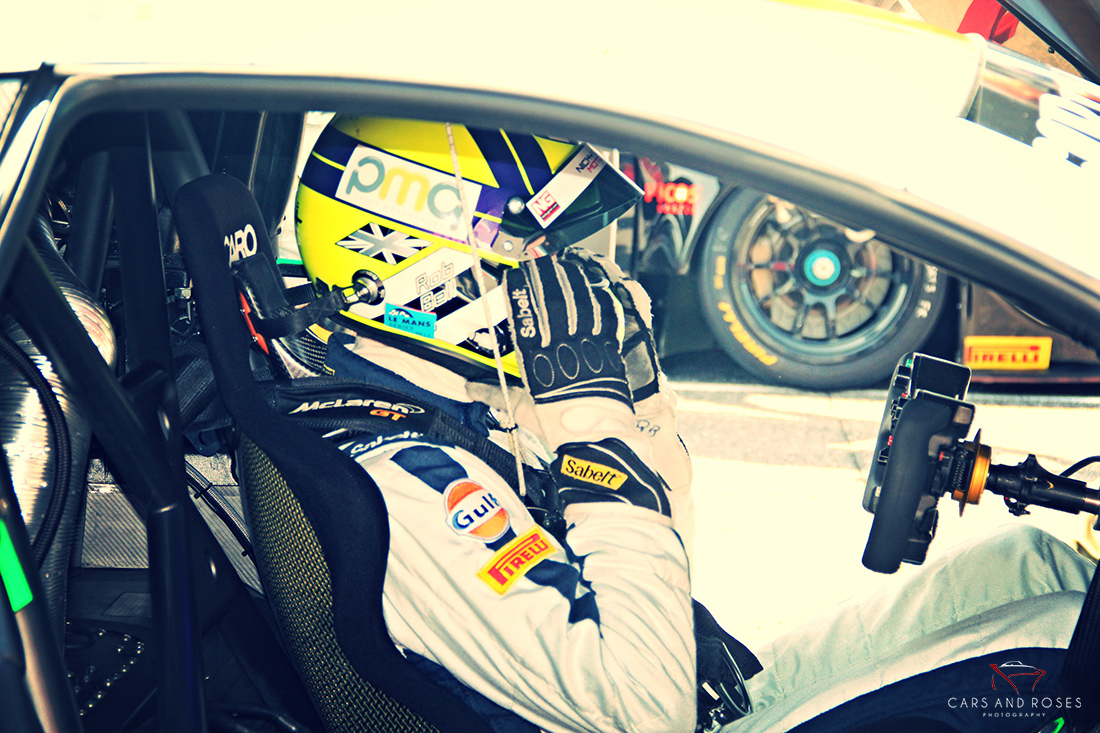
The Ferrari 250 GTO is arguably the most coveted race car among collectors worldwide — a single example sold for more than $51 million in 2018. Its curves, sculpted by Sergio Scaglietti, make it as much a mechanical work of art as a racing machine.
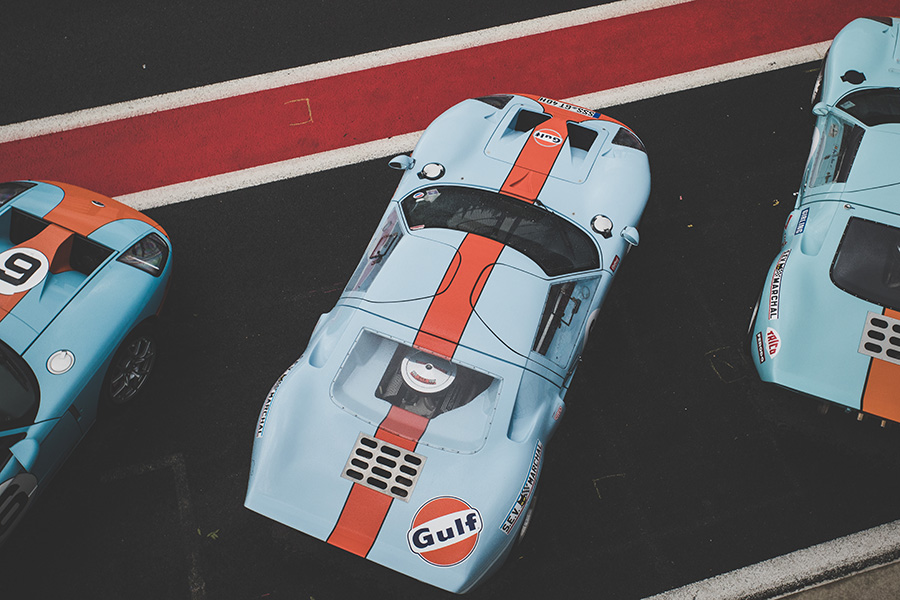
But it’s the rivalry between Ferrari and the Ford GT40 that remains the most famous chapter in Le Mans history. Born from Henry Ford II’s determination to beat Ferrari on its own turf, the GT40 won four consecutive races from 1966 to 1969 — a feat still unmatched by a single model.
The Group C and GT Era (1975-2000)
The 1970s through the 1990s saw the rise of increasingly radical silhouettes, engineered to tame aerodynamics at speeds beyond 350 km/h on the straights.
The Porsche 935, nicknamed “Moby Dick” for its elongated white bodywork, dominated endurance racing in the late 1970s with a turbocharged engine producing over 800 horsepower. It remains one of the most recognisable competition Porsches ever built.
Nearly two decades later, the McLaren F1 GTR won Le Mans on its very first attempt in 1995 — an exceptionally rare feat for a car derived from a road model. Its victory remains one of the most improbable in motorsport history.
The Modern Hybrid Revolution (2000-2020)
The turn of the 21st century ushered in a new technological era, where energy efficiency became just as decisive as raw power.
The Audi R8 LMP dominated the 24 Hours of Le Mans in the early 2000s, with five victories between 1999 and 2005, redefining the standards of endurance reliability.
Finally, the Toyota TS040 Hybrid embodied motorsport’s shift into the hybrid era, pairing a V8 petrol engine with a kinetic energy recovery system — technology that has since transformed Formula 1 itself.
Frequently Asked Questions
What is the most successful race car in history?
The Bugatti Type 35 holds this record with more than 1,000 victories between 1924 and 1930 — a tally no other competition car has ever matched.
How many times did the Ford GT40 win at Le Mans?
The GT40 won four consecutive editions of the 24 Hours of Le Mans, from 1966 to 1969, ending Ferrari’s dominance of the race.
Why is the Porsche 935 nicknamed “Moby Dick”?
Its white bodywork, dramatically elongated at the rear for aerodynamic efficiency, resembled the silhouette of a whale — hence its iconic nickname.
Can I find these race cars as fine art prints at Cars and Roses?
Yes — our Race Cars collection offers limited-edition prints on aluminium, acrylic, and canvas, each certified and numbered.
Which print material works best for race car photography?
Aluminium Dibond is particularly well suited: its crisp, high-contrast surface captures the tension and motion inherent to competition photography.
You Might Also Like
- Ford GT40 Photography: The Le Mans Icon in Fine Art
- Ferrari 250 GTO: The Holy Grail of Fine Art Automotive Photography
- Capturing Elegance: The Art of Black and White Car Photography