

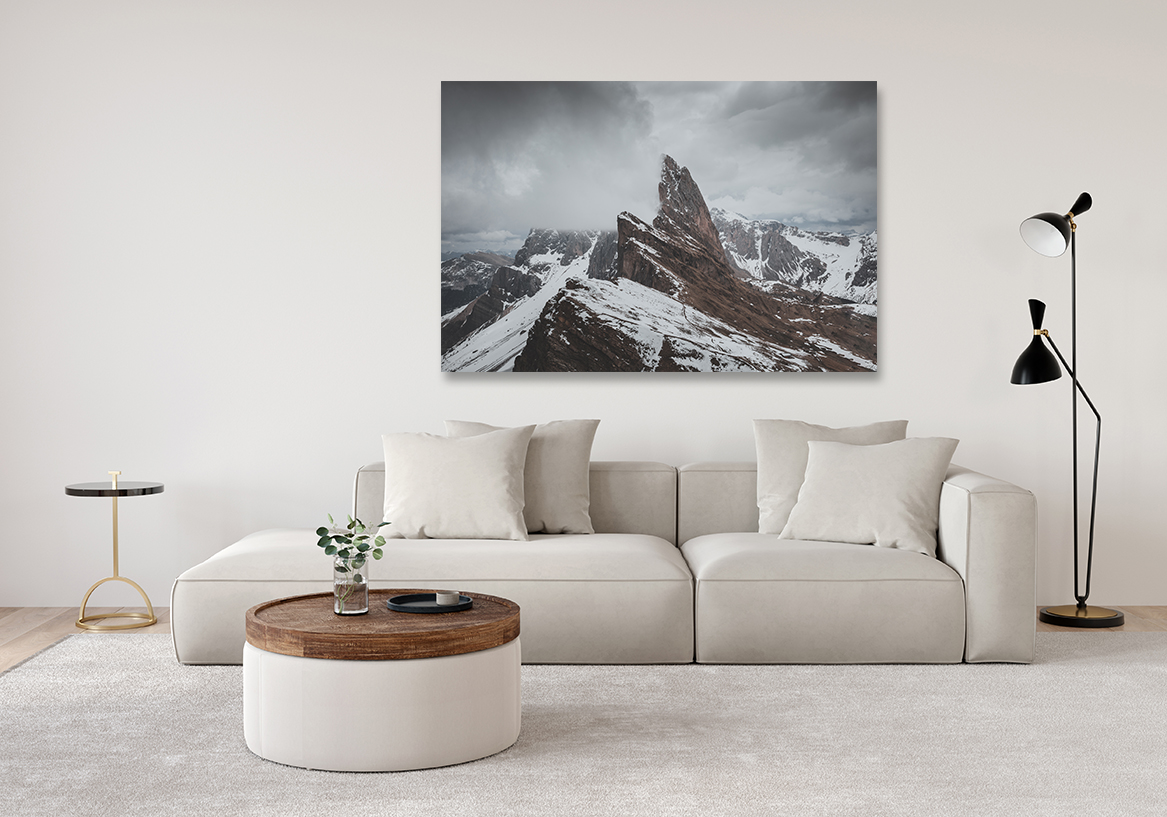
The Dolomites belong to another world. Limestone spires glowing orange at sunset, emerald lakes mirroring impossible peaks, alpine meadows dotted with centuries-old chapels: every image captured in this UNESCO World Heritage mountain range carries a visual power that few landscapes can match. As a fine art print, Dolomites photography brings that power into your home — permanently.
Table of Contents
- The Dolomites: A UNESCO World Heritage Landscape
- Iconic Locations for Landscape Photography
- Light and Ideal Conditions for Photographing the Dolomites
- Dolomites Photography in Interior Decoration
- How to Choose and Display a Dolomites Fine Art Print
- Frequently Asked Questions
The Dolomites: A UNESCO World Heritage Landscape
Listed as a UNESCO World Heritage Site in 2009, the Dolomites span nine distinct massifs across northeastern Italy, covering Trentino-Alto Adige and Veneto. What sets this mountain range apart from any other in Europe is the nature of its rock: dolomite, a calcium-magnesium carbonate that takes on extraordinary hues under raking morning and evening light — from pale pink to deep burnt orange, in what the locals call enrosadira, the blushing of the peaks.
For a landscape photographer, this unique optical phenomenon offers the opportunity to capture images of chromatic intensity found nowhere else in Europe. It is also why Dolomites photography has become one of the most sought-after genres in fine art photography: each image carries the mark of an exceptional place, a fleeting light, an unrepeatable moment.
Iconic Locations for Landscape Photography
Among the many photogenic locations in the Dolomites, a handful stand out for their graphic beauty and ability to produce truly powerful images:
Seceda, in the Val Gardena, offers one of the most spectacular panoramas in the Alps. Its jagged ridges plunging into green alpine meadows create a natural composition between mineral and vegetable. As a large-format fine art print, the Seceda photograph commands instant visual authority in a living room or entrance hall.
Lago di Braies is perhaps the most photographed lake in the Dolomites. Its turquoise waters framed by conifer forests and sheer rock faces create a compelling chromatic balance — cool, serene tones that contrast with the rawness of the surrounding relief. The Lago di Braies print works particularly well in contemporary and Scandinavian-style interiors.
San Giovanni Chapel in Val di Funes is one of the most iconic images of the Dolomites: a small baroque church standing alone in a meadow, with the Odle peaks rising behind it. This composition — human scale against overwhelming natural grandeur — is perfect for décor that seeks poetry alongside drama. The San Giovanni Church photograph is among our most requested prints.
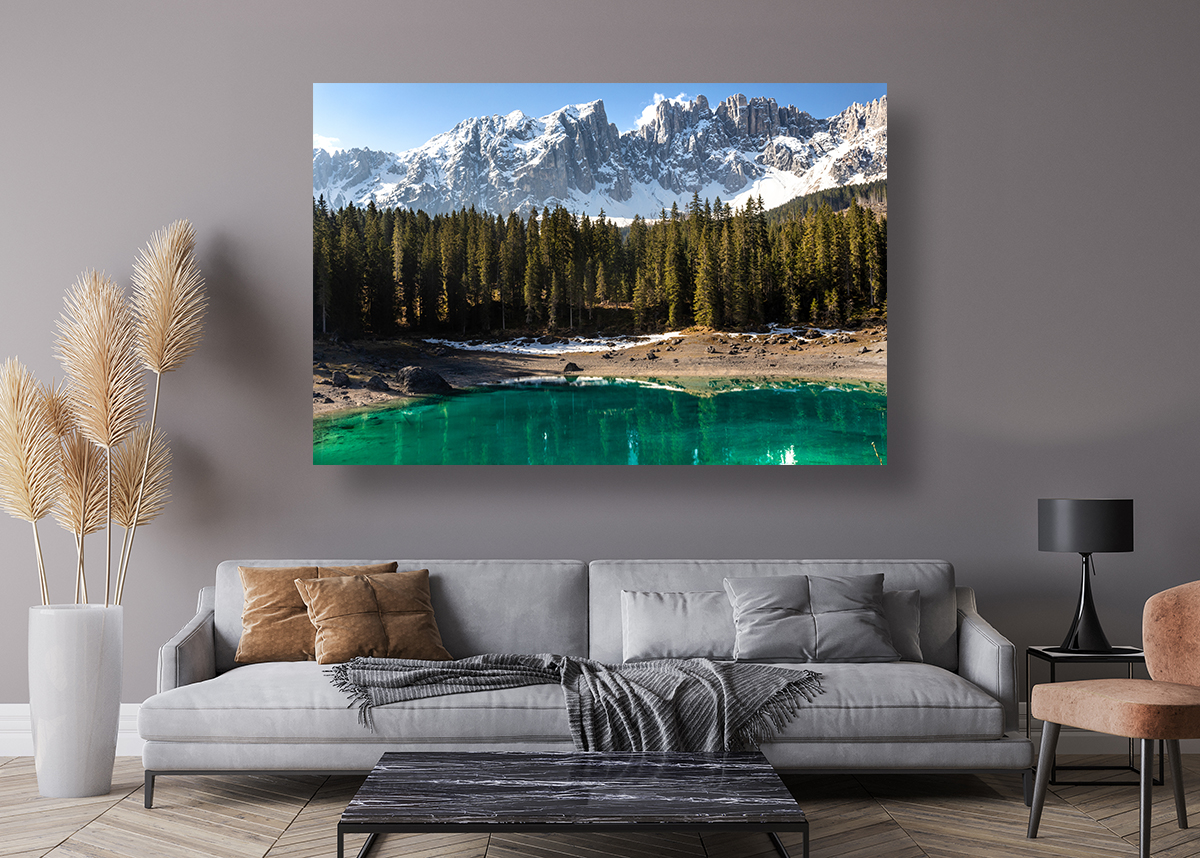
Lago di Carezza (Karersee) offers a flawless reflection of the surrounding peaks in its still waters — a classic landscape photography subject that loses none of its strength in a contemporary frame. Explore the Karersee photograph in our collection.
Light and Ideal Conditions for Photographing the Dolomites
Dolomites photography is governed by very specific light constraints. The enrosadira phenomenon occurs roughly 20 to 30 minutes before sunset and fades in just a few minutes — a narrow window that demands being in the right spot well in advance. The best conditions are found between June and October, when the alpine meadows are green and the peaks are still free of fresh snow.
Wide landscape photography in the Dolomites particularly favors panoramic formats and deep depths of field. The natural leading lines — winding mountain roads, lake shores, rocky ridgelines — draw the eye through the frame and reinforce the sense of immensity. It is this rigorous composition that separates a holiday snapshot from a fine art print made to last.
Winter light, though less accessible, produces images of austere beauty: snow-covered peaks cut against deep azure skies, forests laden with frost, frozen lakes. These high-contrast images adapt perfectly to contemporary black-and-white or cool-toned interiors.
Dolomites Photography in Interior Decoration
Mountain landscape photography addresses a specific decorative need: bringing depth, air and grandeur into an interior. The Dolomites, with their color palette ranging from ochre to turquoise and alpine green, offer rare decorative versatility. Depending on the print chosen, they can warm or cool a room, bring calm or visual tension.
In a living room with natural tones — wood, linen, terracotta — a Seceda or San Giovanni print brings a touch of golden warmth. In a more minimalist interior, white or grey, the Lago di Braies or Karersee will offer a serene counterpoint. For a gallery wall, the Dolomites lend themselves to diptych compositions or very wide panoramic formats.
How to Choose and Display a Dolomites Fine Art Print
Choosing a mountain landscape print involves several parameters: the dominant color palette of the image relative to your interior, the format suited to your wall space, and the support that will best render the texture of the light.
For Dolomites photography, Baryta paper is often the most appropriate support: it faithfully renders the luminous whites of snow-capped peaks and deep blacks of backlit forests, with a richness of detail that standard photo paper cannot achieve. For a more graphic and contemporary finish, dibond aluminum printing adds additional depth to the colors.
In terms of size, mountain landscapes gain from being printed large. A minimum of 80 × 120 cm (32 × 47 in) is recommended for the depth of the landscape to fully express itself. Formats of 100 × 150 cm and above are ideal for the principal walls of a living room or dining room.
Every print in our Dolomites collection is a limited edition, signed and accompanied by a certificate of authenticity. Unlike a poster, it is a photographic work designed to last decades — and appreciate in value. To understand exactly what separates a fine art print from a standard reproduction, read our guide: fine art print vs poster.
Frequently Asked Questions about Dolomites Photography
For a clean, modern interior, Lago di Braies or Karersee are excellent choices: their turquoise and blue-green tones work perfectly with white, grey or light wood spaces. A format of 80 × 120 cm or 100 × 150 cm creates strong visual impact without overwhelming the room.
Yes, as long as you choose a calming rather than dramatic image. Lago di Braies at sunrise, with its soft tones and still reflections, is ideal for a bedroom. Avoid high-contrast or red-dominant images in rest spaces.
A fine art print uses pigment inks that resist light for 80 to 100 years, on archival supports (Baryta paper, cotton paper, aluminum). It is produced in a limited edition and comes with a certificate of authenticity. A standard print is mass-produced on regular paper with no guarantee of color longevity or artistic value.
Our Dolomites prints are available in a range of sizes from 40 × 60 cm to 120 × 180 cm. For specific needs outside this range, contact us directly — we can discuss custom sizes for architectural or interior design projects.
Discover Our Landscape Fine Art Prints
Seceda, Lago di Braies, Karersee, San Giovanni… Each print is a signed limited edition, delivered with a certificate of authenticity.
Read Also
- Fine Art Print vs Poster: How to Choose the Right One for Your Home
- How to Create a Fine Art Gallery Wall: The Complete Guide
- Gift for Car Enthusiasts: Fine Art Automotive Photography