

Diptychs and triptychs give a wall more presence than a single small print, and they often cost about the same as one large format. Four rules make them work: the same format, the same height, a small and even gap, and a shared palette or story. Each photograph is bought separately, with its own edition number and certificate.
This guide explains how to choose between two and three panels, how to hang them and what a series really costs, using real prices from our catalogue. It also covers the mistakes that appear most often when a composition is improvised.
Diptychs and triptychs: which one for your wall?
For instance, two identical prints side by side suit a narrow wall: above a desk, in a short hallway or beside a door. Three prints, on the other hand, fill a wide wall such as the one behind the sofa or a long entrance, without resorting to one enormous format.
In addition, a series spreads the story across the wall. A single image shows one car; three images can show the same model from three angles, the same light in three colours or three eras of one marque. That is why a triptych reads as one piece from across the room and as three separate details up close.
Five rules for a series that looks planned
1. The same format for every panel
To begin with, our catalogue offers two families of format. Square photographs come in 40 × 40, 60 × 60, 80 × 80 and 100 × 100 cm. Landscape photographs, in a 3:2 ratio, go up to 180 × 120 cm. Therefore, when you plan diptychs and triptychs, do not mix the two families in one series: a square next to a landscape breaks the line and looks like a mistake.
2. The same material and finish
Pair aluminium with aluminium, canvas with canvas and plexiglas with plexiglas. Because gloss and texture change from one material to another, the difference is more obvious when the panels hang side by side. If you are unsure, our guide to the best material to print photos on explains the differences.
3. A small, even gap
As a guide, leave 5 to 10 cm between panels that are 40 to 60 cm on a side. Indeed, a gap that is too wide splits the series, and one that is too narrow turns it into a block. Also, always measure from edge to edge rather than centre to centre, and keep the same distance between every panel.
4. The right height
First, centre the whole arrangement about 145–150 cm from the floor, at eye level. Then, above a sofa, leave 15 to 25 cm between the furniture and the lower edge. Moreover, the series should not exceed two thirds of the furniture’s width, just like a single print. Our guide on how to choose the right size gives the same proportions.
5. A shared palette or story
In short, a series works when the eye recognises something in common: the same tones, the same model or the same light. For example, two Porsches from different eras in black and white, or two racing photographs with the same dominant colour. By contrast, a red Ferrari next to a Nordic landscape needs a third element to tie them together.
A real series from the catalogue: the Mustang headlights
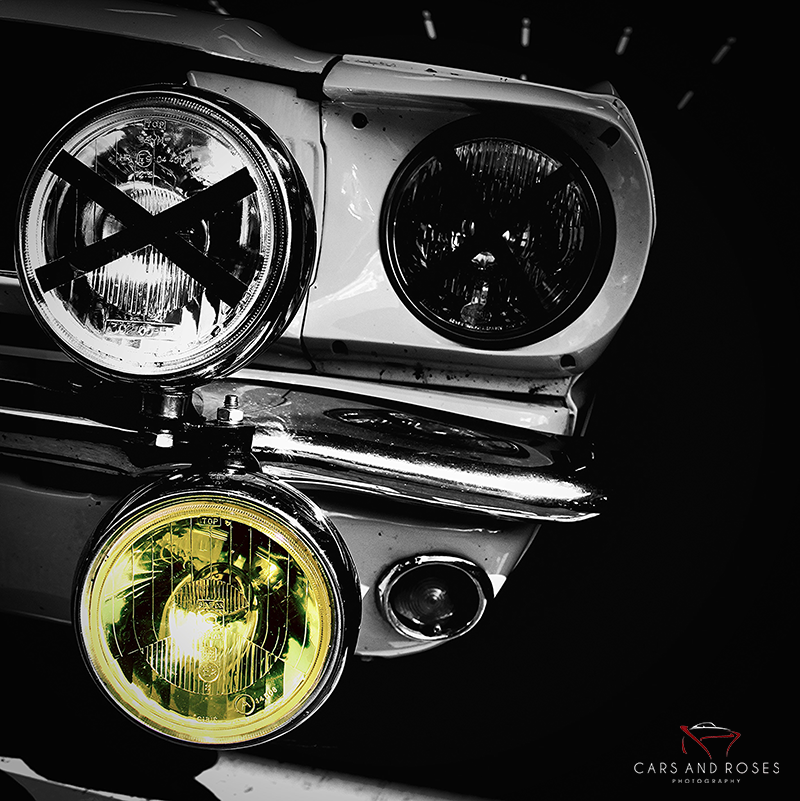
For example, the three photographs Ford Mustang Headlights – Yellow, Purple and Blue make a triptych that is almost ready to hang. They share the same square format and differ by colour, which is exactly the principle of a successful series.
All three share the same price grid, so the arithmetic is simple. Here is what one panel, a diptych and a triptych cost, depending on format and material.
| Format | Material | One panel | Diptych (2) | Triptych (3) |
|---|---|---|---|---|
| 40 × 40 cm | Canvas | €130 | €260 | €390 |
| 40 × 40 cm | Aluminium | €145 | €290 | €435 |
| 60 × 60 cm | Canvas | €200 | €400 | €600 |
| 60 × 60 cm | Aluminium | €267 | €534 | €801 |
| 60 × 60 cm | Plexiglas | €445 | €890 | €1,335 |
For comparison, a single 100 × 100 cm aluminium print costs €557. Altogether, three 40 × 40 cm aluminium panels add up to €435 and take up about 130 cm of wall width with their gaps, so they cover more wall than that single piece for less money.
Similarly, the landscape format gives another example. For the photograph Porsche 911 Turbo and Piper Malibu – Hangar Light, two 60 × 40 cm aluminium panels cost €430 (€215 each) and span about 125 cm. A single 120 × 80 cm aluminium print costs €590. Prices vary by photograph and material, so always check the product page.
Every panel is a numbered edition
However, a series is not a bundle. Each photograph is a limited edition with its own numbering and certificate, and it is ordered separately from its own page. It is therefore wise to check the availability of every panel before settling on the arrangement.
To understand what that numbering means, read Do limited edition prints gain value? And to see how a multi-print order travels, see how we ship a large fine art print.
How to hang diptychs and triptychs without mistakes
Hanging diptychs and triptychs is easier with a template. First, cut kraft paper to the size of each panel and tape it to the wall with painter’s tape. Then adjust the gaps and the height before drilling a single hole. Finally, hang the centre panel first and the side panels after it, using a spirit level. Our guides on how to hang wall art like a pro and how to hang multiple pictures on a wall cover the fixings in more detail.
The most common mistakes
Diptychs and triptychs go wrong in the same ways. Almost every time, the same four come up: mixing square and landscape formats, combining different materials, leaving uneven gaps and hanging the series too high. Furthermore, avoid panels that are too small for a large wall: three 40 × 40 cm photographs get lost on a three-metre wall.
A series for every space
Diptychs and triptychs adapt to most rooms. In the living room, a triptych above the sofa anchors the wall; the fine art gallery wall guide helps if you prefer a looser arrangement. For the office, a diptych above the desk stays understated; see car photography for your home office. As for the garage, two panels in bold colours are enough, as garage wall art ideas explains.
In a dealership or showroom, a triptych on the reception wall works very well; the guide to fine art for a showroom details sizes and lighting. And for a gift with presence, a pair of prints beats one small print: see the Christmas 2026 gift guide.
Diptychs and triptychs reward a little planning: choose one format, one material and one gap, then let the photographs do the rest.
Frequently asked questions
Is a diptych or a triptych better?
It depends on the width of the wall. A diptych suits narrow spaces such as above a desk or beside a door. A triptych works better on a wide wall such as the one behind the sofa, because it fills the space without needing one giant format.
Can I mix canvas and aluminium in one series?
However, it is better to avoid it. Gloss, texture and edges change from one material to another, and the difference is more noticeable when the panels hang together. So choose the same material and the same format for every panel, and the series will look coherent.
How far apart should the panels be?
As a guide, 5 to 10 cm for panels that are 40 to 60 cm on a side. Above all, what matters is that the distance is the same everywhere and measured from edge to edge. Before drilling, test the arrangement with kraft paper templates on the wall.
Are series sold as a set?
No. Each photograph is ordered separately from its own page, with its own edition number and certificate, so choose the photograph, the material and the format for each panel, then check that they match before adding them to your basket.