

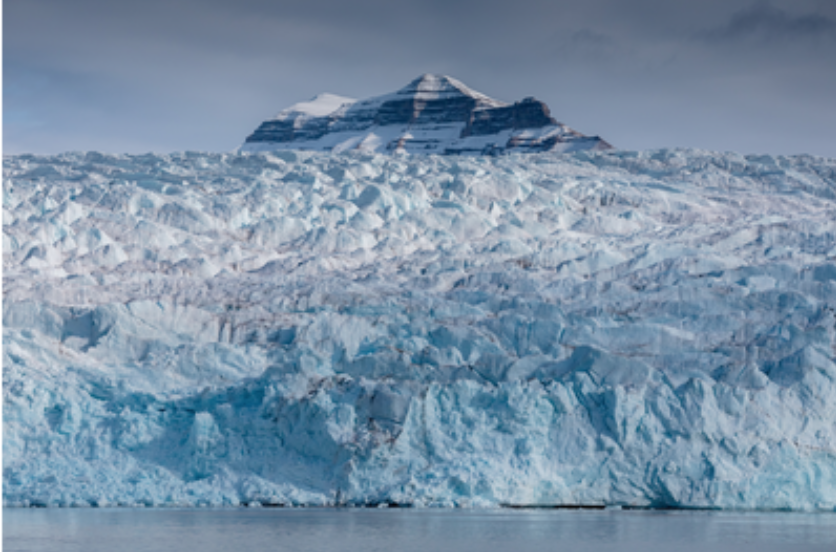
Winter landscape prints work because cold light is calm. The sun stays low, shadows stretch, and the palette narrows to blue, white and slate, which quiets a room instead of filling it. Our Iceland and Svalbard photographs (glaciers, icebergs, black sand and frozen coastline) are available as fine art prints on plexiglass, aluminium or canvas, from €78. This guide shows which image suits which room, how to light it, and when to order if it is a Christmas gift.
What “winter light” really means in a photograph
In the far north the sun never climbs far. Reykjavik gets only about four hours of daylight around the winter solstice, while in Svalbard the sun disappears altogether: in Longyearbyen the polar night runs from roughly mid-November to late January, and what is left of the day is one long, slow blue hour. Light arrives sideways, cools every surface and turns ice into something between glass and stone.
Photographers chase this light because it simplifies a scene. With less colour information, shape, texture and tonal range do the work. That is also why these images age so well on a wall: they do not shout, they do not date, and they never go out of season. A glacier photographed in January looks exactly right in July.
Eight winter prints, eight moods
Every photograph below belongs to our landscape collection and is sold as a fine art print, starting at €78 for the entry-level format (see what the €78 format really gives you). The table says what each one does to a room.
| Mood | Best in | |
|---|---|---|
| Tones of Blue, Svalbard | Calm, almost monochrome, a single colour | Bedroom, reading corner |
| Kayak & Iceberg, Svalbard | Scale and solitude | Living room, above a console |
| Escape in the Arctic Fjords, Svalbard | Open water, cold distance | Study, long wall |
| Jökulsárlón Glacier, Iceland | Drifting ice in a glacier lagoon | Hallway, wide wall |
| Jökulsárlón at twilight, Iceland | Blue hour, softer and warmer ice | Bedroom, dining room |
| Svínafellsjökull Glacier, Iceland | Texture and weight of ice | Office, living room |
| Seljavallalaug Hidden Pool, Iceland | A human note inside the cold | Bathroom, spa-like rooms |
| Iceland Black Sand Beach from Above | Graphic, almost abstract | Modern interiors, stairwells |
Which room for which print
Bedroom and reading corner. Choose the quietest images: Tones of Blue, or the twilight view of Jökulsárlón. They offer low contrast, one dominant colour and nothing that pulls the eye at night. They read as a pause rather than a decoration.
Living room. You want a focal point. Kayak & Iceberg gives a sense of scale, a small human gesture set against a huge field of ice, and it holds its own above a sofa or console even when the room is busy.
Office or study. Texture wins here. The Svínafellsjökull glacier is all ridges and shadow, the kind of image you can look at for a minute during a long call and still see something new. If your study already has dark wood and books, the cold blue makes a clean counterpoint (our collector’s study guide shows how to balance it).
Hallway, stairs and bathroom. The black sand beach seen from above is graphic enough to work as a pattern, and Seljavallalaug, a pool tucked into a valley in southern Iceland, brings warmth to a cold-coloured room without adding a single warm tone.
Cool images, warm light: how to light them
Blue-dominant photographs can look flat under cold white LEDs, because the room light adds to the blue instead of contrasting with it. For that reason, use warm white bulbs (2700 to 3000 K) so that ice reads as ice and not as fluorescent grey. Ideally, wash the wall with indirect light rather than pointing a spot straight at the print.
Position matters as much as bulbs. Glossy surfaces such as plexiglass catch reflections from a window placed directly opposite, so hang the print on a side wall or at an angle to the light source. As a rule, the centre of the image sits at about 145 to 150 cm from the floor. For the full routine on light, dust and sun exposure, read our guide to lighting and caring for a fine art print.
Plexiglass, aluminium or canvas for ice and snow
Plexiglass (the photograph printed on acrylic) gives the deepest blues and the most luminous whites. It is the dramatic choice for glacier scenes, with the trade-off that it is glossy and therefore sensitive to reflections.
Aluminium keeps fine detail very crisp, which suits the cracks and textures of ice, and it is calmer under strong light. It is the safest choice for a bright room.
Canvas is softer and more textile, which warms the whole image. However, canvas sits outside the limited edition, so choose plexiglass or aluminium if the edition matters to you. None of these supports needs a frame: the work is the print on its support.
Choosing the size
For example, wide, calm images such as the fjords or the Jökulsárlón lagoon deserve width: aim for roughly two thirds of the width of the sofa, console or bed below them. Detail-led images such as Svínafellsjökull can go smaller, because they reward looking closely. In general, one large print always beats three small ones scattered on a wall. Finally, if you want a set, keep the same support and the same height for every piece.
A winter print as a gift
A winter landscape is an easy gift for someone who already owns the obvious things. Besides, it pairs naturally with a black-and-white car print: the same restrained palette, the same attention to light. If you are still choosing, our luxury gifts for the car collector who has everything shows how to build a gift around one print, and the prints at €78 make a first purchase easy.
Christmas deadlines: to arrive before Christmas, order by about 10 December for the United States and by about 19 December for Europe. Also, each print comes with a digital certificate of authenticity (what it says and how to verify it).
Frequently asked questions
Are these winter landscape prints limited editions?
Yes, our landscape prints on plexiglass and aluminium are limited editions, and each one comes with a digital certificate of authenticity. Canvas is the exception: it sits outside the limited edition. The certificate guide explains what to check before you buy any art print.
Which support is best for glaciers and ice?
Plexiglass for the most luminous blues and whites, aluminium for crisp detail and calmer reflections, and canvas for a softer, warmer look. In a bright room, aluminium is usually the safest choice.
Does a blue print suit a warm interior?
Yes. A cool image gives a warm room a counterpoint, and the reverse is also true. To make it work, keep the bulbs warm, avoid direct sun on the print, and repeat one tone from the photograph, such as slate or white, in a cushion or a throw so that it feels placed rather than added.
When should I order a winter print for Christmas?
Order by about 10 December for the United States and about 19 December for Europe. After those dates, delivery before Christmas cannot be guaranteed.