

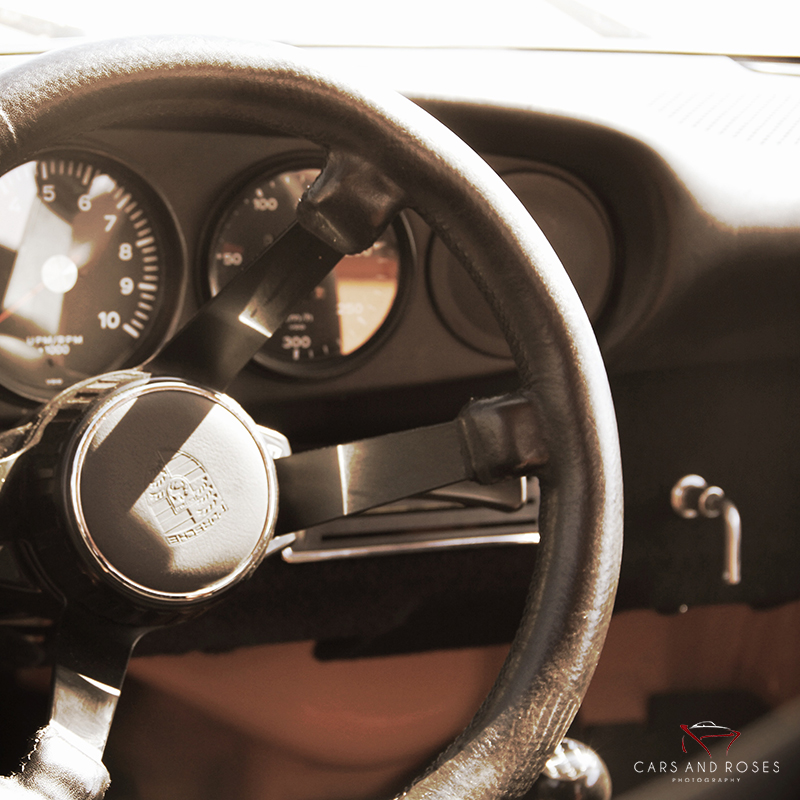
A collector’s study is the one room where car photography feels completely at home. The wood is dark, the light is low and the walls are crowded with books, so a black and white or sepia print fits without a fight. This guide shows what to hang among the books, the watches and the whisky, which sizes work, and six prints from our catalogue that suit the room.
Why a study needs different art
A living room asks for a picture that works from the sofa, ten feet away. A study works differently. You sit at a desk, you read in an armchair, and you look at the wall from two or three metres at most. At that distance people notice details: the stitching on a steering wheel, the needles on a dashboard, the grain of a black and white negative.
The room also has its own palette. Leather, walnut, brass and the spines of old books are all warm and dark. Strong colour fights with that, whereas black and white, sepia and muted tones blend in and make the wall look finished. That is why the best car prints for a study are usually the quiet ones: interiors, details and monochrome scenes rather than a bright supercar at full speed.
None of this is a rule. A single red Ferrari can look superb above a dark bookcase. The point is to choose on purpose, because a study is a room people spend hours in, and the picture in front of you gets looked at far more often than the one in the hallway.
What to pair with each part of the room
Start from what is already there. The table below matches the usual elements of a study with the kind of print that sits well beside them.
| In the room | What works on the wall | Why |
|---|---|---|
| Shelves full of books | Black and white or sepia, landscape format | Neutral tones sit calmly between the spines |
| Desk or writing table | Small detail print: steering wheel, dashboard | You see it up close, so detail rewards the eye |
| Leather armchair and lamp | Warm sepia or amber tones | The lamp light echoes the colours of the picture |
| Whisky tray or sideboard | A medium horizontal print above it | The print and the objects below read as one group |
| Wall facing a window | Canvas, which is matte | Glossy surfaces reflect daylight on that wall |
If you collect watches, the same logic applies. A watch is a small, precise mechanical object, and so is a steering wheel or a dashboard seen close up. Putting the two in the same room tells a coherent story about someone who likes well-made machines.
Six prints that suit a study
These six come from our catalogue and share the same quiet mood. Prices below are the starting price, and each product page lists every size and support.
- Porsche Steering Wheel #12, Sepia Edition: the most “study” picture we have. A close view of a Porsche wheel in warm sepia, from €130.
- Black and White Ford GT40: a Le Mans legend in monochrome, from €78.
- Porsche Black and White Classic Duo: a classic Porsche pairing in black and white, from €78.
- Ferrari 275 GTS Dashboard: dials and chrome, an object-like picture for a desk wall, from €78.
- Aston Martin DB5 Steering Wheel #03: a British interior with a lot of character, from €78.
- Mercedes 300 SL Steering Wheel: the Gullwing’s cockpit, from €78.
If you would rather see everything first, browse the limited edition collection. For a wider choice of ideas, our guide to car art for a shared space covers the lounge and den side of the same question.
Size and hanging height
In a study, scale matters more than people expect. Shelves and wood panelling take up a lot of the wall, so a picture that is too small disappears. These simple rules help:
- Over a desk or sideboard, aim for a print about two thirds of the width of the furniture below it.
- Hang the centre of the picture at about eye level when you stand, roughly 145 to 150 cm from the floor, and a little lower if you mostly sit.
- Leave 15 to 25 cm between the bottom edge and the desk or sideboard, so the two read as one group.
- If you hesitate between two sizes, take the larger one. Dark rooms swallow a small picture.
Our prints come on aluminium or acrylic glass, or on canvas, and none of them needs a frame. That removes one decision, and it also means the print does not have to match the wood of the furniture around it.
Light, gloss and reflections
Dark rooms are usually lit by lamps, and lamps reflect. Acrylic glass is glossy and gives deep blacks, but a bare bulb facing it will show up in the surface. Aim a small picture light from above at an angle, or place the print where no lamp sits opposite it. Aluminium is less sensitive, and canvas is matte, so it hides reflections completely.
A warm bulb brings out sepia and amber tones, while a cool white bulb turns them grey. For the full routine on light and care, read how to light and care for a fine art print, and for colours around the picture see how to match a car print to your interior.
A gift for a collector’s study
A study print also makes a good present, because it suits a person who already owns a lot. The €78 format is a fair entry point, and we explain what it does and does not include in the €78 fine art print explained. If the budget is higher, our luxury gift ideas for the collector who has everything start at €500.
Limited editions and certificates
Our limited editions are made to order on aluminium or acrylic glass, and each one comes with a digital certificate of authenticity that carries a reference anyone can check online. Canvas is also available for these photographs, but it sits outside the limited edition. The details are in what your certificate says and how to verify it.
Frequently asked questions
What kind of car print suits a study best?
Quiet pictures work best: black and white scenes, sepia details, and close views of steering wheels or dashboards. They blend with dark wood, leather and books, and they hold up when you look at them from a desk, two or three metres away.
How high should I hang a print in a home office?
Place the centre of the picture at about 145 to 150 cm from the floor. If it hangs above a desk or sideboard, leave 15 to 25 cm between the print and the furniture, and aim for about two thirds of the furniture’s width.
Will an acrylic glass print reflect my desk lamp?
It can, because acrylic glass is glossy. Keep lamps from facing the print directly, or light it from above at an angle. If reflections are a concern in that room, aluminium reflects less and canvas is matte, so it shows none.
Do I need to buy a frame?
No. Our prints come on aluminium, acrylic glass or canvas and come without a frame, so you do not need to match the wood of your furniture.