

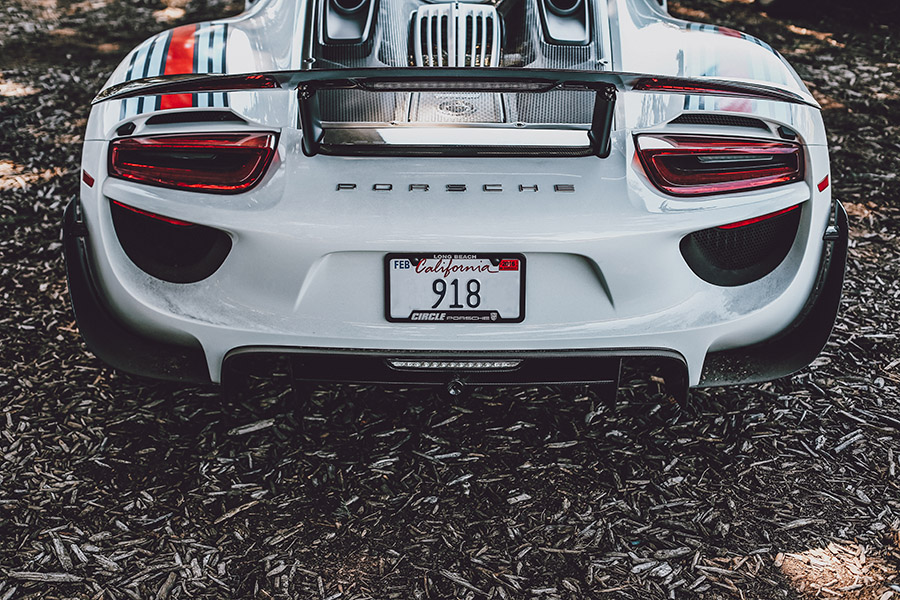
The Porsche 918 Spyder and the 911 GT3 RS are the two modern Porsche legends collectors ask about most. One is a hybrid hypercar built in a run of 918 cars; the other is the track-bred 911 that defines the RS badge. This guide explains what makes each car special, which fine art prints show them best, and how to choose the right size for your wall.
Porsche 918 Spyder: the hybrid hypercar in fine art
Unveiled in 2013, the Porsche 918 Spyder combined a V8 engine with electric motors and was built in a strictly limited run of 918 cars. It sits alongside the Ferrari LaFerrari and the McLaren P1 as one of the “holy trinity” of hybrid hypercars. For a wall, that rarity matters, because a limited car makes a natural subject for a limited edition print.
Our catalogue holds two Porsche 918 photographs. The Porsche 918 Martini photograph shows the car in the famous blue, red and white colours that recall Porsche’s racing past, including the 917 of the early 1970s. In addition, a second Porsche 918 print is available for those who want a second view of the same car. If you want the technical background, the Porsche 918 Spyder page on Wikipedia is a reliable reference.
From the 959 to the 918: Porsche’s halo cars
Porsche has always used a few special cars to show what its engineers can do. In the mid-1980s, the 959 introduced advanced all-wheel drive and turbo technology to a road car. Then, in the early 2000s, the Carrera GT arrived with a V10 engine and a very pure driving experience. Finally, the 918 Spyder, from 2013, added hybrid power and proved that an electrified hypercar could still feel like a Porsche.
This lineage explains why the 918 matters to collectors. It is not only fast; it marks a turning point in the history of the brand. As a result, a photograph of a 918 works as a statement piece, in the same way a 917 or a 959 would have done in an earlier decade.
Porsche 911 GT3 RS: the track car you can hang at home
RS stands for Rennsport, the German word for racing sport. Since the Carrera RS 2.7 of the early 1970s, the badge has meant a lighter, sharper 911 made for drivers who care about lap times. The modern GT3 RS keeps that idea alive, and every generation has its own look, its own colours and its own fans.
We offer several GT3 RS photographs, and each one tells a different story:
On the airfield. Porsche GT3 RS – Wet Runway shows an orange GT3 RS on the wet tarmac of a private airfield, parked beside a light aircraft under an overcast sky. As a result, the picture feels calm and cinematic rather than loud.
In orange. The orange Porsche 911 GT3 RS print is the energetic choice. It brings colour to a neutral room, and it works especially well in an office or a garage.
At sunrise. The Porsche GT3 RS Sunrise photograph trades aggression for warm light, which suits a living room.
In pairs. The Porsche 991 GT3 and GT3 RS photograph puts two cars in one frame. Moreover, the Porsche 997 GT3 RS on the track speaks to fans of the earlier generation.
Across generations, the GT3 RS has also kept one thing constant: a naturally aspirated flat-six engine tuned for high revs. That purity is part of why enthusiasts keep these cars for decades, and why a photograph of one tends to stay relevant long after the model year has changed.
Why modern Porsche photographs age well
A common worry is that a modern car will look dated in ten years. In practice, the opposite is often true. Cars like the 918 and the GT3 RS are already treated as future classics, and a well-composed photograph depends more on light, place and mood than on the model itself. Moreover, a limited edition print keeps its own identity: it is numbered, certified and tied to a finite edition, so it does not behave like a generic poster.
If you are curious about how editions and certificates work over time, our guide to limited edition prints and retired editions explains it in plain language.
Modern Porsche or classic Porsche: which print for which interior?
Many buyers hesitate between a classic and a modern car. The answer depends on the room more than on the car. A classic 356 or an air-cooled 911 suits warm, wooden spaces, while a 918 Spyder or a GT3 RS looks sharper in a minimalist interior with concrete, glass or black metal.
Therefore, think about colour and light first. Orange and Martini colours add energy; black, white and grey keep a space quiet. If you prefer to see the classics, our articles on the Carrera RS 2.7, the 964 and 993 and the 911 Turbo lineage cover the earlier generations, and our Porsche photography prints guide compares them side by side.
Which size and finish for a Porsche 918 or GT3 RS print
Most of the GT3 RS and 918 prints start at €78 for a 30×20 cm canvas, and a few older pieces start at €130. For the current landscape format, the usual prices are below. However, always check the exact price on the product page before ordering.
| Size | Canvas | Aluminium | Plexiglass |
|---|---|---|---|
| 60×40 cm | €167 | €215 | €355 |
| 90×60 cm | €247 | €397 | €680 |
| 120×80 cm | €365 | €590 | €1,087 |
For a modern Porsche, aluminium is usually the best match, because the sharp finish suits the car’s clean lines. Plexiglass adds depth for colourful images such as the orange GT3 RS. Canvas is the warmest and most affordable option. You can browse the full Porsche collection to compare every photograph, and read our gift guide for Porsche lovers if you are choosing for someone else.
Frequently asked questions about the Porsche 918 Spyder and GT3 RS prints
How many Porsche 918 Spyders were built?
Porsche built 918 cars, which is where the name comes from. That small number is one reason the car is so sought after, and it is why a limited edition print of a 918 feels fitting on a collector’s wall.
What does RS mean on a Porsche?
RS stands for Rennsport, German for racing sport. It marks the lighter, more focused versions of the 911, starting with the Carrera RS 2.7 in the early 1970s and continuing with the GT3 RS today.
Which Porsche print suits a modern interior?
A modern car in a clean composition, such as the Porsche 918 Martini or the GT3 RS on the wet runway, works best in contemporary rooms. Aluminium is the finish that fits that style most naturally.
Are the prints limited editions?
Yes. Each photograph is a numbered limited edition, usually restricted to 200 copies per support and per size, with a certificate of authenticity. Once a format is sold out, it is no longer available.