

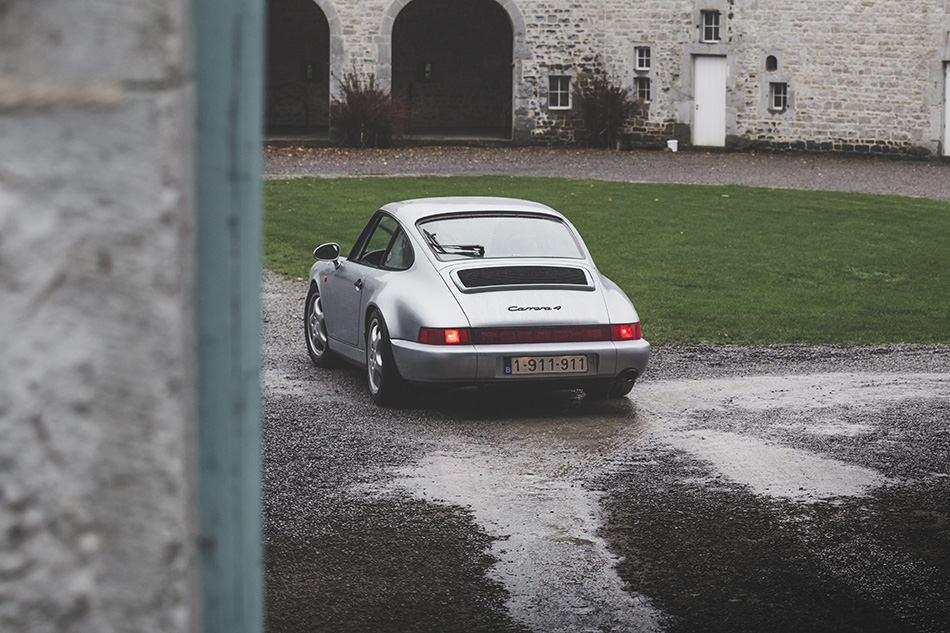
The Porsche 964 (1989–1994) and 993 (1994–1998) were the last two generations of the 911 built around an air-cooled engine before Porsche switched to water-cooling with the 996 in 1998. Together they cover nine years in which the 911 modernized without losing the character that made it famous — and today they are two of the most collected analog 911s on the market.
Why “air-cooled” still matters
For nearly 35 years, every 911 shared the same basic formula Ferdinand Porsche’s engineers settled on in 1963: a rear-mounted flat-six engine cooled by air rather than a liquid loop. The 964 and 993 were the final chapters of that story. When the water-cooled 996 arrived in 1997–98, it brought real gains in reliability, emissions and output — but it also closed a mechanical era. That closure is exactly why collectors, photographers and interior designers now treat the 964 and 993 as a distinct, finite category: there will never be a new air-cooled 911, which makes every surviving one a fixed piece of history rather than a stepping stone to the next model.
The 964 (1989–1994): modernizing the icon without losing its soul
The 964 looked almost identical to the classic G-series 911 at a glance, but under the skin roughly 85% of the car was new. Porsche added power steering, a driver’s airbag, coil-spring suspension in place of torsion bars, and — for the first time in a 911 — all-wheel drive on the Carrera 4. The Carrera RS variant stripped the car back down: thinner glass, lighter panels, no sound deadening, built for drivers who wanted the new chassis without the new comfort. It is the 911 that proved the shape could evolve technically while staying recognizably itself.
The 993 (1994–1998): the last and most refined air-cooled 911
The 993 is widely considered the high point of the air-cooled 911. It introduced a multi-link rear suspension that tamed the old car’s reputation for sudden oversteer, a smoother and wider body with integrated bumpers, and the most powerful naturally aspirated flat-six Porsche had built to date. The Carrera RS 3.8 pushed that formula to its limit — a car still regularly cited by collectors and journalists as the best-driving air-cooled 911 ever made. When Porsche retired the platform in 1998, it did so at what many consider its absolute peak, which is a large part of why 993 values have climbed steadily ever since.
Spotting the difference at a glance
From across a room, a 964 and a 993 can look like the same car — and that’s part of the appeal of hanging one as art rather than parking it in a driveway, where only another enthusiast would know what they’re looking at. A few tells help if you want to be precise about which generation is on your wall. The 964 keeps the flatter, more upright windshield and the narrower “whale tail” or small ducktail spoilers of the classic 911, with bumpers that still read as separate add-ons rather than part of the body. The 993 softens all of that: the nose sits lower, the bumpers blend into the bodywork in one continuous line, and the rear is noticeably wider on Carrera 4 and Turbo models thanks to the new suspension. On a black-and-white print the easiest giveaway is the headlight surround and bumper line — soft and separate on a 964, integrated and sculpted on a 993.
Collecting one today
Both generations have moved well past “used 911” territory into genuine collector cars, but for different reasons. 964s are valued for being the first 911 to modernize the chassis while keeping period-correct looks, which makes Carrera RS and Carrera 4 examples increasingly sought after by buyers who want classic proportions with usable dynamics. 993s are valued as the last of the breed — the final naturally air-cooled 911, built in comparatively low numbers for a car that would be replaced within four years. That scarcity, combined with the multi-link chassis and the reputation of the Carrera RS 3.8 and Turbo, is why 993 prices have been among the fastest-rising in the entire 911 family over the past decade.
| Year | Model | Milestone |
|---|---|---|
| 1989 | 964 launch | New Carrera 2 / Carrera 4, coil springs, power steering |
| 1991 | 964 Carrera RS | Lightweight, stripped-down homologation special |
| 1994 | 993 launch | New multi-link rear suspension, wider integrated body |
| 1995 | 993 Turbo | First 911 Turbo with twin turbochargers and all-wheel drive |
| 1995 | 993 Carrera RS | 3.8-litre naturally aspirated, considered the purest 993 |
| 1998 | 996 launch | Air-cooled era ends; water-cooled 911 begins |
For which room
A 964 or 993 print reads as a study in restraint — clean period color, a silhouette everyone recognizes without a logo in sight. It works especially well in a home office or study next to our Porsche 911 Carrera RS 2.7 print, continuing the same lineage across one wall. Right now, our collection includes several 964-era prints — including the Porsche 964 Carrera 4 Photograph and the Porsche 964 Carrera RS Photograph — while a dedicated 993 print isn’t in our catalog yet. If the 993 is the one you’re after, our 911 Turbo lineage, from the 930 Widowmaker to the 992, traces that exact era, and we’re always happy to hear which 993 moment you’d want to see photographed next.
FAQ
What’s the real difference between a 964 and a 993?
The 964 (1989–1994) kept the classic 911’s flatter, narrower body on a modernized chassis with coil springs and power steering. The 993 (1994–1998) went further: a new multi-link rear suspension, a wider body with smoother, integrated bumpers, and more power — most enthusiasts consider it the better-driving car.
Why do people call these “the last real 911s”?
Because they’re the last 911s with air-cooled engines. Porsche switched to water-cooling with the 996 in 1998 for emissions and reliability reasons, which permanently changed the car’s engineering character — so 964s and 993s are the final examples of the original formula.
Is the 993 really more valuable than the 964 today?
Generally yes, especially for Carrera RS and Turbo variants — the 993 is often described as the most desirable air-cooled 911, but well-kept 964 Carrera RS cars have also climbed significantly in recent years.
What size print works best for a 964 or 993 photograph?
Mid-size formats (60–90 cm wide) suit a desk or hallway without overwhelming the room; for a dedicated study or garage wall, our larger aluminum formats let the car’s lines read clearly from across the room.
Did the 964 and 993 share the same engine?
No — the 964 used a 3.6-litre flat-six, while the 993 introduced a revised 3.6-litre (and later 3.8-litre in the RS and GT2) with higher output and, on the Turbo, Porsche’s first twin-turbo six paired with all-wheel drive.
You might also like
- Porsche 911 Carrera RS 2.7: The Ducktail That Started a Legend — the generation that started the lineage the 964 and 993 continued.
- The Porsche 911 Turbo Lineage: From the 930 Widowmaker to the 992 — how the Turbo evolved across both of these generations and beyond.
- Behind the Print #2: The Story of Our Best-Selling Photograph — our own air-cooled Targa, shot at a rally in Belgium.
See the full range in our Classic Cars collection.