

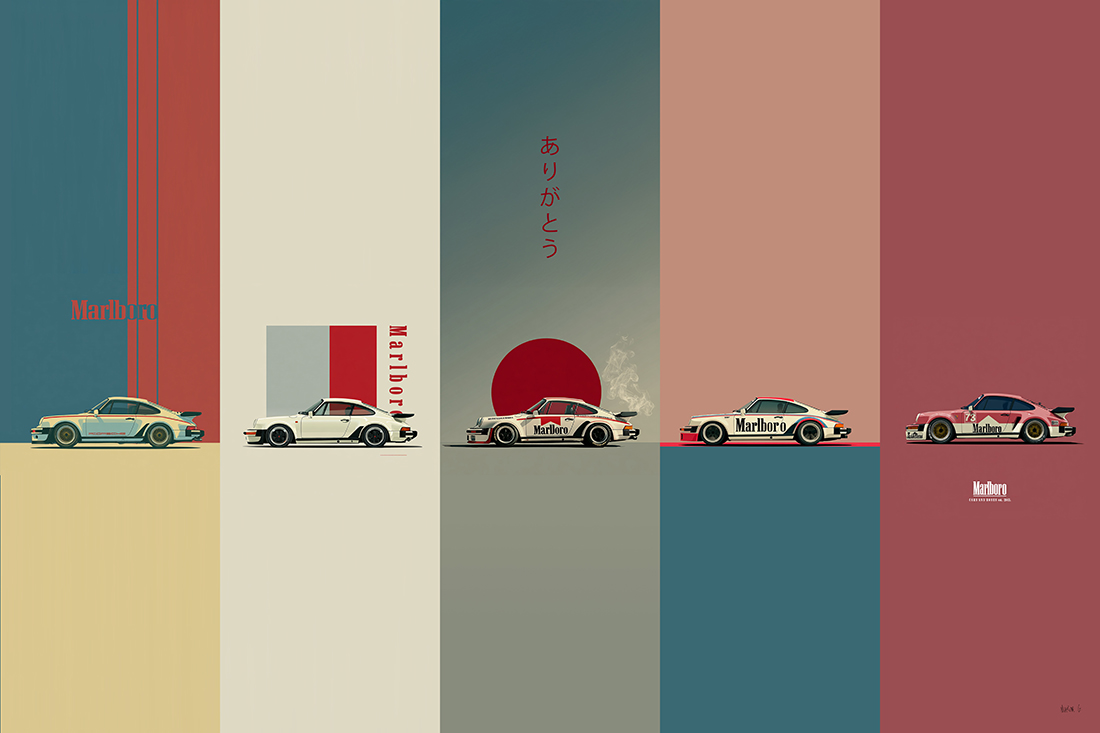
The 930 “Widowmaker” started the legend in 1975, but the Turbo story didn’t stop there. Seven generations, fifty years, one question running through all of them: how do you keep the soul of an unkillable supercar while making it something you can actually drive on a Tuesday? Here’s how the 911 Turbo evolved from a single-turbo monster into an all-wheel-drive, twin-turbo masterpiece — generation by generation, and which ones make the best wall art.
930 (1975-1989): the legend that started it all
It begins with a whale-tail spoiler and 260 horsepower that arrives all at once, well after you’ve already lifted off the throttle — the infamous turbo lag that gave the 930 its nickname. We’ve already written a full deep-dive on the original Widowmaker, its silhouette, and why it’s still the most requested generation in automotive fine art photography. If you only read one chapter of this saga, make it that one.
964 Turbo (1990-1994): the quiet transition
Most people forget this one existed. The 964 Turbo launched with the 930’s carryover 3.3L engine before switching, late in its run, to the lineage’s first 3.6L block. Integrated bumpers, ABS, power steering — this is the generation that started civilizing the beast without giving up raw power. It’s also the rarest of all seven today, which makes it a genuine collector’s piece.
993 Turbo (1995-1998): the last air-cooled, the first all-wheel-drive
The 993 Turbo is a turning point twice over: the last air-cooled engine in the entire 911 lineage, and the first Turbo to come standard with all-wheel drive. Twin smaller turbos replaced the 930’s single large unit, all but eliminating the lag that named the original. Plenty of purists still call it the last “real” 911 before the modern era began.
996 Turbo (2000-2005): the leap to water-cooling
Switching to water-cooling was controversial at launch, but the 996 Turbo proved its case fast: 420 horsepower, standard all-wheel drive, and the same block that would later power the GT2. It also introduced the “fried egg” headlights, still debated to this day, but they give the 996 Turbo an instantly recognizable silhouette on a large-format print.
997 Turbo (2006-2012): the grown-up
Direct injection, variable-geometry turbochargers (a first for a gasoline engine), and an optional PDK gearbox from 2010 onward — the 997 Turbo closed the analog chapter of the lineage with an engineering discipline most collectors rank at the top of the reliability-to-performance curve. Much like the BMW 3.0 CSL “Batmobile”, it’s a hinge generation where the sport-versus-comfort compromise hit a balance rarely matched since.
991 & 992 Turbo (2013-today): the daily supercar
Electric power steering, over 500 horsepower in S trim, 0-60 mph in under 3 seconds for a four-seat convertible that still starts every morning without drama — the 991 and 992 Turbo close the loop the 930 opened. Raw power has never been higher, and it’s never been easier to live with either.
| Generation | Years | Power | 0-60 mph | Defining trait |
|---|---|---|---|---|
| 930 | 1975-1989 | 260-300 hp | 5.4 s | Turbo lag, whale-tail spoiler |
| 964 | 1990-1994 | 320 hp | 5.0 s | Rarest generation |
| 993 | 1995-1998 | 408 hp | 4.5 s | Last air-cooled, 1st AWD |
| 996 | 2000-2005 | 420 hp | 4.2 s | 1st water-cooled engine |
| 997 | 2006-2012 | 500 hp | 3.4 s | Direct injection, PDK |
| 991/992 | 2013-today | 580 hp | 2.6 s | The daily supercar |
How to spot each generation at a glance
A few details are all it takes to date a 911 Turbo in a photograph, no spec sheet required. The 930 gives itself away with its massive whale-tail spoiler and dramatically flared, almost square wheel arches. The 964 keeps that wide body but softens the edges, with bumpers integrated into the shell instead of bolted-on units like earlier generations. The 993 introduces tilted, oval headlights and a retractable rear wing that replaces the fixed spoiler — the first Turbo that no longer announces itself purely by its tail. The 996 is instantly recognizable by the “fried egg” headlights mentioned earlier, before the 997 returns to rounder, more classic optics closer in spirit to the 993. The 991 and 992, finally, stand out with active side air intakes that open and close depending on cooling needs — a detail that reads beautifully in close-up photography, almost like a mechanical portrait.
Why the 930 is still the most requested piece in fine art
On a wall, it’s almost always the 930’s silhouette that wins: the whale-tail spoiler and flared arches create an instantly recognizable signature, even in black and white, even in a small format. Our two best-selling prints from the Turbo lineage are, fittingly, both 930s: the Japanese Art Porsche 911 Turbo Marlboro, and the Yellow Porsche 930 Turbo S Fine Art Photography.
Which room, which finish
A black-and-white 930 print, in the same restrained spirit as our Carrera RS 2.7 “Ducktail” piece, sits naturally in a home office or entryway — minimal color, maximum character. The Yellow Turbo S, on the other hand, works as a statement piece in a living room or garage-loft, especially at larger sizes (36×24 in. and up) mounted on brushed aluminum to catch the reflection of the paintwork. For a bedroom or a quieter study, plexiglass softens the contrast without losing image sharpness.
FAQ
Why is the 930 called the “Widowmaker”?
The original 930 Turbo delivered all its power at once, after a lag that caught drivers off guard mid-corner. Combined with a demanding rear-engine chassis, that abruptness earned the model its fearsome reputation — one that was largely engineered out by the next generation.
Which 911 Turbo generation is rarest in limited-edition prints?
The 964 Turbo (1990-1994) is the least represented generation in our catalog and in most collections generally: a shorter production run, a mid-cycle engine swap, and a market value that’s climbed faster than any other model year in recent seasons.
Aluminum, plexiglass, or canvas for a Porsche Turbo print?
Aluminum sharpens contrast and suits bold colors like yellow or red in brightly lit rooms. Plexiglass adds a glass-like depth that flatters black and white. Canvas remains the warmest option for a traditional living room.
Do you carry a print from every Turbo generation?
Our catalog focuses on the generations our clients request most, primarily the 930. We regularly expand the Porsche collection — reach out if you’re after a specific generation.
Every print in the Turbo lineage ships as a limited, numbered edition with a signed certificate of authenticity — so whichever generation you choose, from the original Widowmaker to the modern 992, it stays a genuine collector’s piece rather than a mass-produced poster.
Want to explore more icons? Our full car photography collection brings together the entire Porsche lineage alongside other motorsport legends.