

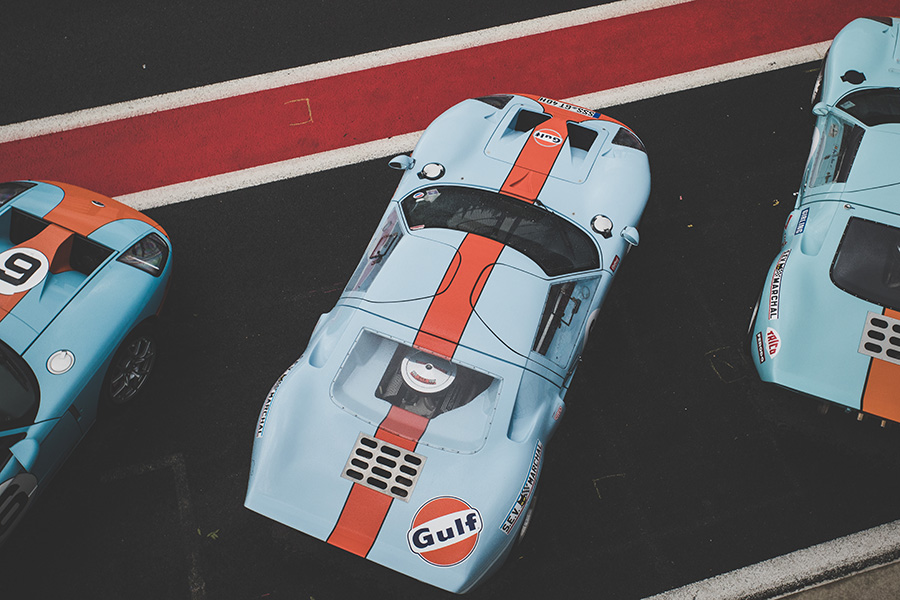
The Ford GT40 is not just a racing car — it is the revenge of a nation on the tracks of Le Mans, an act of mechanical courage immortalised in motorsport history. Photographed through an artist’s eye, it reveals contained power, a low and taut line that defies the wind, and a visual presence unlike any other.
Contents
- The Ford GT40: The American Challenge That Crushed Ferrari at Le Mans
- The Lens Before a Racing Legend
- Gulf or Red: Two Faces of a Photographic Icon
- Fine Art and Ford GT40 Photography: History Elevated
- Choosing and Gifting a Ford GT40 Photograph
The Ford GT40: The American Challenge That Crushed Ferrari at Le Mans
In 1963, Henry Ford II attempted to buy Ferrari. The failed negotiation inspired a stinging response: beat the Italians at their own game, at the 24 Hours of Le Mans. From this came the GT40 project — a car designed by and for victory, with British Lola engineering and the raw power of American Ford V8 engines. The “40” refers to its height in inches, barely more than a metre from the ground.
The machine took two years to find its rhythm but then dominated with unparalleled brutality: four consecutive victories at Le Mans from 1966 to 1969. In 1966, Ford achieved a historic 1-2-3 finish with three GT40s crossing the line together. These images are etched into the collective memory of motorsport — and it is precisely for this reason that a Ford GT40 photograph provokes such a particular emotion.
The Lens Before a Racing Legend
Photographing a Ford GT40 is a singular artistic challenge. The car is low, compact, almost flat against the road. Its plunging bonnet, lateral air intakes, and swollen rear haunches give an impression of density, of mass concentrated in motion. The fine art automotive photographer must find the angle that captures this tension — often at ground level, shooting upward, to convey the full menace of the machine.
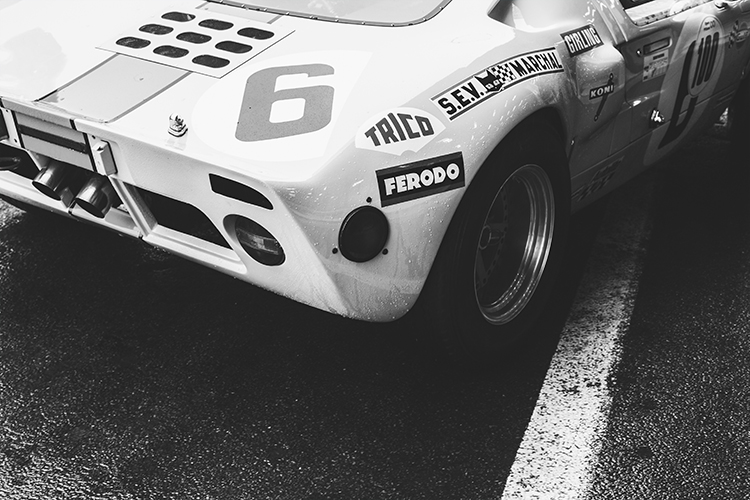
In black and white, the GT40 takes on an almost dramatic dimension. The shadow zones beneath the bodywork, the reflections on the lacquered flanks, the texture of the slick tyres: everything contributes to an image of rare intensity. In colour, it is the Gulf livery — light blue and orange — that dominates the imagination, to the point of becoming one of the most recognisable colour combinations in the world. A black and white Ford GT40 fine art print strips away all colour considerations to keep only the essentials: form, light, speed suspended in time.
Gulf or Red: Two Faces of a Photographic Icon
The Gulf livery of the GT40 is one of the most photographed in automotive history. Born of a partnership with Gulf Oil, the sky blue and mandarin orange combination dressed the championship-winning GT40s of 1968 and 1969. Captured as fine art, it offers an instantly identifiable colour palette, almost Pop Art in its vibrancy. The curves of the bodywork become surfaces of pure colour — an abstraction that seduces car enthusiasts and contemporary art collectors alike.
The red version, that of the early attempts from 1964 to 1966, embodies raw force and American ambition. More dramatic, more taut, it fits perfectly into an industrial or minimalist interior. A GT40 Gulf fine art print captures the blue and orange livery with extraordinary fidelity — the metallic substrate of Dibond aluminium entering into resonance with the car’s iconography to create an object of rare aesthetic power.
View the Collection →
Fine Art and Ford GT40 Photography: History Elevated
Fine art automotive photography transforms a competition vehicle into a contemplative object. With the Ford GT40, this process takes on a particular dimension: the car is already a living legend, charged with a narrative that goes beyond sporting results. Each photograph is an invitation to enter that narrative — to feel the heat of the 24 hours, the tension of the Gulf pits, the adrenaline of corners in the night rain.
Printed on Dibond aluminium, a Ford GT40 photograph captures the reflections of the bodywork with extraordinary fidelity. The metal of the support resonates with the mechanics of the subject — a subtle dialogue between form and material. On plexiglas, the depth of the image creates a window onto the track, an illusion of presence that stops visitors in their tracks. These numbered, certified prints are not simply decorations: they are artistic testimonies to a vanished era.
Choosing and Gifting a Ford GT40 Photograph
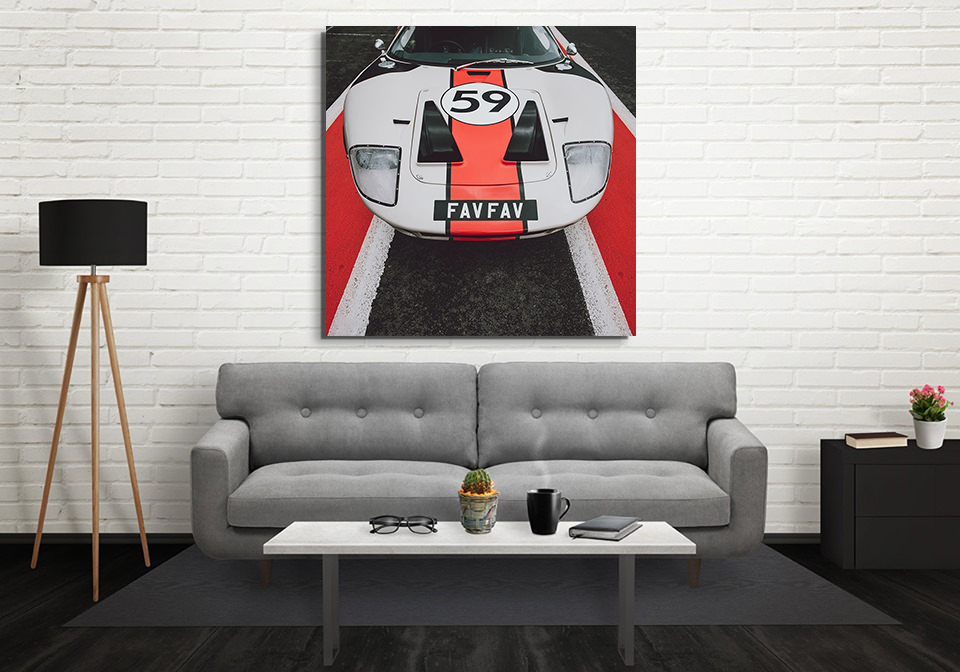
A fine art Ford GT40 photograph is the ideal gift for a classic car enthusiast, a motorsport history buff, or an automotive art collector. Formats adapt to any space: a discreet 40×27cm for a desk or bookshelf, an imposing 120×80cm for a living room or meeting room. Each print comes with a numbered certificate of authenticity.
Choosing between the different liveries is a question of atmosphere. The Gulf blue and orange brings warmth and vibrancy to a contemporary interior. The classic red asserts itself with authority in strongly characterised spaces. Black and white, universal and timeless, integrates elegantly anywhere. Whatever the choice, a Ford GT40 photograph permanently transforms the space it inhabits.
Why is the Ford GT40 so popular in fine art photography?
The Ford GT40 combines all the ingredients of an exceptional photographic subject: an ultra-low and recognisable silhouette, a powerful historical narrative (4 consecutive Le Mans victories), and iconic liveries such as the Gulf blue and orange. It provokes an immediate emotional response in car enthusiasts and motorsport history fans, making it one of the most sought-after cars for fine art printing.
Which livery should I choose for a Ford GT40 photograph?
The Gulf livery (sky blue and orange) is the most iconic and suits luminous contemporary interiors perfectly. Classic red suits spaces with strong character. Black and white is universal and timeless, ideal for integrating into any decorative style. Each version is available as a numbered print on aluminium, plexiglas or canvas.
Did the Ford GT40 really win Le Mans 4 times in a row?
Yes. The Ford GT40 won the 24 Hours of Le Mans four consecutive years: 1966, 1967, 1968 and 1969. In 1966, Ford achieved a historic 1-2-3 finish with three GT40s in the top three positions. GT40 chassis number 1075, winner in 1968 and 1969, is the only car to have won Le Mans twice under its own identity.