

Aluminium, plexiglass or canvas? There is no best finish, only the best finish for your wall and your light. We offer four: direct print on aluminium, real photo print on aluminium Dibond, photo print under plexiglass, and matte canvas. Here they are on four real walls, with prices at 90×60 cm, so you can choose with your eyes instead of a spec sheet.
The four finishes at a glance
Every photograph in the catalogue can be ordered in several finishes, and the price gap between them is wider than most people expect. The table below uses a single listing, the Porsche black and white classic duo, at 90×60 cm. The finishes on offer can vary slightly from one photograph to another, so always check the finish menu on the listing itself.
| Finish | What it is | Look and feel | Sizes on that listing | Price at 90×60 cm |
|---|---|---|---|---|
| Matte canvas | Print on matte canvas | Soft linen texture, no glare | 30×20 to 150×100 cm | €247 |
| Direct print on aluminium | Image printed straight onto the aluminium | Flat, graphic, slightly metallic surface | 60×40 to 180×120 cm | €397 |
| Real photo print on aluminium Dibond | Photographic paper mounted on a Dibond panel | Photographic depth, smooth colour gradients | 60×40 to 180×120 cm | €502 |
| Photo print under plexiglass | Photographic print behind a thick acrylic pane | Deep blacks, gallery shine, reflective | 60×40 to 180×120 cm | €680 |
Wall 1: direct print on aluminium, a series on a dark wall
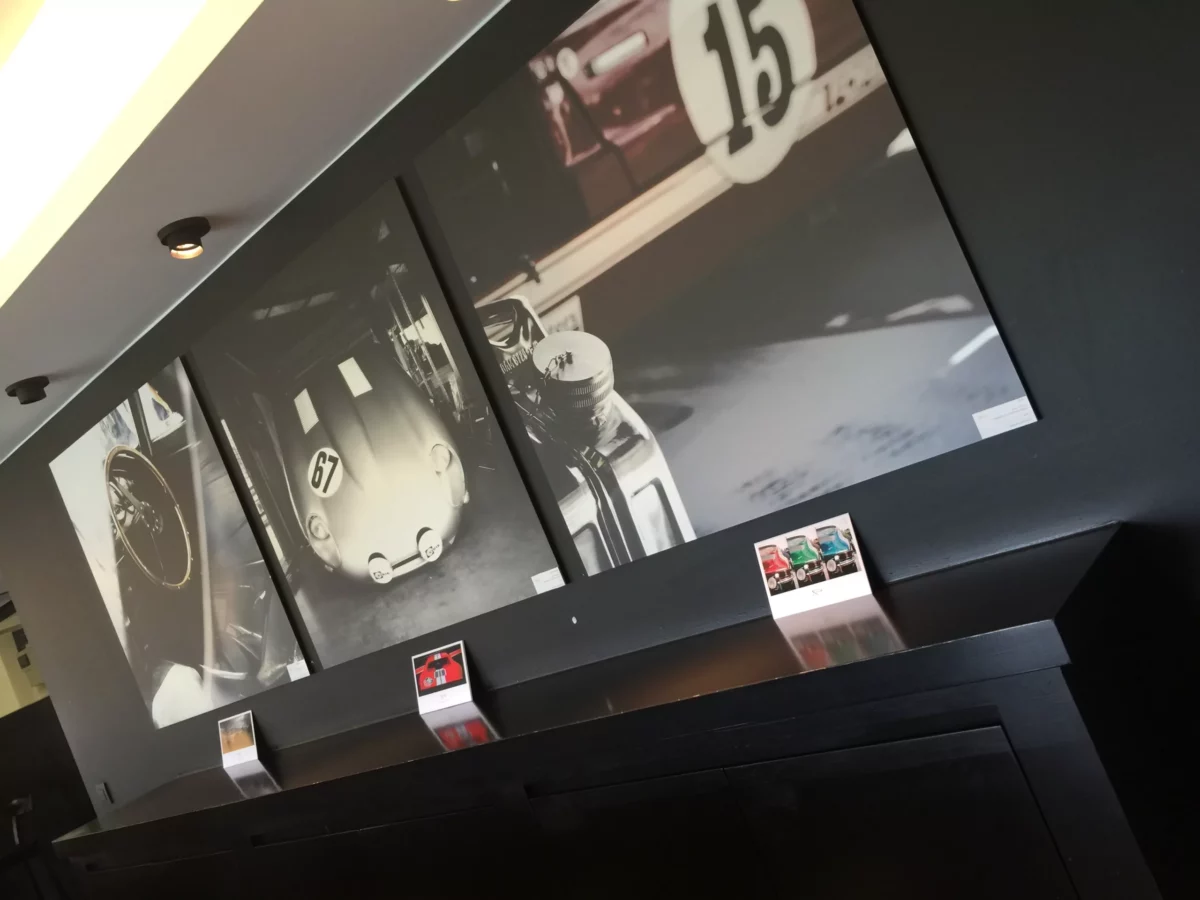
The first wall is a triptych in black and white on a dark wall, lit by ceiling spots. With a direct print the image goes straight onto the aluminium: no paper layer, no glass, just a flat metal surface that keeps the picture sharp right to the edges. The panel behind it is Dibond, two thin aluminium sheets (0.3 mm each) around a polyethylene core, which is why even large formats stay flat while remaining light.
Look at how calm the three panels are. Nothing competes with the photograph, and that is the strength of this finish: it disappears into the wall and lets the image do the talking. It suits series, offices, hallways and any room with downlights. At €397 for 90×60 cm it sits in the middle of the range, and it is the one we would pick if you want a modern, graphic result without paying for glass.
Wall 2: matte canvas, big, light and glare-free
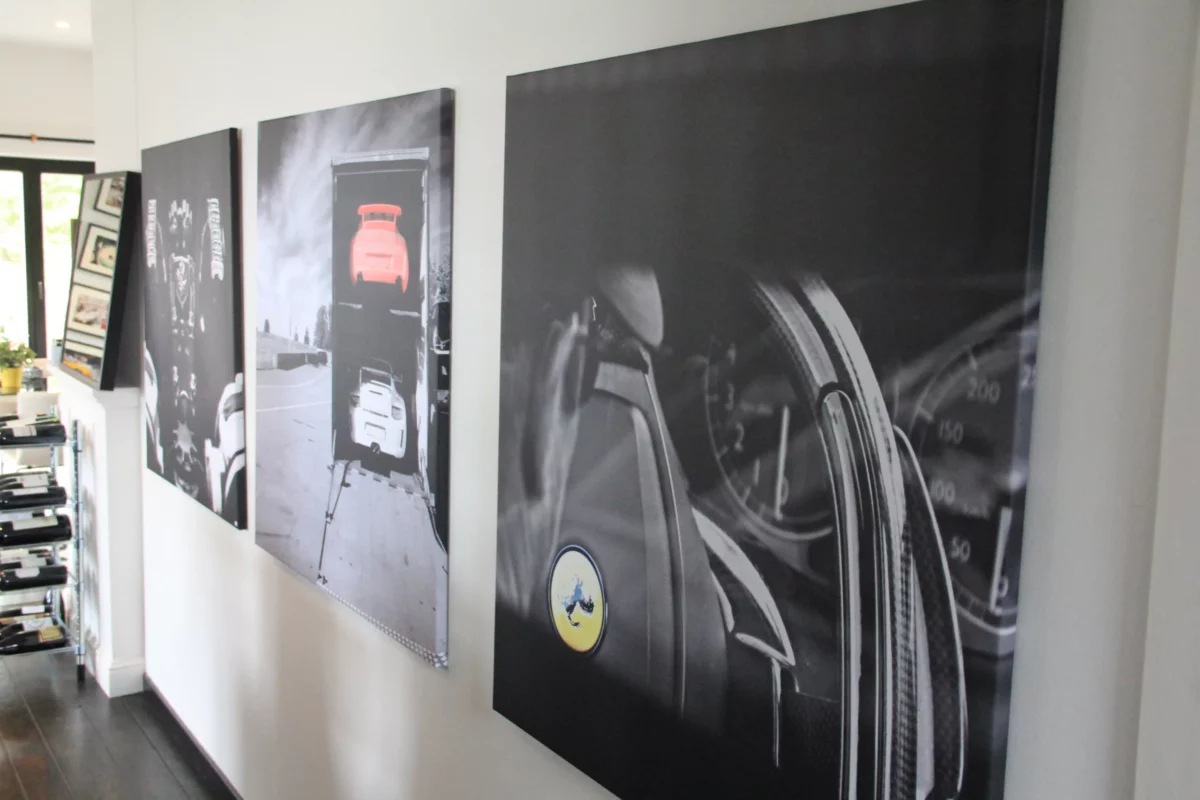
The second wall is a white hallway with three large canvases. The photo was taken at a steep angle, almost along the wall, with daylight coming from the end of the hallway, and there is not a single reflection on any of the three prints. That is the canvas advantage: a matte surface with a subtle linen texture, so light, whatever its direction, never fights the image.
Canvas is also the lightest and the most affordable finish: from €78 at 30×20 cm, €247 at 90×60 cm, and up to 150×100 cm on that listing. The trade-off is that the weave slightly softens the very finest details compared with a smooth surface, and there is no 180×120 cm canvas. For a bright room with big windows, a long corridor or a first purchase, it is a very safe choice.
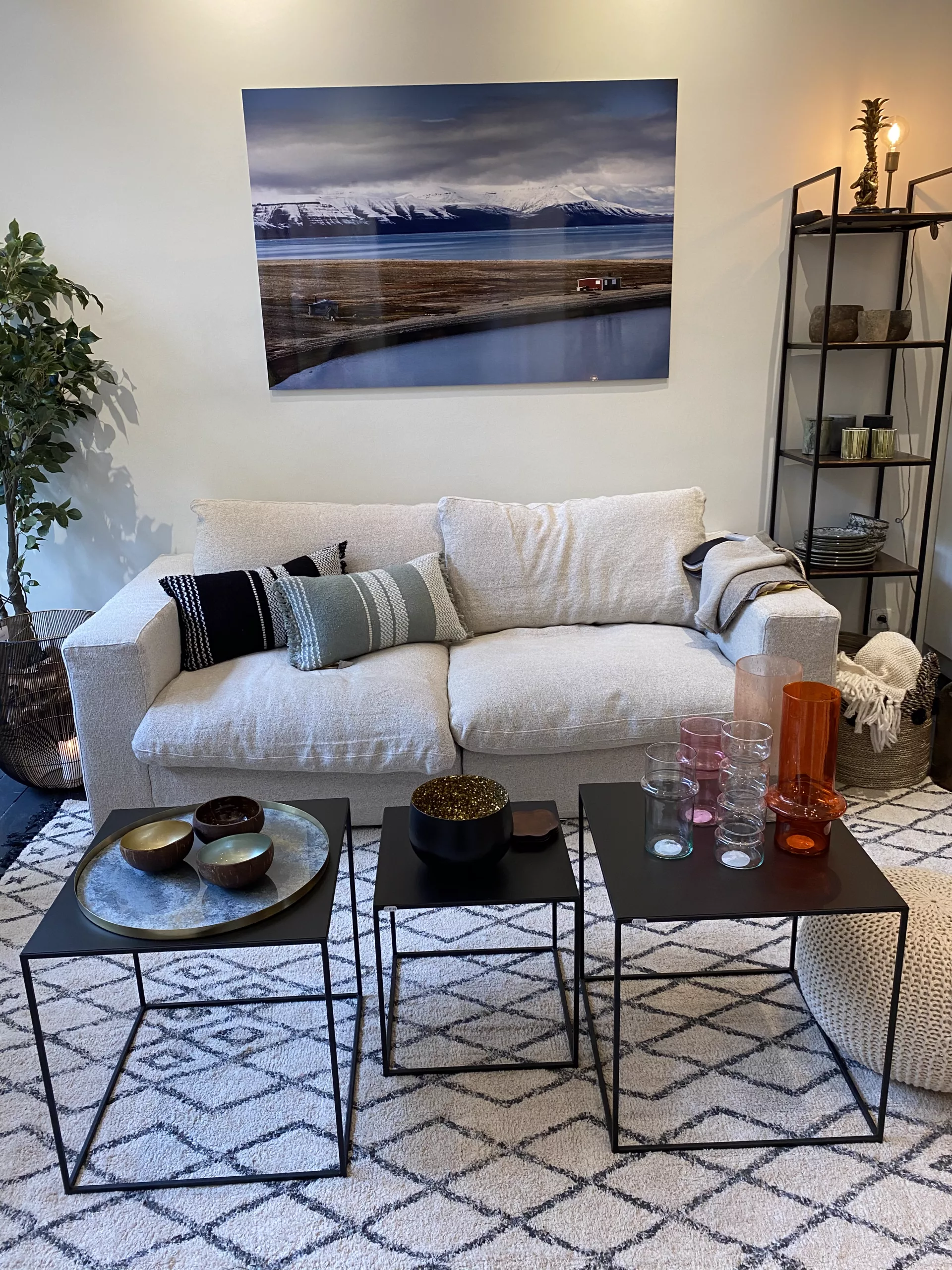
Wall 3: real photo print on Dibond, a landscape above the sofa
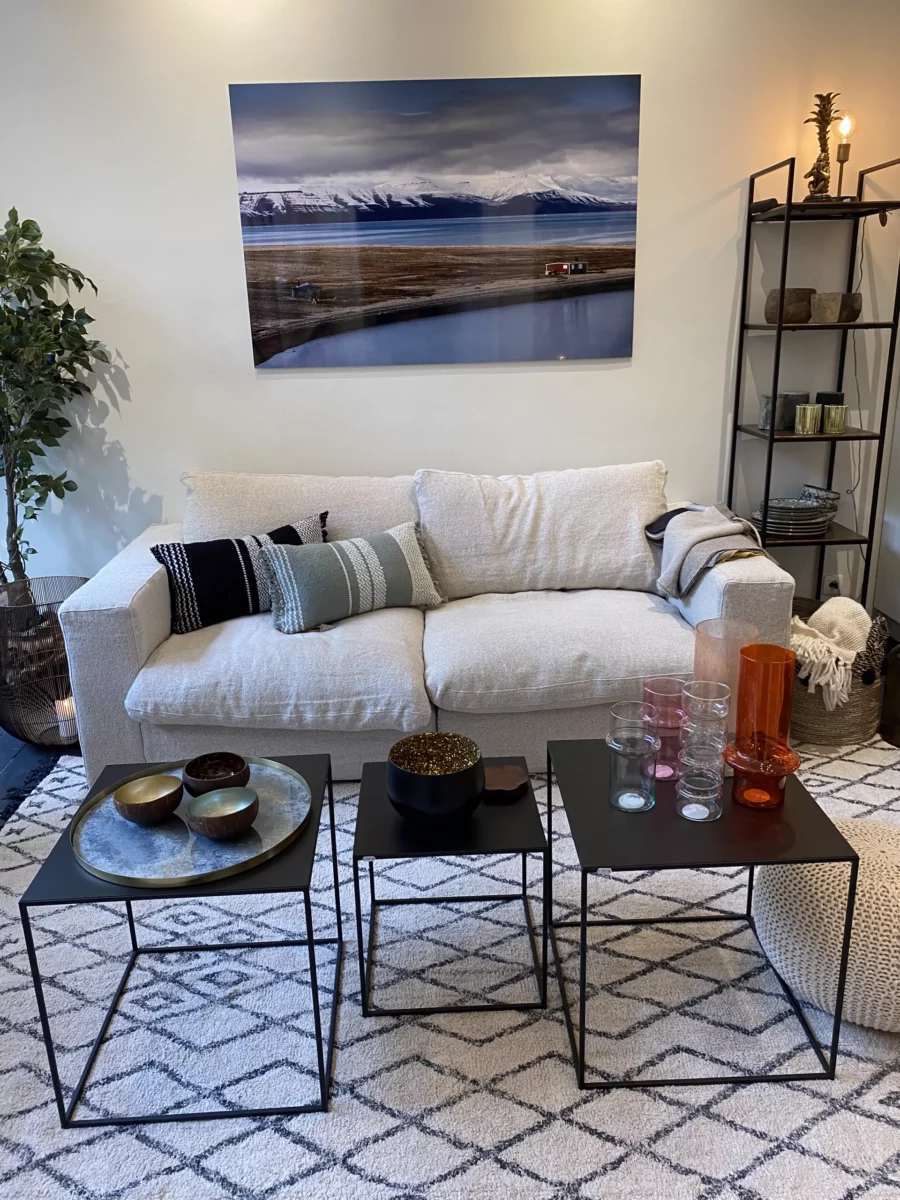
The third wall is a living room: a landscape of sea and snow-capped mountains above a cream sofa. This is a real photo print on Dibond. The photograph is developed on photographic paper (Fujiflex Crystal Archive) and then mounted on the aluminium panel, which gives it the depth and the smooth colour transitions of a true photographic print. Look at the sky sliding into the water: there is no visible grain and no texture between the eye and the picture.
The surface has a gentle sheen, a little more reflective than canvas and far less than glass. At €502 for 90×60 cm it costs more than a direct print, and you pay for that tonal richness, which matters most on colourful landscapes, skies and water. Over a sofa, hang it about 20 cm above the back and keep it a little narrower than the sofa, as in the photo.
Wall 4: plexiglass, the gallery look and the reflections that come with it
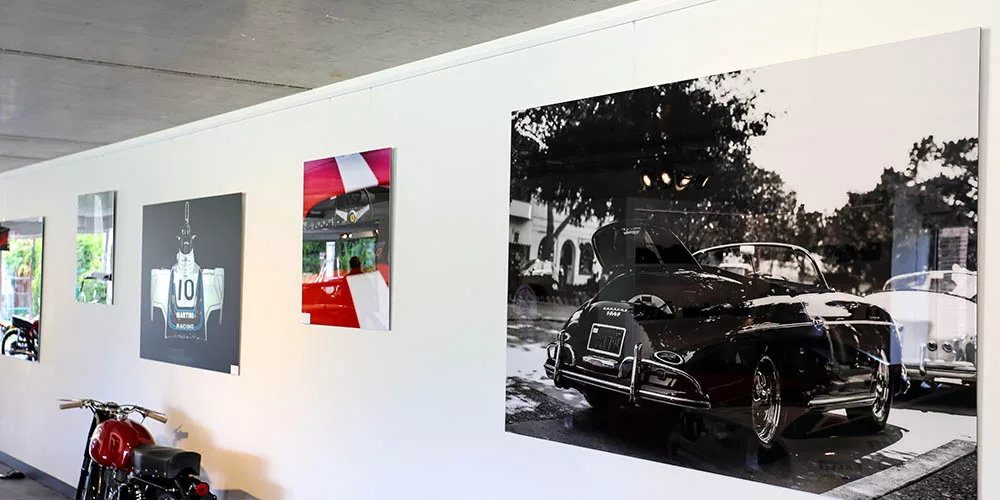
The fourth wall holds a large black and white photograph of a classic convertible, with smaller prints beside it. This is the plexiglass finish: a photographic print placed behind a thick, glossy acrylic pane. Blacks look deeper, whites brighter, and the image gains a depth that a flat surface cannot give. It is the finish that looks most like a piece bought in a gallery.
It also does what glass does: it reflects. On the right of the panel you can see the light and the surroundings mirrored in the pane. That is why placement matters. Avoid hanging it directly opposite a window or under a bare bright bulb, and prefer a wall at a right angle to the light. Plexiglass is the most expensive finish, €680 at 90×60 cm and €2,376 at 180×120 cm on that listing, and the acrylic is softer than real glass, so it scratches more easily. Clean it with a microfibre cloth only, as explained in our care guide.
Which finish for which wall?
Start from the room, not from the price. These rules cover most cases.
| Your situation | Our pick |
|---|---|
| Very bright room, big windows, light from several directions | Matte canvas or direct print on aluminium |
| Dark or moody wall, spotlights or lamps | Photo print under plexiglass, or real photo print on Dibond |
| Colourful landscape, sky or water | Real photo print on Dibond, or plexiglass |
| Black and white car portrait | Plexiglass for the deepest blacks, direct print on aluminium for a graphic look |
| Large format, 180×120 cm | Aluminium, Dibond or plexiglass (canvas stops at 150×100 cm on that listing) |
| First print or tight budget | Matte canvas, from €78 |
| A set of two or three prints | The same finish for all of them, and vary the sizes instead |
Four checks before you order
First, size: a print that is too small is the most common regret, so read our guide to choosing the right size before you pick a finish. Second, light: note where the windows and lamps are, and which wall faces them. Third, budget: the finish can double the price of the same photograph, so compare at your real size, not at 30×20 cm. Fourth, care: canvas and aluminium forgive a lot, plexiglass asks for a microfibre cloth and a little attention. If you hesitate between two finishes, our comparison of fine art prints and posters and the guide to aluminium Dibond go further on materials.
Frequently asked questions
Which finish reflects the least light?
Matte canvas reflects the least, and it is the safest choice for a bright room. Direct print on aluminium comes next. Real photo print on Dibond has a soft sheen, and plexiglass is the most reflective because of its glossy acrylic pane. Where the light comes from matters as much as the finish.
What is the difference between direct print and real photo print on Dibond?
With a direct print the ink goes straight onto the aluminium, giving a flat, graphic look. With a real photo print, photographic paper is mounted on the Dibond panel, which gives smoother tonal gradients and more photographic depth. It costs more: €502 against €397 at 90×60 cm on the listing used above.
Is plexiglass worth the extra cost?
If the photograph has deep blacks or strong contrast, and you can place it away from direct light, yes: the depth is real. If your wall faces a large window, or you want an easy-care piece, aluminium or canvas will give you more pleasure for less money.
Can I mix finishes in one room?
You can, but a set of prints that hang together looks calmer in one finish. If you want variety, vary the sizes and the photographs rather than the materials. Different finishes in different rooms is not a problem at all.
How do I clean each finish?
Use a dry or very slightly damp microfibre cloth on all of them, wiping in one direction. Never use paper towels on plexiglass, and avoid solvents. The full routine for each material is in the care guide.
Read next
- How to Care for Your Fine Art Print: Aluminium, Plexiglas & Canvas
- Car photography on aluminium Dibond: the guide
- Behind the Print #3: Unboxing a Large Acrylic Glass Print (180×120 cm)
- How to match a car print to your interior palette
Ready to choose? See the Porsche black and white classic duo or the Ferrari 275 GTS dashboard print, or browse the limited edition collection. Unsure about your wall? Write to info@carsandroses.com with a photo of it and we will tell you which finish we would choose.