

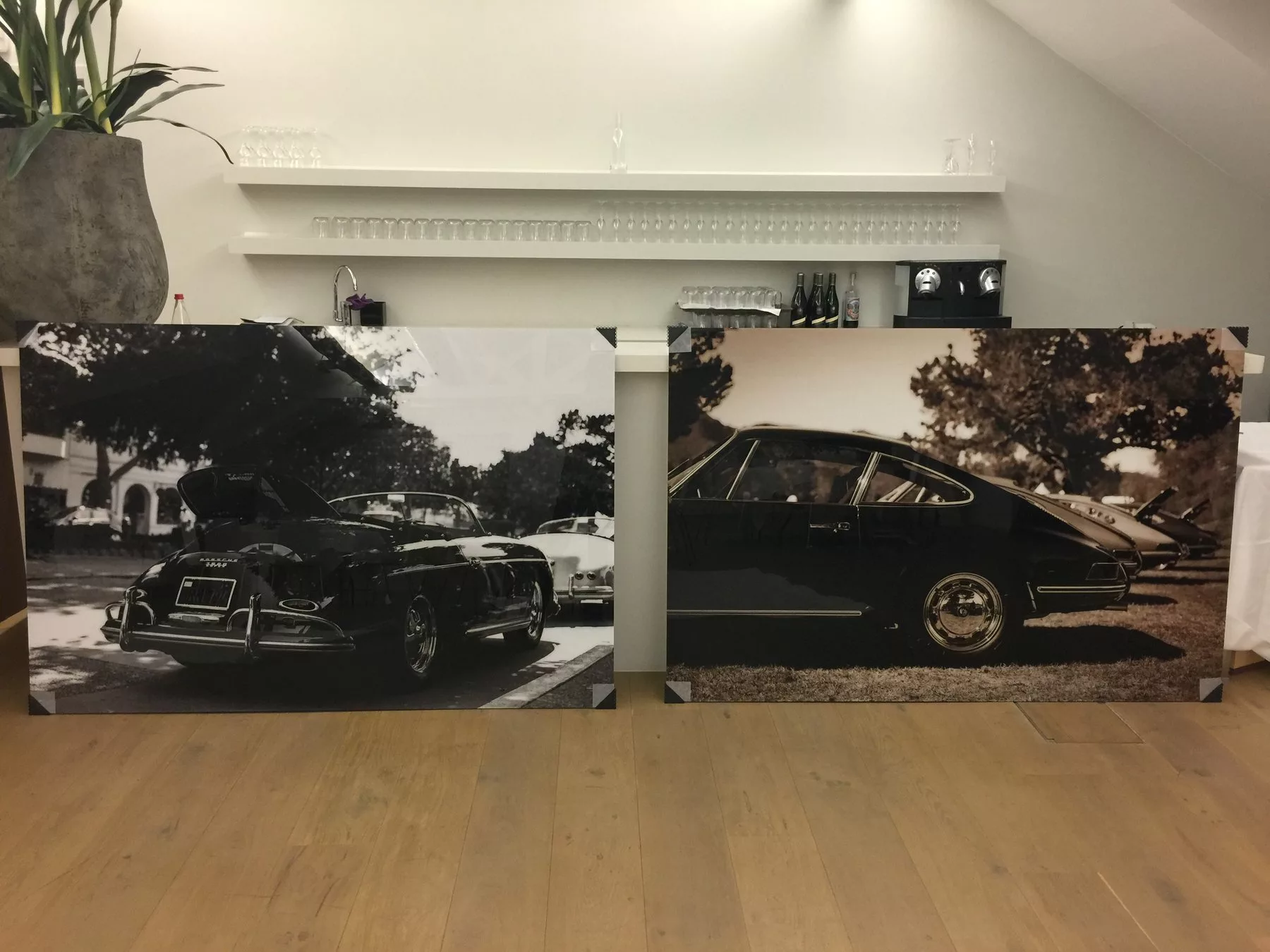
Two prints, 180 × 120 cm each, just out of their boxes. A large acrylic glass print sits at the top of our size range, so this is the moment I wanted to show you. Here is what arrives, how it is protected, and how these fine art prints look on a real wall. Both belong to numbered editions.
What is on the floor
On the left is “Carmel 356”, a black and white photograph of two Porsche 356s that we saw in Carmel, California. Indeed, I chose black and white to give these old cars their soul back. On the right is “Sepia Porsche Classic Row”: a line of Porsche 911s at a show on a golf course. At first, the original was in colour. However, sepia felt more authentic, so that is the version we print.
I had already removed the protective paper and the cardboard when I took this photo. Therefore, only the small plastic corner protectors are still in place. I leave them on until the print is on the wall. Corners are the most exposed part of a big print, so they deserve this extra care.
How a large print travels
A print this size needs more than a box. Each order ships in premium packaging with reinforced protection. Moreover, UPS, DHL or FedEx handle the delivery. Finally, if something arrives damaged, we replace it free of charge. Our shipping guide explains packaging, customs and insurance in detail.
Why a large acrylic glass print at this size
Both photographs here are acrylic glass. First, we print the image on photo paper. Then a glossy 2 mm sheet of acrylic glass seals it, on a rigid aluminium Dibond back panel. As a result, the blacks look deep and the contrast stays strong, which suits a big format.
Glossy also means reflections. Look at the red print in the next photo: it picks up the room around it. For this reason, I suggest a wall that does not face a bright window.
On a client’s wall
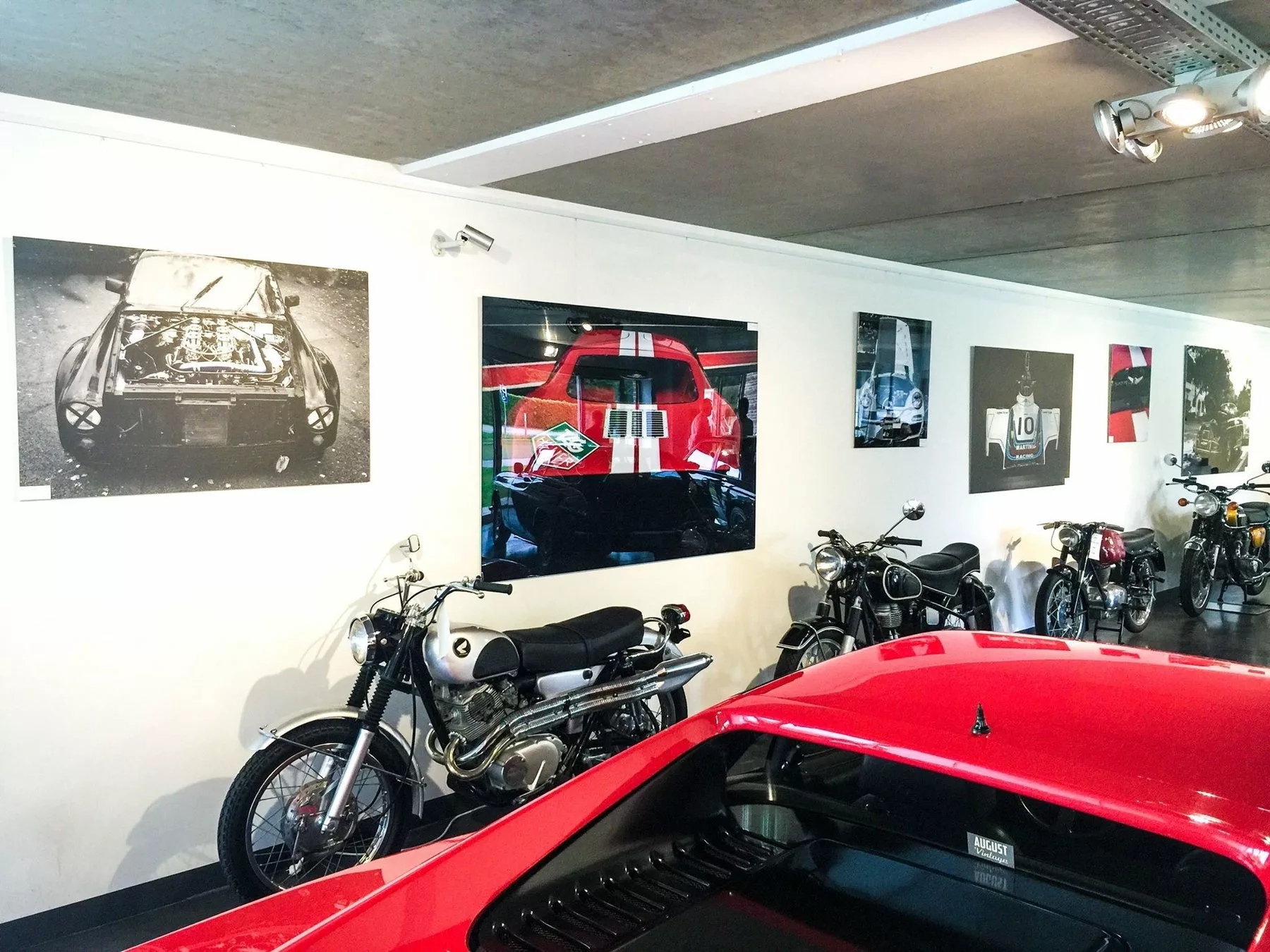
This wall is in a client’s garage, next to vintage motorcycles and a red sports car. The prints mix three finishes: aluminium, one brushed aluminium, and acrylic glass for the rest. By contrast, there is no canvas on this wall.
Mixing finishes works because each one reacts to light in its own way. Acrylic glass is glossy and deep. Aluminium with direct printing, on the other hand, is more matte and calmer. To see more real installations, visit our prints in our clients’ homes.
A close look at brushed aluminium
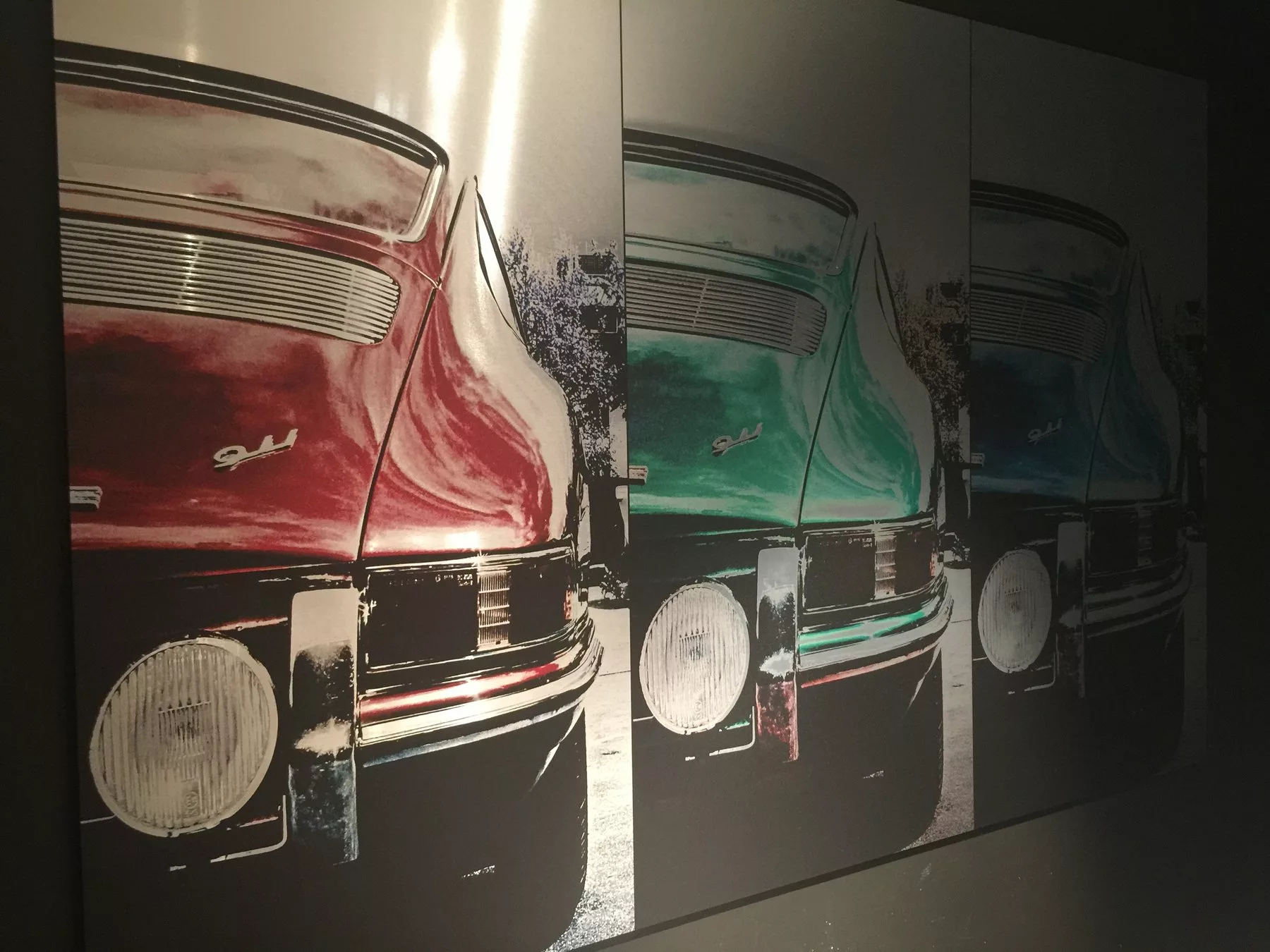
Here is a brushed aluminium print up close. The metal shows through the lighter tones. Thus, the image gets a soft shimmer that paper cannot give. This finish works very well for black and white. It also shines on bold graphic series in colour, like these three panels of a Porsche 911 seen from behind, in red, green and blue.
How to unbox a large print, step by step
Here is the routine I recommend for a format like this one.
- First, clear the floor and stand the print upright against a stable wall.
- Next, remove the cardboard and the protective paper slowly.
- Then keep the corner protectors on until the print is hung.
- Also, hold the print by its edges, ideally with two people at this size.
- Finally, wipe the surface with a clean microfibre cloth. Our care guide explains which products to avoid.
Read next
- Behind the Print #1: from scouting to aluminium
- Behind the Print #2: the story of our best-selling photograph
- Car photography on aluminium Dibond
- How to choose the right size for your photo print
Frequently asked questions
How is a large print protected in transit?
Each order ships in premium packaging with reinforced protection, and the corners carry plastic protectors. UPS, DHL or FedEx handle the delivery. In addition, if the print arrives damaged, we replace it free of charge. Our shipping guide details timing and insurance.
Are 180 × 120 cm prints limited editions?
Yes, when they are on acrylic glass or aluminium. We limit each car photograph to 200 numbered and signed prints, with a certificate of authenticity. However, canvas is not part of the limited edition. Our guide explains why limited editions can gain value.
When should I remove the corner protectors?
I keep them on until the print is hung. Corners are the most fragile part of a large format, especially while you move it. Then, once it is on the wall, remove them gently without pulling on the corner, and wipe the surface with a clean microfibre cloth.
Acrylic glass or aluminium for a large format?
Acrylic glass brings depth and gloss, with reflections. Aluminium, in contrast, is more matte and reflects less. Therefore, think about the light on your wall before you choose. Our guides compare both supports in detail, and you can mix them on the same wall.