

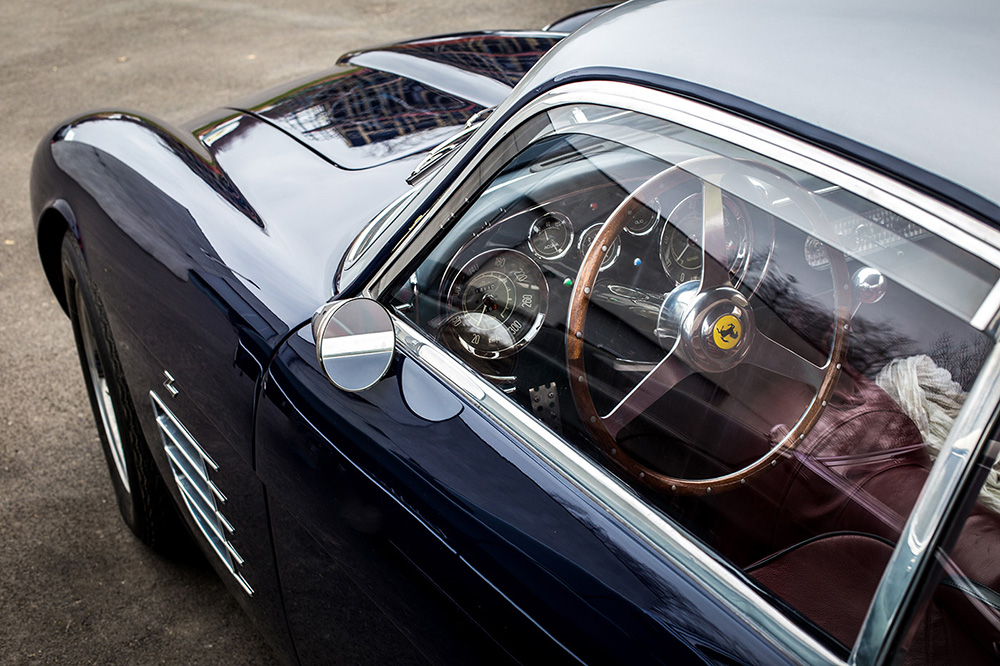
Most car photography chases the exterior — the silhouette, the paint, the stance on the road. But open the door, and a whole other world of craftsmanship appears: machined aluminium, hand-stitched leather, period typography on a gauge cluster. This guide looks at why the interior — the steering wheel, the dashboard, the cockpit — deserves its own place on the wall, not just a footnote to the full car.
In This Guide
- Why Photograph a Car’s Interior?
- Steering Wheels as Sculpture
- Dashboards & Cockpits
- The Aston Martin DB Thread: DB2, DB3, DB5
- Materials That Do Justice to Fine Detail
- Styling: Pairing a Detail Print with the Full Car
- FAQ
Why Photograph a Car’s Interior?
A full car in a photograph is, by necessity, a compromise — the lens has to step back far enough to fit the whole silhouette, which means the details shrink to a suggestion. Step inside instead, and those same details become the entire frame: the grain of a wood-rimmed wheel, the wear pattern on a leather seat bolster, the exact typography Porsche or Ferrari chose for a speedometer sixty years ago. These are objects designed by hand, in an era when a dashboard was as much a piece of furniture as a piece of engineering — which is exactly why they hold up as fine art on their own.
Steering Wheels as Sculpture
Isolated from the rest of the car, a steering wheel reads less like an interior fitting and more like a small sculpture — three spokes, a horn button, a rim shaped by decades of a driver’s hands. Our Porsche 911 steering wheel print is one of the most requested pieces in this category for exactly that reason.
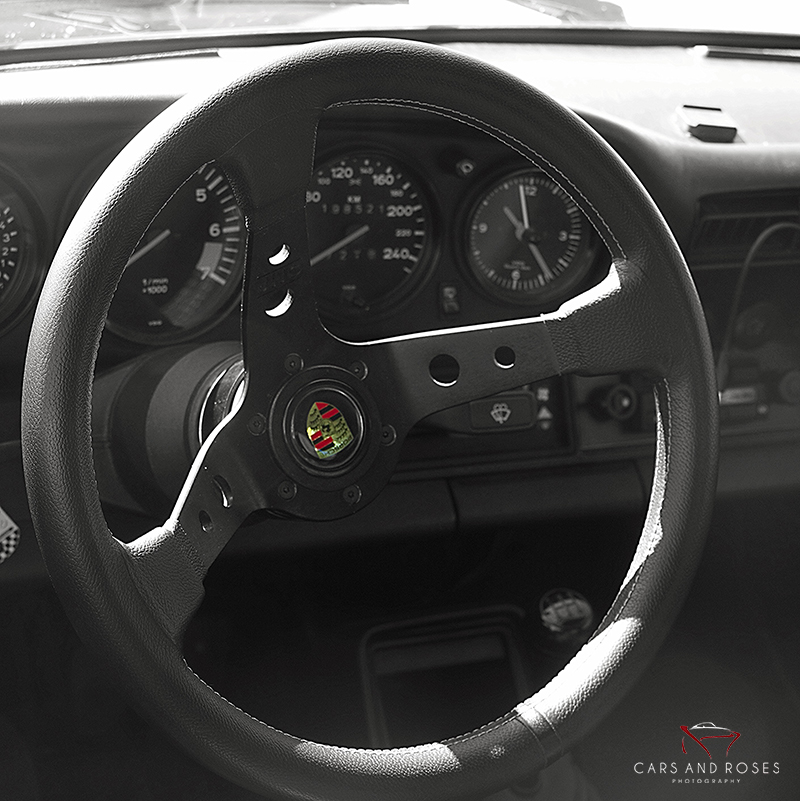
The same principle applies across marques. The Mercedes 300 SL steering wheel carries the elegance of the Gullwing era in its thin ivory-toned rim; the Ferrari 250 GT steering wheel pairs a wood rim with the Cavallino Rampante on the boss; and the Aston Martin DB5 steering wheel — yes, the car James Bond drove — has its own quiet mystique even without the rest of the cockpit in frame.
Dashboards & Cockpits
A dashboard print widens the frame just slightly — enough to catch the gauge cluster, the switchgear, sometimes a sliver of the seat — without losing the intimacy of a detail shot. Our Ferrari 250 GT Zagato interior is a good example: instruments, wood rim and stitched leather all in one composition, still unmistakably a detail piece rather than a full-car shot.
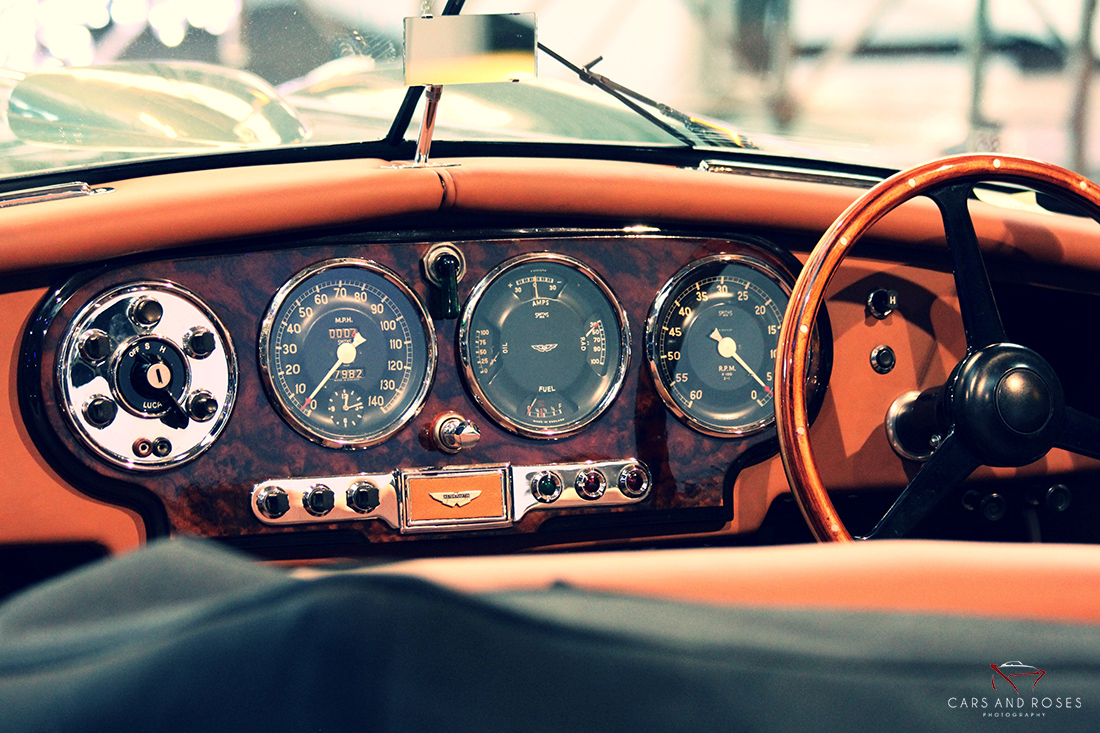
The Aston Martin DB2 interior pictured above leans further into the cockpit as a whole scene, while a piece like the Ferrari 275 GTS dashboard stays tightly framed on the instruments alone — two different ways of telling the same kind of story.
The Aston Martin DB Thread: DB2, DB3, DB5
Aston Martin’s interiors happen to be some of the richest in our catalogue, spanning three generations of the DB line. The DB2 interior shows the postwar grand tourer at its most restrained; the DB3 interior in black and white strips the cockpit down to pure form and shadow; and the DB5 steering wheel closes the arc with the model that needs no introduction. Hung together as a triptych, the three pieces read as a short visual history of British grand touring — proof that an interior series can carry a room just as well as three shots of the cars themselves.
Materials That Do Justice to Fine Detail
Detail photography rewards a finish that can hold sharp micro-contrast — the grain of leather, the machining marks on a metal spoke. Aluminium (Dibond) is usually the strongest choice here: it sharpens texture and gives chrome and brushed metal a cool, gallery-clean edge. A matte fine-art paper in a frame suits warmer subjects — a wood-rimmed wheel, aged leather — better than a glossy finish would. For the full comparison of aluminium, plexiglas and canvas, see our guide to caring for fine art prints.
Styling: Pairing a Detail Print with the Full Car
Because an interior or steering wheel print is already a close-up, it doesn’t need to dominate a wall the way a full-car photograph often does — which makes it an easy piece to pair. A wide exterior shot of a model next to its own steering wheel or dashboard detail creates a small diptych that tells a fuller story than either image alone, and works particularly well in a compact gallery wall of two or three frames. See our minimalist decor guide for how to keep that kind of pairing restrained rather than busy.
FAQ
Why buy a photo of a steering wheel instead of the whole car?
A steering wheel or dashboard print isolates the craftsmanship — the machined metal, the patina on original leather, the typography of a period gauge cluster — the details a full-car photo compresses into the background. It reads as a more intimate, gallery-scaled piece, especially paired with a full exterior shot of the same model.
What size works best for a steering wheel or interior print?
Because the subject is already a close-up, these prints read well at smaller formats than a full-car photograph — 30×20cm to 50×70cm on aluminium or framed paper suits most walls, though a XXL canvas like the Aston Martin DB2 interior can anchor a room on its own.
Can I mix an interior print with an exterior shot of the same car?
Yes — it’s one of the most requested pairings. A wide exterior shot alongside its own steering wheel or dashboard detail creates a diptych that tells a fuller story of the car, and works particularly well in a small gallery wall of two or three pieces.
Which finish suits macro/detail photography best?
Aluminium (Dibond) sharpens metal and leather texture with a slight cool cast that flatters chrome and machined parts; a matte fine-art paper in a frame suits warmer materials like patinated leather or wood-rimmed wheels. See our full materials guide for the complete comparison.