

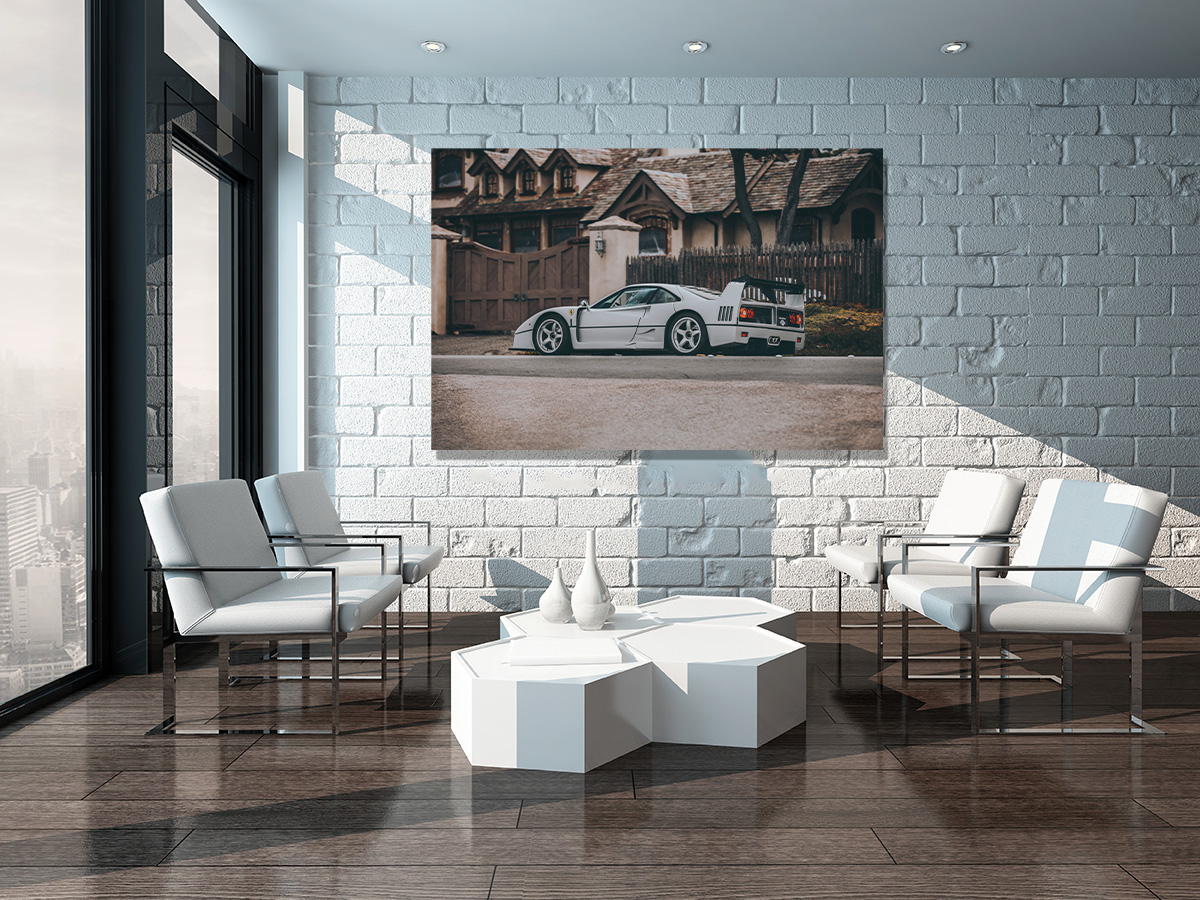
Among all fine art printing materials, aluminium Dibond has established itself as the reference choice for car photography enthusiasts. Its metallic surface, rigidity and unmatched aesthetic make it far more than a simple frame — it is a work of art in its own right that transforms any room into a private gallery.
Contents
1. What is aluminium Dibond?
2. Why car enthusiasts choose Dibond
3. Dibond vs canvas vs acrylic: the comparison
4. Integrating an aluminium print into your interior
5. Available sizes: from 40×27 to 180×120 cm
What is aluminium Dibond and how is it made?
Aluminium Dibond is a composite material consisting of two thin aluminium sheets (0.3 mm each) thermally bonded to a polyethylene core. This metal sandwich provides exceptional rigidity at a remarkably low weight — ideal for large formats that never warp over time.
The photographic print is produced directly on the aluminium surface, or on Fujiflex Crystal Archive photographic paper before being face-mounted onto the Dibond. At Cars and Roses, every print is produced by Whitewall laboratories — a world reference in fine art printing — using chromogenic inks guaranteed for 100 years without colour deterioration.
The result is a perfectly flat surface, free of canvas grain or texture, that renders every detail of the photograph with absolute fidelity — the curve of a bonnet, the reflection of a headlight, the texture of a tyre. For fine art car photography, it is the support that best captures the mechanical precision of the subject.

Why car enthusiasts choose aluminium Dibond
Fine art car photography is a demanding discipline. The pure lines of a Porsche 911, the sculpted bodywork of a Ferrari F40, the shining chrome of a Jaguar E-Type — all these details deserve a support that does them justice. Aluminium Dibond delivers in several key ways.
Depth of blacks and colour brilliance are significantly superior to canvas printing. Dibond achieves a higher optical density, resulting in stronger contrasts and particularly striking metallic tones — a decisive advantage when photographing lacquered or chrome bodywork.
Durability over time is another compelling argument. Unlike canvas, which can sag or yellow over the years, Dibond does not warp, is unaffected by humidity and resists UV rays. A well-maintained aluminium print is a work of art for generations to come.
Contemporary and minimalist aesthetics make Dibond perfectly suited to modern interiors. Mounted without a frame using a hidden wall fixing system, the print literally floats in space — a gallery effect that few other supports can match.
Aluminium Dibond vs canvas vs acrylic: the comparison
Choosing your support means choosing the style of your décor. Here are the essential differences between the three supports offered by Cars and Roses.
Aluminium Dibond offers maximum photographic accuracy, a contemporary and clean look, and unmatched durability. It is the choice of collectors and purists who want an uncompromising work of art. Its matte or satin surface eliminates unwanted reflections even under direct lighting.
Canvas on stretcher bars brings a warmth and texture reminiscent of traditional painting. It integrates naturally into classic, period or vintage interiors. Less precise in rendering fine detail, it compensates with a painterly presence that Dibond cannot replicate.
Acrylic (plexiglass) takes luminosity to the extreme. The photograph is face-mounted behind a PMMA panel that magnifies it with spectacular depth and brilliance. Ideal for night photography, luminous atmospheres or prestige spaces, it represents the most luxurious expression of photographic printing.

Integrating an aluminium car print into your interior
A Dibond print is understated and versatile. It integrates into virtually all contemporary decorative styles — Scandinavian minimalist, industrial loft, modern luxury or classic contemporary. A few principles help maximise the visual impact of your work.
Location is everything. A bare wall, ideally without an adjacent window to avoid light contrasts, showcases the print without competing with it. The ideal height places the centre of the image at eye level (approximately 160 cm from the floor). For large formats (120×80 cm and above), the main wall of a living room or dining room is the natural setting.
Wall colour plays a key role. A white or light grey background amplifies the impact of vivid colours — a red Ferrari or yellow Porsche stands out with striking energy. A dark background (charcoal, bottle green) creates a more intimate, enveloping atmosphere, particularly well suited to black-and-white photography or metallic tones.
Directional lighting is the Dibond print’s best ally. Unlike acrylic, matte or satin Dibond does not catch the light — a ceiling spotlight angled slightly off-axis illuminates the details of the photograph without glare. A picture rail or dedicated wall light transforms your print into a true museum-quality display.
Available sizes: from 40×27 cm to 180×120 cm
Cars and Roses offers its car photography on aluminium Dibond in a complete range of sizes suited to any space. From 40×27 cm for a refined display on a desk or shelf, up to 180×120 cm for architectural impact in a large living room or professional space.
The intermediate formats — 75×50, 90×60, 105×70 and 120×80 cm — are the most popular for standard living room walls (2.5 to 3.5 m wide). The 90×60 cm format is often the best balance between visual presence and harmonious integration. For enthusiasts wishing to create a gallery wall, combining two or three different sizes creates a dynamic and personal composition.
Each print is delivered with an invisible mounting system (aluminium rails or tensioned cable) enabling simple, professional installation. Cars and Roses prints are numbered, signed and accompanied by a certificate of authenticity — essential criteria for any work intended to gain value over time.
FAQ — Aluminium Dibond and car photography
What is the difference between aluminium Dibond and brushed aluminium?
Brushed aluminium is a surface finish (polished metal effect with parallel striations) applied to a Dibond substrate. Dibond refers to the composite material itself. At Cars and Roses, both are available: standard Dibond for a neutral photographic surface, brushed aluminium for an industrial and luxurious effect that is particularly striking on automotive subjects.
Is aluminium Dibond suitable for a bathroom or kitchen?
Yes — and this is one of its major advantages. Aluminium Dibond is unaffected by humidity and temperature variations, making it an ideal support for wet rooms. Simply wipe with a lightly damp microfibre cloth to clean it.
How is an aluminium Dibond print mounted on the wall?
Every Cars and Roses print is delivered with an appropriate mounting system: aluminium rails for large formats or a cable suspension system for medium sizes. Installation requires only a level, a pencil and a wall plug — the print then clips onto the rails with no visible fixings.
Are colours more vivid on aluminium than on canvas?
Yes, significantly. The smooth surface of aluminium Dibond allows a higher optical density than canvas. Blacks are deeper, whites are brighter, and the metallic tones so prevalent in car photography are rendered with a precision and brilliance that canvas simply cannot match.
What guarantee comes with a Cars and Roses aluminium Dibond print?
All our prints are produced with chromogenic inks guaranteed for 100 years by Whitewall laboratories. Each work is delivered with a numbered certificate of authenticity. In the event of any problem upon delivery, Cars and Roses will replace the print at no additional cost.