

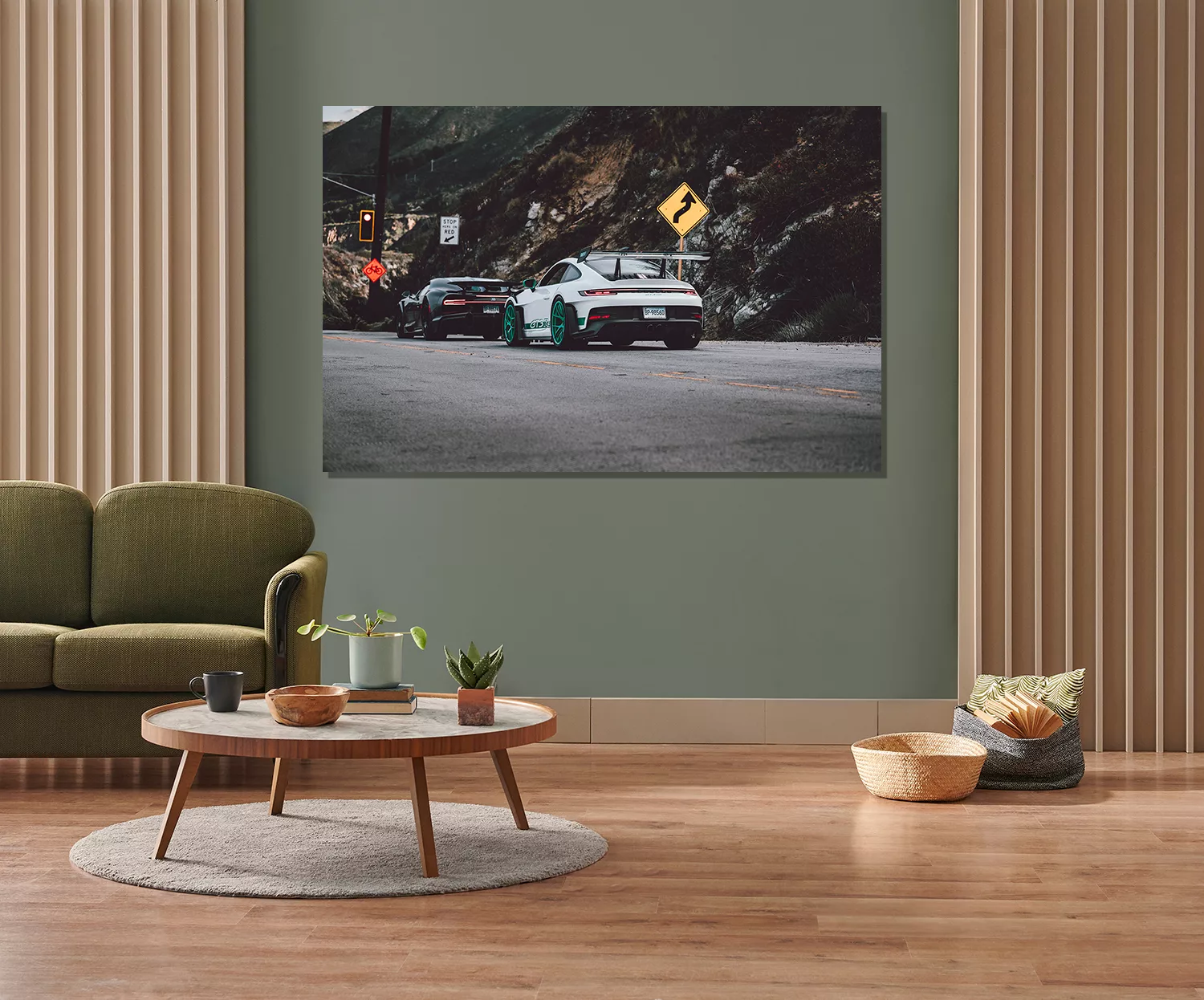
Choosing car wall art for your home goes far beyond picking an image of a car and hanging it up. It is about making a statement, telling a story, and turning an ordinary space into something genuinely memorable. The trick is knowing what to look for — and, above all, how to choose well.
Contents: Why modern car art · Choosing your style · Size and placement · Photography vs poster vs painting · Limited edition vs reproduction
Why choose modern car wall art for your interior?
The automotive wall art market has transformed dramatically in recent years. Far from the garage posters of the 1980s, modern car prints are fully realised works: composed with care, lit with precision, and printed large-format on premium substrates. They hold their own in contemporary apartments, design offices, and prestige spaces.
A well-chosen piece of car wall art does far more than decorate: it creates an immediate focal point, reveals the personality of its owner, and starts a conversation. A classic Porsche 911 in black and white above an anthracite sofa is a choice that does not go unnoticed. A Ferrari captured mid-acceleration in an office corridor is a statement.
Contemporary automotive photography has reached an artistic level that genuinely rivals painting. Photographers who work with Cars and Roses chase perfect light, ideal composition, and the moment that reveals a machine’s soul. The result, printed large-format on fine art paper or aluminium, produces a piece that is simultaneously collectible and genuinely beautiful.
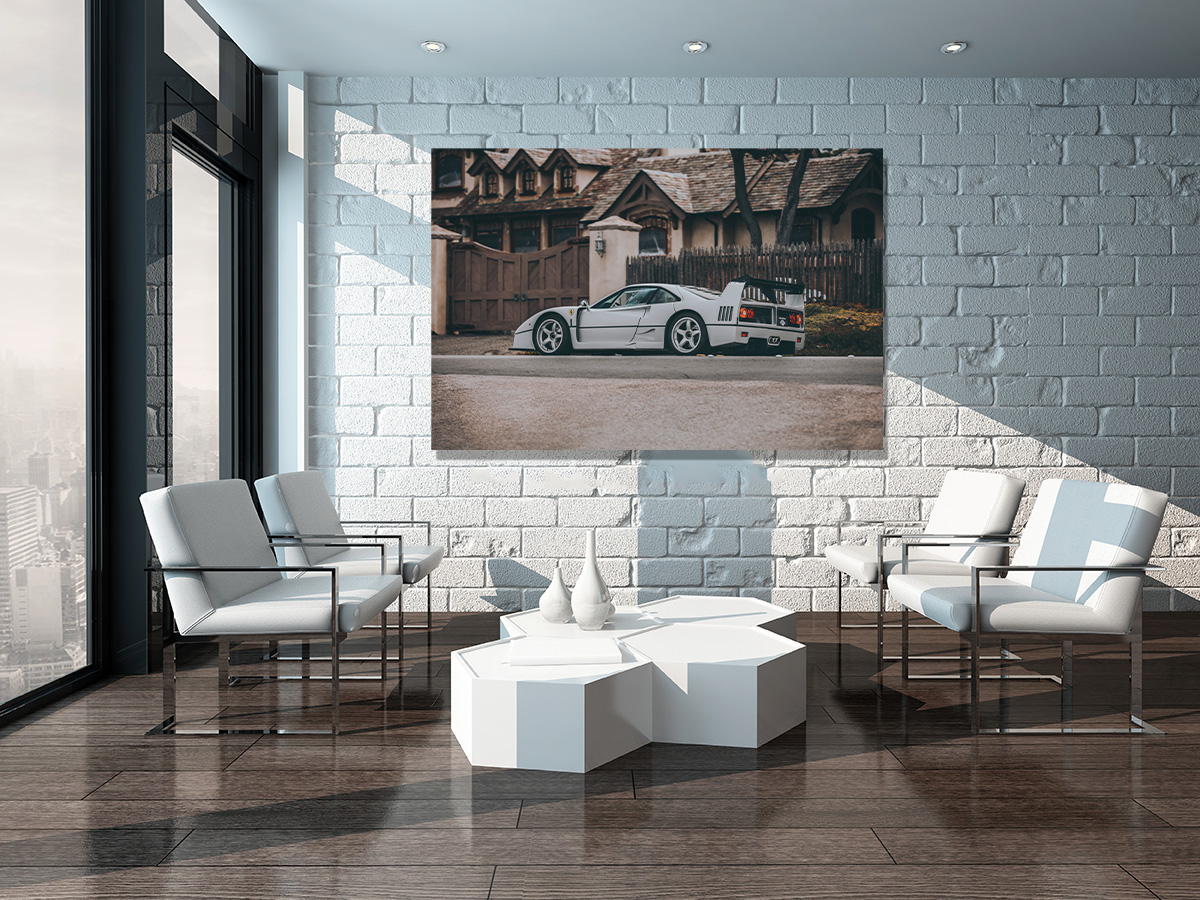
What style of car art to choose?
The first question is about your interior’s overall style. A piece of car wall art does not float in a vacuum — it is in constant dialogue with the rest of the room.
Contemporary minimalist interiors: go for black and white. A Porsche 911 or classic Ferrari photographed in high-contrast monochrome integrates perfectly into a clean, pared-back space. Removing colour eliminates any risk of chromatic conflict and gives the image a timeless, artistic quality.
Industrial or loft interiors: dark compositions with black or deep navy backgrounds work exceptionally well. A racing car photographed at night, or a silhouette in contre-jour against a concrete backdrop, creates the kind of visual tension that suits these spaces perfectly.
Classic or prestige interiors: colour photographs of iconic gran turismo cars — an Aston Martin DB5, a Jaguar E-Type, a Ferrari 250 GT — bring a natural elegance. Warm tones and late-day light pair naturally with wood, leather, and champagne tones.
Office or professional space: panoramic formats and clean compositions are preferable. A large horizontal print of a racing car in full action, or a stripped-back close-up of a bodyline, serves as both décor and visual motivation.
Size and placement: where to hang car wall art?
Size is consistently underestimated when choosing car wall art. An automotive photograph needs space to breathe and reveal its detail. A print that is too small loses the essential impact that makes it worthwhile.
The living room is naturally the most impactful placement. The wall behind the sofa is classic but effective: a 32×24 in or 40×28 in print commands the space without overwhelming it. For a genuinely strong statement, a 48×32 in or panoramic 48×20 in format turns the wall into something extraordinary.
The entrance hallway deserves serious thought. It is the first space perceived — and therefore the most memorable. A vertical 20×28 in or square 24×24 in composition of a car in close-up works beautifully here.
The office can accommodate smaller formats — 16×20 in or 20×28 in — that remain visible without dominating the working space. For large offices or meeting rooms, a 32×24 in or larger is appropriate.
On hanging height: the universal rule applies — visual centre of the image at approximately 57-60 inches (145-155 cm) from the floor. For a print above a sofa, leave 8-10 inches between the top of the back cushions and the bottom of the frame.

Photography, poster, or painting: which finish for car wall art?
The market for car wall art divides into three broad categories, with very significant differences in price, quality, and value.
Mass-produced posters and prints are the most affordable, but also the least impactful. Printed offset or in low-resolution digital, typically on standard matte paper, they lack depth and fine detail. They are everywhere, which entirely undermines their decorative differentiation.
Oil or acrylic painting brings a unique texture and irreplaceable artisanal character. But quality varies enormously by artist, and a quality automotive painting can reach several thousand dollars for larger formats.
Limited edition fine art photography offers the best balance of accessibility, quality, and value. Printed with long-lasting pigment inks on baryta paper or aluminium, it renders with remarkable precision the bodywork details, light reflections, and mechanical textures of the subject. In limited edition form, each print is signed and numbered — giving it the status of a collectible without the prohibitive cost of an original painting.
Automotive Collection
Limited Edition Car Wall Art — Porsche, Ferrari, Aston Martin, Jaguar
Numbered fine art prints · Signed by the photographer · From 16×24 in to 48×32 in
Limited edition vs mass reproduction: the difference that matters
Choosing limited edition car wall art over a mass reproduction is choosing the exceptional over the ordinary. The difference is immediately visible — and felt.
A limited edition print is produced in a restricted number — often between 5 and 30 copies depending on the photographer. Each copy carries a number (3/10, 7/15…) and the artist’s signature. A certificate of authenticity accompanies each print. These elements are not decorative: they guarantee that your piece will never be found in a million other homes.
In terms of value, a limited edition print behaves like a collectible: its value can hold or appreciate over time, as the photographer gains reputation or the edition sells out. A mass reproduction, by contrast, never appreciates beyond its purchase price.
Finally, the print quality is simply incomparable. A limited edition fine art print is produced on professional equipment with calibrated inks on carefully selected substrates. At large format, the result speaks for itself: sharp detail at close range, perfectly rendered tones, and a depth that standard printing simply cannot replicate.
FAQ — Modern Car Wall Art
What is modern car wall art?
Modern car wall art refers to high-quality photographic or artistic representations of automobiles produced for interior decoration. Unlike traditional posters, modern car prints use premium substrates (fine art paper, aluminium dibond) and professional printing techniques that give them an artistic quality equivalent to a fine art work. They are designed for contemporary living rooms, offices, and design spaces.
What size car print should I choose for a living room?
For a living room, a print between 32×24 in and 48×32 in works well. For a truly impactful statement on a large wall, a panoramic 48×20 in format is ideal. The general rule: the print should span at least 60% of the width of the wall or furniture it is centred above.
Should car wall art be in colour or black and white?
It depends on your interior. Black and white integrates into any decorating style and gives the image a timeless, artistic quality. Colour is more expressive and suits warmer or more classic interiors. For a contemporary, pared-back space, black and white is generally the safer and more enduring choice.
How should I frame car wall art?
For fine art photography prints, a thin metal frame in black or brushed aluminium is often recommended: it enhances the image without distracting from it. For aluminium dibond mounts, framing is generally unnecessary — the print stands alone with a modern, contemporary look. Float frames (where the print appears to float inside the frame) are also very popular for automotive photographs.
Is limited edition car wall art a good investment?
A limited edition photographic print can behave like a collectible whose value holds or appreciates over time, particularly if the photographer gains recognition or the edition sells out. Above all, it is a durable decorative investment: unlike mass reproductions, its quality does not degrade and it does not go out of fashion.