

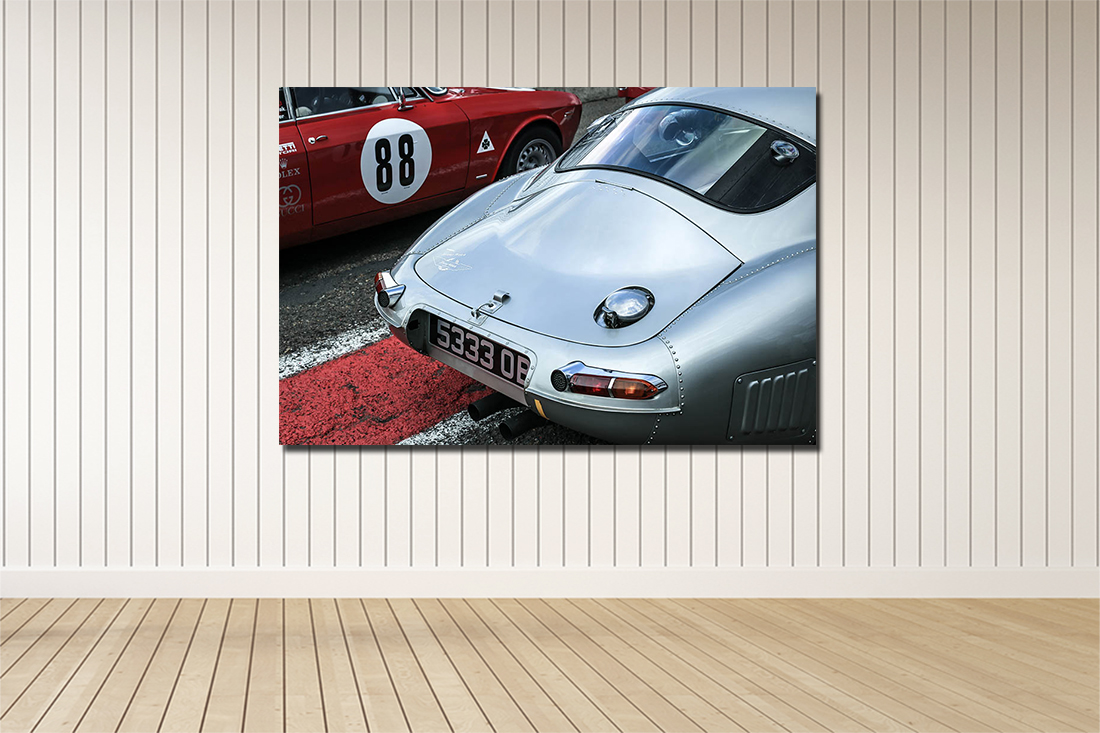
In March 1961, at the Geneva Motor Show, a car entered automotive history with typically British understatement — and immediate worldwide impact. The Jaguar E-Type had just been unveiled. Enzo Ferrari, not a man given to handing out compliments, immediately dubbed it “the most beautiful car ever made.” Sixty years on, no jury has proved him wrong.
Contents
- The birth of a legend: Geneva, March 1961
- Malcolm Sayer, the aerodynamicist who sculpted the wind
- Three series, one soul
- The E-Type in motorsport and culture
- Why the E-Type remains a timeless work of art
The birth of a legend: Geneva, March 1961
On 15 March 1961, Jaguar presented the E-Type at the Geneva Palais des Expositions. The impact was immediate and overwhelming. The international press spoke of an aesthetic shock. Engineers reached for their slide rules. The public simply stood and stared at the purest line ever placed on four production wheels.
What struck first was that long, teardrop bonnet — almost indecently elongated — which seemed to want to swallow the horizon whole. The roofline swept in one unbroken curve down to the tailgate. The headlights were faired behind blown plexiglass covers. Every surface, every curve, every crease appeared to have been dictated not by stylists but by the laws of physics. This was no accident — it was the signature of Malcolm Sayer.
But beyond the styling, there were the numbers. The Series 1 E-Type, powered by a straight-six 3.8-litre engine producing 265 bhp, claimed a top speed of 150 mph — making it, in 1961, the fastest production car in the world. And all of this for £2,097 at launch — roughly the price of a well-equipped family saloon. Jaguar had just redefined the performance-to-price ratio for the next two decades.
Malcolm Sayer, the aerodynamicist who sculpted the wind
To understand the E-Type, you must understand its creator. Malcolm Sayer was not a designer in the conventional sense. An aeronautical engineer by training, a veteran of the Bristol Aeroplane Company, he approached automotive bodywork as he would have designed an aircraft wing: through equations. Every curve of the E-Type is mathematically defined, calculated to minimise drag and maximise downforce.
Sayer had already worked on the racing Jaguar C-Type and D-Type — two cars that had dominated Le Mans in the early 1950s. With the E-Type, he applied to a road car the same principles that had made Jaguar victorious on the circuits. The result was a steel monocoque, light and rigid, clothed in an aluminium body whose beauty was merely the visible consequence of rigorous aerodynamic logic.
Sir William Lyons, Jaguar’s founder, oversaw the entire project with his unerring sense of elegance. The collaboration between Sayer’s scientific rigour and Lyons’ artistic eye produced this miraculous balance of form and function that the automotive world had never seen before — and has never quite seen since.
LIMITED EDITION — NUMBERED — CERTIFIED
British Classics — Fine Art Photography
Jaguar, Aston Martin, Austin Healey — British elegance on aluminium, plexiglass and canvas.
From €78 — Print 30×20cm
Three series, one soul
The E-Type was produced from 1961 to 1975 in three distinct series, each reflecting both the evolution of the car and the regulatory constraints of the era.
Series 1 (1961–1968) is today considered the purest. Headlights faired behind plexiglass covers, restrained chrome brightwork, an uncluttered cockpit: everything breathes the essential. The 3.8-litre engine leads the way before being replaced in 1964 by a more tractable 4.2-litre unit better suited to everyday use. In 1966, a 2+2 version appears, slightly lengthened to accommodate two token rear seats.
Series 2 (1968–1971) must negotiate new American safety and emissions standards. The headlights lose their fairings, the bumpers grow heavier, regulation creeps into the design. The original purity fades slightly, yet the silhouette remains irresistible.
Series 3 (1971–1975) marks the arrival of the magnificent 5.3-litre V12, producing 272 bhp — the most refined engine ever fitted beneath a Jaguar bonnet. The grille widens, the front track broadens. The E-Type bows out in style, on a note of power and mechanical nobility, before regulations and oil crises finally close this chapter of automotive history.
The E-Type in motorsport and culture
Though born for the road, the E-Type’s competition genes were always straining for expression. From 1961, lightened versions — the celebrated Lightweights — were entered in endurance racing. Fitted with aluminium bodywork and prepared engines, they distinguished themselves at Le Mans, the 12 Hours of Sebring, and on American circuits.
But it is in popular culture that the E-Type has truly written its destiny. Frank Sinatra owned one. Steve McQueen drove one. In 1996, New York’s MoMA added it to its permanent collection as an outstanding example of industrial design — one of the very few automobiles ever to receive that honour. The E-Type was no longer merely a car. It was a rolling sculpture.
In film, in music, in fashion — the E-Type’s silhouette has become an archetype of Sixties British elegance, as iconic as the Mini or the Rolls-Royce Silver Shadow. Except that the E-Type also had 150 mph in its legs.
LIMITED EDITION — NUMBERED — CERTIFIED
B&W Photography — Timeless Elegance
Classic cars in monochrome — emotion and nostalgia at their finest.
From €98 — Plexiglass 60×40cm
Why the E-Type remains a timeless work of art
Sixty years after its Geneva debut, the Jaguar E-Type has not aged a day. It is one of those rare human creations that seem to have existed for all time — as if the entire history of the automobile were merely a long preparation for its arrival.
What makes it eternal is precisely what Sayer built into it: truth. A body shaped by the laws of aerodynamics follows no fashion. It will not age because it never belonged to an era. It belongs to mathematics.
For a collector or an automotive enthusiast, hanging a fine art photograph of the E-Type on a wall is to welcome a fragment of that eternity into one’s home. The sweep of the bonnet, the tension of the lines, the glint of chrome in monochrome light — each image captures something that transcends the mere representation of a car. It is beauty in its purest state, frozen in a moment, forever.
Discover our collection of classic car fine art photography in numbered limited editions.
FAQ — Jaguar E-Type
- Why did Enzo Ferrari call the Jaguar E-Type the most beautiful car ever made?
- At the 1961 Geneva Motor Show, Enzo Ferrari reportedly uttered those words upon seeing the E-Type for the first time. The purity of its line, its natural aerodynamics and the balance of its proportions had clearly impressed even the most demanding of Italian car builders.
- How many Jaguar E-Types were produced?
- Approximately 72,500 units were built between 1961 and 1975 across all series. Series 1 cars and the rare Lightweight competition variants are the most sought-after by collectors today.
- What is the difference between the Series 1, 2 and 3?
- The Series 1 (1961–1968) is the most pure stylistically, with its plexiglass-faired headlights. The Series 2 (1968–1971) adopts open headlights to meet US regulations. The Series 3 (1971–1975) receives the 5.3-litre V12 engine and a lightly revised body.
- Why is the Jaguar E-Type in the MoMA collection?
- In 1996, New York’s Museum of Modern Art added the E-Type to its permanent industrial design collection, recognising it as an outstanding work of art — one of the very few automobiles to have received this honour.