

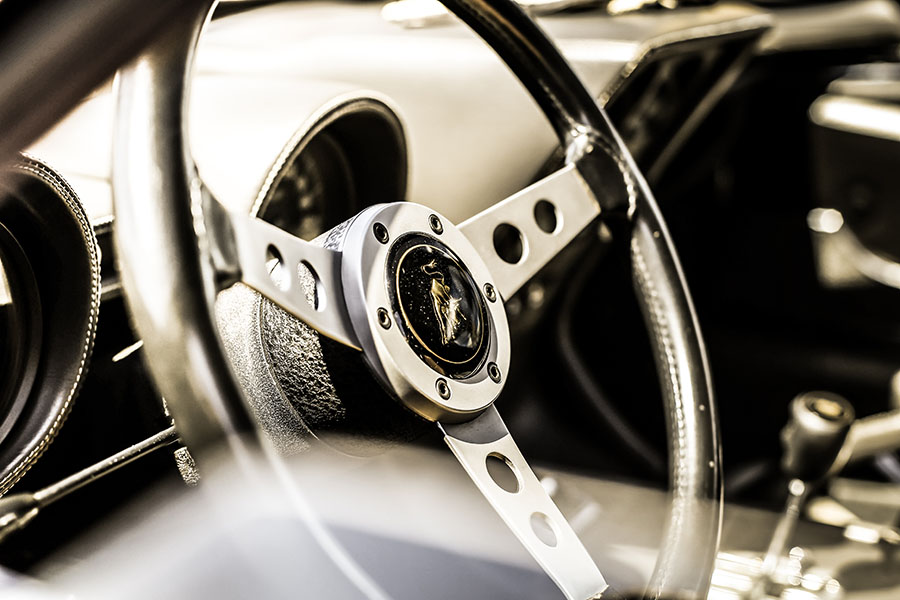
In 1966, Lamborghini unveiled a car that stopped the world in its tracks: the Miura. Designed by a 25-year-old Marcello Gandini, it redefined what a supercar could look like — and six decades later, it remains, for many, the most beautiful car ever built. Here’s why the Miura still matters, and how to bring this legend to your walls. 👉 Explore our race car art collection
Contents
- 1966: a revolution born at Bertone
- Marcello Gandini: the 25-year-old genius
- The Miura against its rivals: beauty unmatched
- On screen and in popular culture
- Lamborghini wall art: living with a legend
1966: a revolution born at Bertone
It started in secrecy. In 1965, three young Lamborghini engineers — Gian Paolo Dallara, Paolo Stanzani, and Bob Wallace — designed a revolutionary chassis on their own time: a V12 engine mounted centrally, transversely, just behind the seats. Ferruccio Lamborghini was initially reluctant, but eventually gave his blessing. The bare prototype, called the P400, was shown at the Turin Motor Show in 1965 and caused an immediate sensation.
But it was at the 1966 Geneva Motor Show that everything changed. Bertone, who had clothed the chassis in just a matter of weeks, unveiled a body of stunning formal coherence. The car was named Miura, after the famous fighting bull lineage bred on the plains of Andalusia. The name fit perfectly: the car was beautiful, powerful, and dangerous. Orders poured in before the car had even been road-certified.
The Miura created an entirely new category: the modern mid-engine supercar. Ferrari wouldn’t respond until the 365 GT4 BB in 1973. The Miura was seven years ahead of its time.
Marcello Gandini: the 25-year-old genius
Behind the Miura’s beauty, one name: Marcello Gandini. When he drew the Miura, he had only recently joined Bertone — and he was just 25 years old. Yet he delivered a work of staggering formal maturity. Every line was intentional: the knife-edge profile, the side air intakes evoking the gills of a sea creature, the retractable headlights framed by chrome eyelashes.
What makes the Miura visually unique is its total absence of compromise. The bodywork makes no attempt to hide the engine, disguise the aerodynamics, or reassure the buyer — it celebrates the mechanics. The rear glass panel offers a view of the V12, like a jeweller’s display case. Every angle reveals a perfect proportion. The Museum of Modern Art in New York (MoMA) eventually added a Miura to its permanent collection — the ultimate consecration for a production object.
Gandini would go on to design the Countach, the Stratos, the Espada. But the Miura remains, for him and for the world, his absolute masterpiece.
The Miura against its rivals: beauty unmatched
The 1960s and 70s were the golden age of automotive design. Ferrari, Maserati, Aston Martin, Jaguar — each produced masterpieces. Yet whenever historians, designers, journalists, or enthusiasts are asked to name the most beautiful car ever made, the Miura appears without fail. Whether in rankings by Car Magazine, Top Gear, or Road & Track, it consistently sits in the top three.
Its main contemporaries — the Ferrari 275 GTB, the Jaguar E-Type, the De Tomaso Mangusta — were all magnificent. But none achieved that unique combination of visceral sportiness and plastic refinement. The Miura looked like nothing that came before it. It was, in the most literal sense of the word, an aesthetic rupture.
Today, well-preserved Miuras trade between €1.5 and €2.5 million. The “Jota” variants — the homologated race version, of which only a handful were built — can exceed €4 million. With just 764 examples produced between 1966 and 1973, the Miura remains one of the most coveted automobiles in the world.
On screen and in popular culture
The Miura is inseparable from one scene: the first three minutes of The Italian Job (1969). An orange Miura threading through alpine tunnels to the sound of Matt Monro’s On Days Like These — this sequence is widely considered one of the most beautiful opening shots in cinema history. The fact that the car is destroyed by a bulldozer moments later only deepens the tragedy.
Beyond film, the Miura became an absolute visual icon. It inspired generations of designers — from the McLaren F1 to the Bugatti Veyron, many have cited the Miura as their earliest obsession. Posters of the car adorned children’s bedrooms throughout the 1970s and 80s, much like Ferrari posters in the decade that followed.
This cultural presence makes the Miura a first-class artistic subject. Printed on fine art canvas or aluminium, a Miura photograph doesn’t merely decorate a wall — it tells sixty years of automotive passion, Italian genius, speed, and pure beauty.
Lamborghini wall art: living with a legend
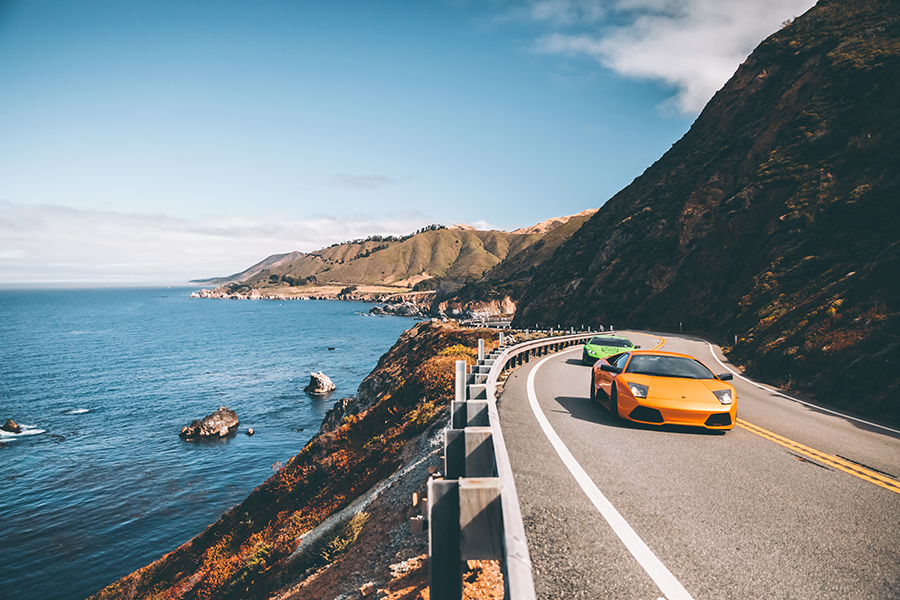
A piece of automotive wall art is more than decoration. It’s a statement. Choosing a Lamborghini photograph for your home is an assertion of sensibility — a love of excellence, of pure form, of machines that transcend their mechanical purpose. The Miura’s proportions — that low profile, that tension between softness and aggression — lend themselves particularly well to large format prints.
At Cars and Roses, we offer limited edition fine art photography printed on fine art canvas or aluminium dibond, in formats ranging from 30×20 cm to large-scale wall pieces. Every print is numbered and certified. Sports cars and racing legends are at the heart of our collection — for those who want to live surrounded by extraordinary machines.
👉 Discover the race car collection — From €78
FAQ — Lamborghini Miura
How many Lamborghini Miuras were made?
764 Lamborghini Miuras were produced between 1966 and 1973, across three variants: the P400, P400 S, and P400 SV. In addition, a handful of Jota homologated racing versions were built, most of which have unfortunately been destroyed or heavily modified over the years.
Why is the Lamborghini Miura so famous?
The Miura is famous for inventing the modern supercar: it was the first mid-engine transverse production car, featured revolutionary design by a 25-year-old Marcello Gandini, delivered world-class performance (280 km/h), and starred in the opening sequence of The Italian Job (1969). A Miura was later added to MoMA’s permanent collection in New York.
What is a Lamborghini Miura worth today?
A well-preserved Lamborghini Miura currently trades between €1.5 and €2.5 million. The rarer SV variant regularly reaches €2 million and above. Authentic Jota examples or cars with documented provenance (famous owners, concours history) can exceed €4 million at major auction houses.
Who designed the Lamborghini Miura?
The Lamborghini Miura was designed by Marcello Gandini at the Bertone design house, when he was just 25 years old. It was his first major project — and many consider it his masterpiece. He went on to design the Countach, Stratos, Espada, and Renault 5, among many others.
What engine did the Lamborghini Miura have?
The Miura was powered by a 3.9-litre V12 producing 350 hp (P400), 370 hp (S), or 385 hp (SV), mounted centrally and transversely. This layout, revolutionary in 1966, became the template for virtually every supercar that followed it.