


In 1992, Gordon Murray placed on McLaren's drawing board the plans for a car that existed nowhere else. Three seats, the driver's seat at the centre, BMW V12 engine, carbon fibre monocoque. No one had ever built anything so radical. Thirty years later, the McLaren F1 remains the absolute benchmark of the hypercar — a machine that defined the rules of an entire genre. 👉 Explore our race car art collection
Contents
- 1992: the birth of an impossible project
- Gordon Murray: the architect of the absolute
- The BMW S70/2 V12: the engine of perfection
- 1995: the unexpected Le Mans victory
- McLaren F1 wall art: capturing perfection on your walls
1992: the birth of an impossible project
It all started on a Concorde flight in 1988. Gordon Murray, then technical director of the McLaren Formula 1 team, was growing restless in first class. He pulled out a notepad and began sketching. What he drew was not a racing car — it was the ultimate road car, conceived without compromise, from a blank sheet of paper.
Four years later, the McLaren F1 was a reality. Premiered in December 1992, it immediately set its own rules. The chassis was entirely carbon fibre — a first for a road car. The carbon fibre and Kevlar bodywork brought the weight down to 1,138 kg dry. Every gram had been weighed, every component justified. Murray had the engine bay lined in gold leaf — the only material capable of reflecting enough heat from the V12.
106 examples were built between 1992 and 1998: 64 road F1s, 5 LMs, 3 GTs, 7 GTRs and a handful of prototypes. Each was delivered with a personalised toolkit, a service kit and a driving course. This was not a car — it was an institution.
Gordon Murray: the architect of the absolute
Understanding the McLaren F1 requires understanding Gordon Murray. Born in South Africa in 1946, he joined Brabham at 25 and designed revolutionary Formula 1 cars. At McLaren, he was the author of the MP4/4 — the car that won 15 of the 16 Grands Prix in 1988 with Senna and Prost, a win rate no one has ever equalled.
The F1 road car was the work of his life. Murray imposed absolute rules: no turbo, no automatic gearbox, no electronic assistance. The steering was unassisted. The gearbox was a 6-speed manual. ABS was absent. When you drove a McLaren F1, you truly drove — without a safety net.
Murray himself spent weeks in the workshop supervising every step of assembly. Each F1 was hand-built by a small team, at the pace of one car per week.
The BMW S70/2 V12: the engine of perfection
Murray needed an engine. He approached Honda, Porsche, Ferrari — all declined or offered existing units. BMW agreed to develop, from scratch, an engine exclusively for the F1. Paul Rosche, head of BMW Motorsport, took charge of the project. The result was the S70/2 — a 6.1-litre naturally aspirated V12, 627 hp at 7,500 rpm, 479 Nm at 5,600 rpm.
This engine is a work of mechanical art. Each piston is titanium. The cylinder head is forged aluminium. The V12 weighs just 266 kg — a remarkable lightness for a unit of this power. Rosche later said it was the most satisfying project of his career, above even his Formula 1 engines.
The performance figures were staggering for 1992. The McLaren F1 reached 386 km/h as a top speed — a record for an unmodified road car that stood until 2005. The 0-100 km/h sprint was dispatched in 3.2 seconds. These figures are matched by modern supercars laden with sophisticated electronics — the F1 achieved them with pure mechanics alone.
1995: the unexpected Le Mans victory
In 1995, McLaren entered the F1 GTR at the 24 Hours of Le Mans. Nobody expected a victory — the car was an adaptation of the road car, not a pure racing prototype. Reality proved otherwise.
The F1 GTR #59 driven by Yannick Dalmas, Masanori Sekiya and J.J. Lehto crossed the finish line in first place after 24 hours of racing. The McLaren F1 GTRs finished 1st, 3rd, 4th, 5th and 13th. Five cars classified from six entered — an unprecedented result for a first appearance with a production-derived car.
This victory permanently elevated the McLaren F1 into legend. It joined the pantheon of Le Mans-winning cars — the Ferrari 250 GTO, the Ford GT40, the Porsche 917. But it remains the only one to have done so with a car you could drive normally the following morning.
McLaren F1 wall art: capturing perfection on your walls
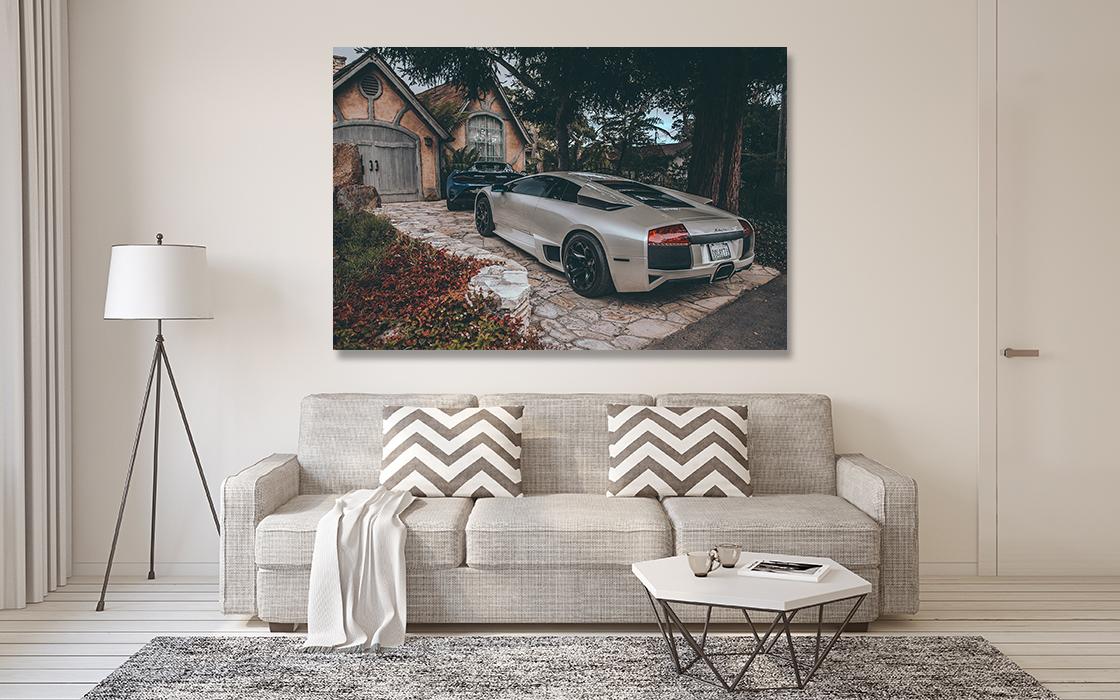
A McLaren F1 print is far more than an automotive photograph. It is a tribute to the idea that mechanical perfection can be a form of art in its own right. The F1's lines — that long bonnet, those side vents, that short muscular tail — are the result of engineering thinking completely free of compromise. At large format, these proportions are breathtaking.
At Cars and Roses, we offer limited edition fine art automotive photography, printed on fine art canvas or aluminium dibond, in formats from 30×20 cm up to large-scale wall pieces. Every print is numbered and certified. Our race car collection includes McLaren and other circuit legends — for those who want to live surrounded by extraordinary machines.
👉 Discover the race car collection — From €78
FAQ — McLaren F1
How many McLaren F1s were produced?
106 McLaren F1s were built between 1992 and 1998: 64 road F1s, 5 LMs, 3 GTs, 7 racing GTRs and a handful of prototypes. Each example was assembled entirely by hand in the workshops at Woking, England.
What is the top speed of the McLaren F1?
The McLaren F1 reached 386.4 km/h during testing at Ehra-Lessien in March 1998, driven by Andy Wallace. This production road car speed record stood for seven years, until the Koenigsegg CCR surpassed it in 2005. No electronic aids, no turbo — just 627 hp and perfect aerodynamics.
Why is the McLaren F1 driver's seat in the centre?
Gordon Murray positioned the driver's seat at the centre of the McLaren F1 for ideal weight distribution and unobstructed 360° visibility. This placement also puts the driver at the heart of the car — as in Formula 1 — symbolising the supremacy of the driving experience above all else.
What is a McLaren F1 worth today?
A McLaren F1 in good condition changes hands today for between €15 and €25 million, depending on specification and history. LM and GTR versions achieve records at major auction — one has exceeded $20 million at RM Sotheby's. In 1992, it cost £634,500 — already the world's most expensive road car.
What engine does the McLaren F1 use?
The McLaren F1 is powered by the BMW S70/2 — a 6.1-litre naturally aspirated V12 developed exclusively by BMW for this project. It produces 627 hp at 7,500 rpm and 479 Nm of torque. Paul Rosche, who oversaw the project at BMW, considers it the most remarkable work of his career, above even his Formula 1 engines.