

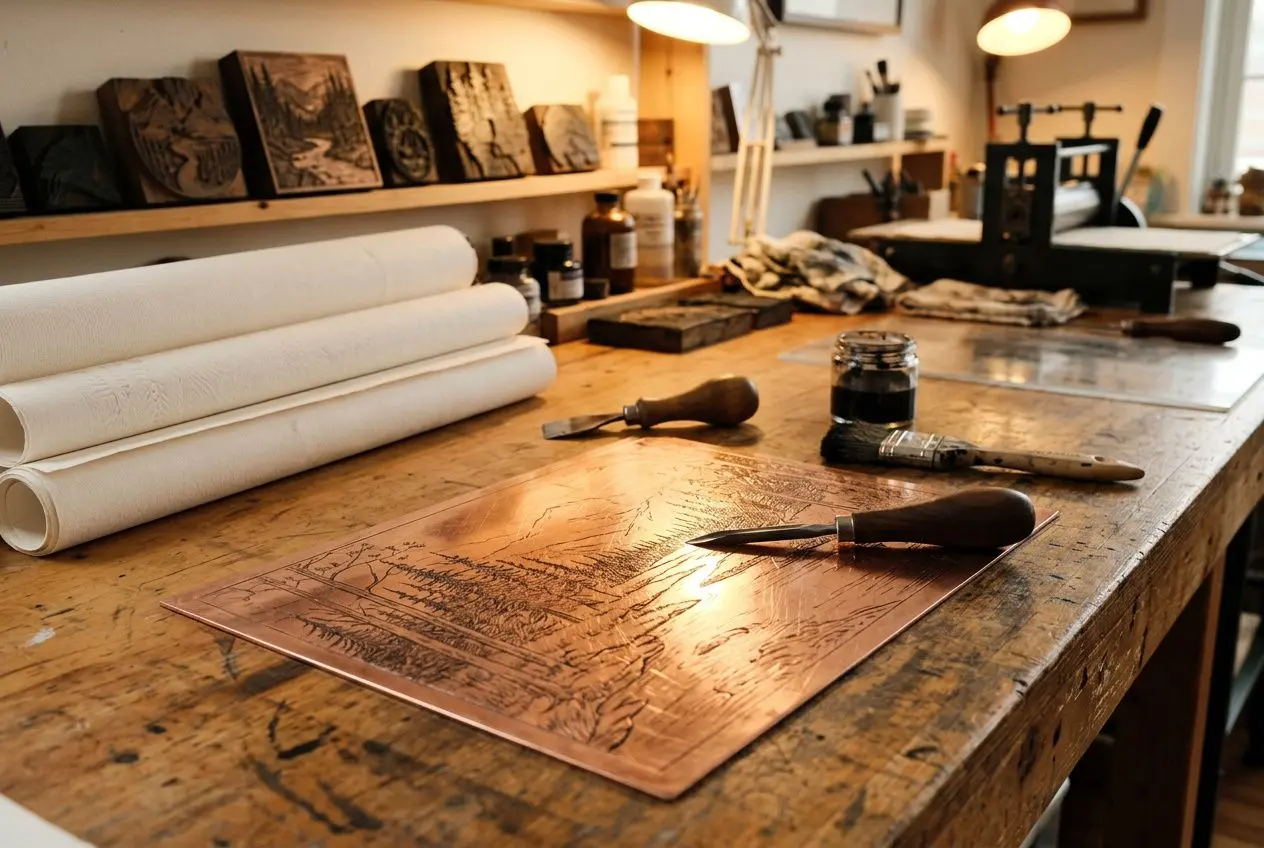
Printmaking is the process of transferring ink from a carved, etched, or otherwise prepared surface—called a matrix—onto paper or fabric. This guide delves into the craft, explaining why a solid grasp of the printmaking process is essential for any serious collector. You’ll see how artists use a plate, metal, or block to turn one matrix into a multitude of stunning, museum-quality impressions.
Modern archival printmaking depends on museum-grade pigment inks and acid-free materials to bond color deeply into the paper. These rigorous methods ensure fine art prints resist fading and moisture damage for over a hundred years. At Cars and Roses, we apply archival printing techniques to every limited edition photograph, guaranteeing its brilliance will last.
What is printmaking and why does it matter in art
Fundamentally, printmaking is about creative multiplication—sharing a powerful, original idea with a wider audience. An artist uses a prepared matrix to produce numerous impressions, each one considered an authentic work of art. Unlike simple reproductions, this technique is conceived specifically for the press, not for replicating an existing painting.
Printmaking definition and its core principles
The definition of printmaking centers on using direct pressure to transfer ink from a matrix. This matrix—be it wood, metal, or stone—holds a meticulously crafted image. It is prepared to both hold and then smoothly release color onto a chosen surface.
- Original conception: The artist designs the work specifically to be a print, not as a copy of an existing piece.
- Multiple impressions: Every piece pulled from the matrix is an original artwork, typically signed by the creator.
- Limited editions: Artists often destroy the matrix after printing a pre-set number to ensure the edition’s exclusivity.
Every impression reflects the artist’s true intent and unique touch. When you buy a numbered print, you’re acquiring a distinct original, not a mass-produced copy. Variables like press pressure, the dampened paper, and the fine details of the etching make each piece one-of-a-kind.
A brief history of printmaking across civilizations
An introduction to printmaking history reveals that humans have been transferring images for millennia. Early humans created hand stencils by blowing pigment onto cave walls, demonstrating an ancient drive to multiply imagery. Later, Sumerians carved cylinder seals to press designs into clay, establishing the core principle of the matrix.
Chinese scholars pioneered using paper as a printing surface by creating rubbings from text carved into stone. Japanese monks later adopted woodblock methods to reproduce sacred manuscripts, spreading art and knowledge across Asia. By the 14th century, the European woodcut was distributing imagery to vast audiences, effectively democratizing art.
Gutenberg’s printed Bible accelerated literacy and transformed society through mass communication. Relief printing and intricate intaglio techniques became powerful drivers of an intellectual revolution. Today, these traditional printmaking methods coexist with modern digital techniques to achieve superb archival standards.
Limited editions and the concept of original prints
A limited edition means the artist commits to producing a fixed number of impressions before retiring the matrix. This strict edition size guarantees no further prints will ever be made. This deliberate scarcity builds real collectible value and preserves the work’s artistic integrity.
Each numbered impression is a genuine original, never a mere copy. The artist’s signature and the edition number are placed directly on the paper to certify its authenticity. The creator’s hand is always evident, from carving the woodblock to carefully mixing the ink.
The four fundamental printmaking techniques explained
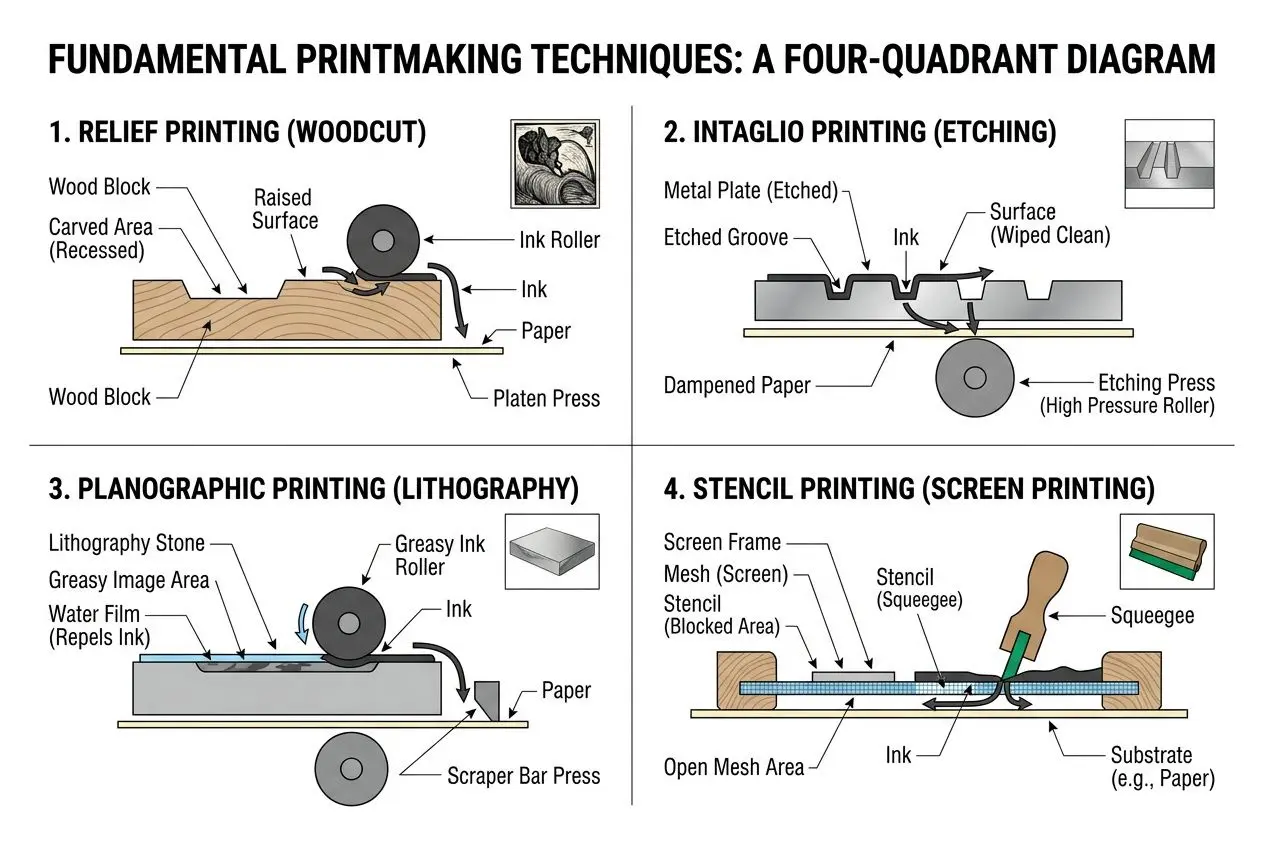
Printmaking theory classifies techniques by how a matrix holds and transfers ink. Relief printing features raised areas, whereas intaglio relies on recessed lines to capture fine detail. Planographic and stencil methods work through chemistry and forced passage, which explains why these distinct forms of printmaking yield such different visual results.
Relief and intaglio, two opposite approaches
To create art, relief and intaglio printing follow entirely opposite paths. In relief printing, the artist carves a block, leaving raised surfaces to catch the ink. In intaglio printing, lines are cut directly into a metal plate, and firm pressure from the press forces dampened paper deep into the grooves.
Planographic and stencil printmaking methods
The 4 types of printmaking also include methods that skip carving altogether. In planographic printing, lithography being the best-known example, a greasy image drawn onto a flat surface selectively attracts ink before transferring it onto paper. A stencil, by contrast, pushes ink through a fine mesh screen to produce bold, graphic designs at speed.
- Relief printing: Non-image areas are carved away from a block, leaving raised inked surfaces, as seen in woodcut and linocut techniques.
- Intaglio printing: Lines are incised into metal and ink fills the grooves before the surface is wiped clean. This covers etching, engraving, drypoint, and mezzotint.
- Planographic printing: Images are drawn onto a flat, treated surface that selectively accepts ink; lithography and monotype are the main examples.
- Stencil printing: Ink is pushed through a prepared mesh screen, as in serigraphy and risograph printing.
Each technique demands genuine mastery of specific materials and chemistry. An intaglio artist working with a copper plate, for instance, must carefully manage acid bite duration and calibrate press pressure with precision. These hands-on skills are what underpin traditional printmaking craftsmanship.
Modern giclée printing adapts these historical principles for contemporary fine art: tiny ink droplets are sprayed onto paper with a precision comparable to a copper plate etching. It connects heritage printmaking methods to current technology, and the results hold up well in museum-grade contexts.
Comparing all four techniques at a glance
Each approach produces visually distinct results depending on how ink contacts the surface. Relief printing delivers crisp edges and bold contrasts; intaglio offers delicate tonal gradations; lithography tends to blend both qualities in a painterly way.
Stencil methods produce vibrant flat colors and allow rapid, repeatable production, whether for commercial runs or fine art editions. Understanding these differences matters for collectors: a traditional woodcut and a detailed etching don’t just look different, they are different objects, made through fundamentally distinct processes.
| Technique | Matrix material | Ink application | Visual character | Edition size |
| Relief (woodcut) | Wood or linoleum | Rolled onto raised surfaces | Bold contrast, crisp edges | 50–200 impressions |
| Intaglio (etching) | Copper or steel plate | Fills recessed lines, surface wiped | Fine detail, tonal subtlety | 50–100 impressions |
| Planographic (lithography) | Limestone or metal plate | Adheres to greasy image only | Tonal range, painterly quality | 100–300 impressions |
| Stencil (screen printing) | Mesh screen with blocked areas | Forced through open mesh | Flat color, graphic impact | Unlimited, if desired |
Woodblock printing and lithography, two landmark printmaking processes
Woodblock printing and lithography rank among the most significant printmaking processes in history. Each printmaking method fundamentally changed how images were reproduced and circulated. Both techniques still hold a firm place in contemporary art practice today.
Step-by-step woodblock printing process
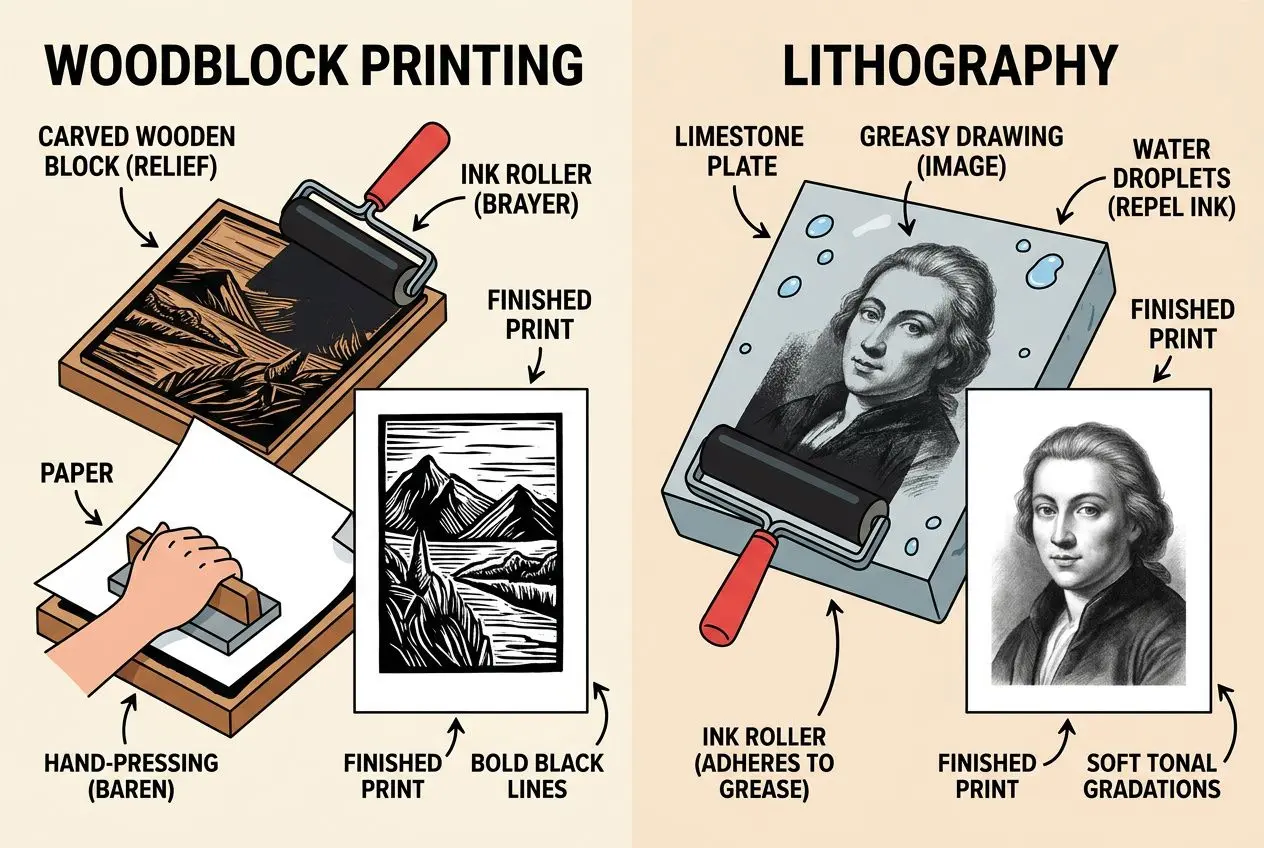
The woodblock printing process starts when an artist transfers a sketch onto a solid block. The non-image areas are then carved away, leaving raised surfaces that will carry the ink.
Oil-based ink is rolled evenly across the carved inked surface to ensure full coverage. Dampened paper is laid directly onto the block, and firm pressure from a press transfers the image onto the paper.
- Image design and transfer: Draw or transfer the image onto your block, deciding precisely which sections will be removed.
- Carving and matrix preparation: Cut away unwanted material to shape the matrix, applying sizing where needed for proper adhesion.
- Inking and pressing: Spread ink evenly across the block, lay dampened paper down, and apply pressure to produce the final plate impression.
The linocut approach follows identical steps but uses linoleum instead of a traditional woodblock. This relief printing variant avoids splintering and delivers a more durable matrix. A single block typically yields around 100 to 200 impressions before it begins to degrade.
The process of lithography from drawing to impression
The process of lithography rests entirely on chemistry, specifically the fact that grease repels water. The artist draws directly onto a polished limestone plate or a smooth metal surface using greasy materials. Unlike etching or carving, the image remains completely flat throughout this printing process.
The plate is then dampened with water and a mild acid-gum mixture. This step is central to the printmaking process: the chemical treatment fixes the greasy drawing while making bare areas receptive to water.
Oil-based ink is rolled across the damp surface; it adheres strictly to the greasy drawing and is actively repelled by the wet, non-image zones on the plate.
Dampened paper is placed onto the inked surface and run through a press, completing the printmaking method. The result is a reversed impression that captures fine artistic detail, a precision that made lithography the go-to solution for commercial fine art reproduction across the 19th century.
Archival printmaking standards for museum-quality fine art
True archival printmaking helps impressions resist fading and yellowing for well over a century. This impressive durability meets the rigorous standards required by museums and serious art collectors everywhere. Three main elements ensure this permanence: museum-grade pigment ink, acid-free substrates, and strong protective coatings.
Pigment inks and acid-free substrates in archival printing
Archival printmaking relies entirely on pigment inks rather than dye-based options that fade quickly. These large, insoluble particles bond firmly to the chosen substrate to resist fading indoors. Their chemical stability is vital for creating any print meant to last for future generations.
- Pigment ink composition: Large insoluble particles bond tightly to materials, ensuring excellent fade resistance and color stability.
- Acid-free substrates: Canvas linen and cotton-rag paper lack acids, stopping the yellowing that ruins ordinary paper.
- Chemical bonding integrity: The molecular link between ink and surface easily resists moisture, temperature shifts, and oxidation.
- Premium materials: Museum-quality cotton rag, aluminum dibond, and Fuji Crystal provide superior durability and UV protection.
Standard inkjet prints use basic dyes that fade quickly under everyday home lighting conditions. Conversely, museum-grade pigment inks feature tiny particles held safely within a protective fluid carrier. They embed perfectly into the fiber structure to preserve stunning color and contrast for decades.
Choosing the right substrate significantly boosts this overall permanence and prevents long-term material degradation. Cotton-rag paper avoids the harmful acids and lignin that typically cause unwanted yellowing. At Cars and Roses, every fine art piece combines archival pigment ink with a truly premium, durable substrate.
Giclée technique and UV-protective coatings explained
This precise technique sprays microscopic ink droplets directly onto prepared surfaces to embed color deeply. The stunning result is a giclée fine art print that genuinely rivals traditional printmaking permanence. It achieves incredible photographic detail far beyond what a manual printing press can typically accomplish.
Clear protective coatings shield the finished print from moisture, dust, and harmful UV radiation. These transparent layers add no texture, yet they extend the visual brilliance of the artwork indefinitely. The pressure of the printing process, paired with these reliable coatings, guarantees lasting museum-quality impressions.
How Cars and Roses applies archival printmaking standards
At Cars and Roses, every limited edition photograph undergoes our strict archival printing process. We choose special pigment inks formulated explicitly for high-end fine-art applications and stunning visuals. We then apply them onto acid-free substrates and finish with UV-protective coatings for maximum longevity.
Each unique print is carefully numbered, signed, and delivered with proper certification documentation. Collectors invest in a beautiful work of art that will easily maintain its visual appeal for over a century. Your chosen piece will look completely unchanged when proudly passed down to future generations.
Frequently Asked Questions
What are the main steps in the printmaking process?
First, an artist prepares the matrix—such as a wooden block or metal plate—by carving or etching a design into it. Then, they roll ink across this prepared surface. After that, they place a sheet of paper onto the inked surface. Finally, the printmaking process concludes when the ensemble passes through a press, using considerable pressure to transfer the image.
Why do artists limit the number of prints in an edition?
Artists cap print runs to maintain the value and rarity of their art. They produce a set number of copies— the edition—and then typically deface or retire the original matrix. This printmaking convention prevents overproduction, turning each impression into a distinct and sought-after piece.
What makes a print archival, and why does it matter?
An archival-grade print relies on two things: pigments that are lightfast—like certain carbon-based ink—and a stable base, often rag or cotton paper that is acid-free. Unlike decorative posters, these premium materials prevent fading and discoloration for decades. For collectors, that means your investment in fine art printmaking remains vibrant for generations.