

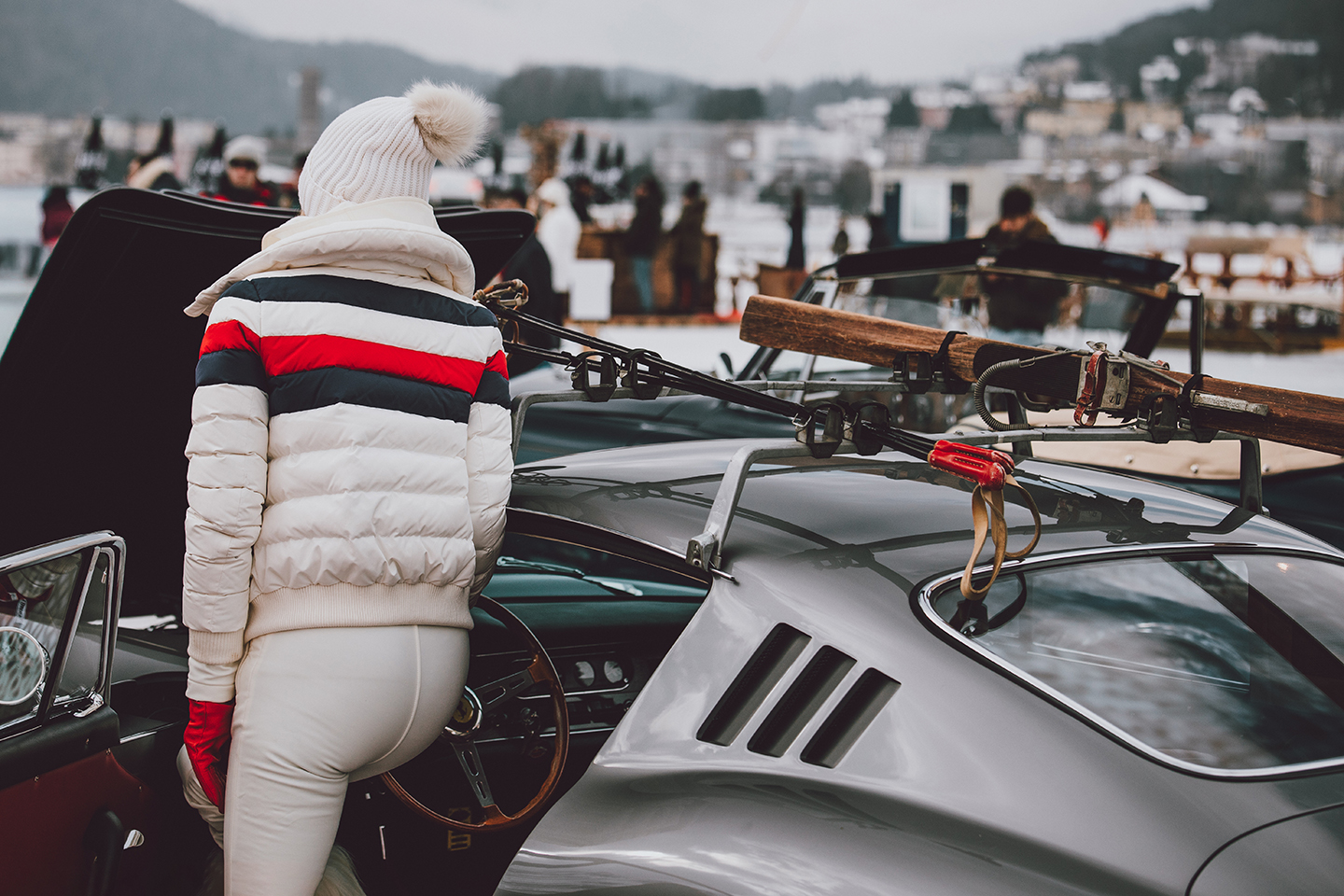
Ferrari turns 80 in 2027, counting from the 125 S, the first car to carry the name, which left the Maranello workshop in 1947. Since then, a handful of cars have shaped the whole story, from a 1.5-litre V12 to the 1,184 hp F80. This guide walks through them in order, explains why each one matters, and shows which ones you can hang on your wall as a fine art print.
80 years of Ferrari at a glance
The anniversary arrives next year. Meanwhile, the table below gives the short version of 80 years of Ferrari. For each landmark, you can also see whether our catalogue has a print of it.
| Year | Car | Why it matters | Print at Cars and Roses |
|---|---|---|---|
| 1947 | 125 S | First car with the Ferrari name, powered by a 1.5-litre V12 | Not yet |
| 1952 | 225 S | Sports-racer from the early racing years | Yes: 225 S Spyder print |
| 1957 | 250 Testa Rossa | Red-painted cylinder heads, built for endurance racing | Yes: Testa Rossa print |
| 1962 | 250 GTO | Only 36 built, often called the greatest Ferrari | Yes: 250 GTO print |
| 1964 | 275 GTB | Front V12 with a rear transaxle gearbox | Yes: 275 GTB print |
| 1969 | Dino 246 GT | Mid-engine V6, named after Enzo Ferrari’s son | Yes: Dino print |
| 1975 | 308 GTB | Mid-engine V8 that became a pop icon | Story only: Ferrari 308 story |
| 1984 | Testarossa | Flat-12 with the famous side strakes | Story only: Testarossa story |
| 1987 | F40 | Built for the 40th birthday, faster than 200 mph | Yes: grey F40 print |
| 1989 | 348 TS | Open-top V8 of the late 1980s | Yes: 348 TS print |
| 2024 | F80 | 799 cars, 1,184 hp hybrid V6 | Not yet |
1947–1962: from the 125 S to the 250 GTO
Enzo Ferrari had run racing cars for years, but the 125 S of 1947 was the first to carry his name. For instance, Gioacchino Colombo designed its small V12, and the Maranello team built the car. In other words, the whole story started with a modest engine and a bold idea: sell road cars to pay for racing.
Racing success also came quickly. Soon after, Ferrari won the 24 Hours of Le Mans for the first time in 1949, and later took six victories in a row from 1960 to 1965. The 225 S of 1952 and the 250 Testa Rossa of 1957 belong to this era. The second one got its name from its red-painted cylinder heads, and the name returned on a road car in 1984. For this reason, we are happy to offer both the 225 S Spyder print and the Testa Rossa print.
Then came the 250 GTO. As a result, Ferrari built only 36 between 1962 and 1964, and the letters stand for Gran Turismo Omologato. Scaglietti shaped its body, and today it ranks among the most valuable cars in the world. If you want the full story behind it, read our Ferrari 250 GTO guide.
1964–1975: the road-car golden age
The 275 GTB of 1964 paired a 3.3-litre V12 with a rear transaxle and independent suspension on all four wheels. Also, its long nose and short tail still look perfect today. For example, we photographed one at the St. Moritz concours, and the 275 GTB print is a natural fit for a classic interior.
In 1969, the Dino 246 GT introduced a mid-engine V6 and a brand of its own. In fact, Enzo named it after his son Alfredo, known as Dino, who died in 1956. As a result, many collectors consider it one of the most graceful Ferraris of the 1970s. Our Dino 246 GT article explains why, and the Dino print lets you live with it.
The 308 GTB followed in 1975 with a mid-engine V8 and a Pininfarina body. Moreover, the 308 GTS became a television star in the 1980s. We do not have a print of it yet, but our 308 story covers the car in detail.
1984–1989: Testarossa, F40 and the 348
The Testarossa of 1984 is the poster car of the decade. In addition, its flat-12 engine sits behind the driver, and the side strakes made it instantly recognisable. Our Testarossa guide tells its story, even though no print of it is available at the moment.
Then Ferrari built the F40 in 1987 for the company’s 40th birthday. Meanwhile, its twin-turbo V8 pushed it beyond 200 mph, and it was the last Ferrari that Enzo approved before his death in 1988. In our catalogue, you can choose the grey F40 print or the classic F40 print. For the background, see our F40 article.
The 348 TS arrived in 1989. However, it is a less famous car, and this is exactly why our Pebble Beach 348 TS print feels fresh on a wall. It shows a 348 TS on the 17-Mile Drive at Pebble Beach, a road made for driving.
2009–2024: from modern Spiders to the F80
Modern Ferraris use turbochargers and hybrid systems, yet they keep the same obsession with speed and beauty. Our Los Angeles Spider print shows this side of the story, with a mid-engine Spider photographed in Los Angeles.
Next, the story reaches the F80. Finally, Ferrari unveiled it in October 2024, and it combines a twin-turbo V6 with electric motors for 1,184 hp. Ferrari plans only 799 cars, and it succeeds the LaFerrari of 2013. There is no F80 print in our catalogue yet. However, the older icons above show how each generation has pushed the same idea a little further.
Why Ferrari fits a wall so well
Ferrari design relies on strong lines, deep reds and a sense of motion, and these qualities translate well to a printed photograph. Indeed, a single car on a plain wall can anchor an entire room. Moreover, a red car works as an accent colour against white, grey or wood. Because our prints keep the 3:2 format of the original photograph, the car appears exactly as the photographer framed it. Finally, aluminium and acrylic glass give a clean, deep finish that suits both vintage racers and modern supercars.
What our Ferrari catalogue covers, and what it does not
Overall, our Ferrari collection runs from the 1950s racers to a modern Spider. There is no print of the 125 S or of the F80 at the moment, so the two ends of the timeline are story only. In fact, everything in between is available, and several cars have more than one photograph. For example, the 250 GTO and the F40 each exist in two versions. You can browse them all in our Ferrari collection.
Which Ferrari print for which wall?
Each car photograph is a limited edition of 200 copies, printed on aluminium or acrylic glass. Canvas prints are also available, and they are not limited. We sell all prints without a frame, and prices start at €78.
For a living room wall above a sofa, 90×60 cm is a safe choice: aluminium costs €397 and acrylic glass €680. On a bigger wall, 120×80 cm in aluminium costs €590. A desk or a hallway suits 60×40 cm in aluminium, at €215. In every case, the photograph keeps its 3:2 proportions, so we crop nothing. If you are still hesitating, our Ferrari wall art guide helps you pick the right car for your interior.
Is Ferrari really 80 years old in 2026?
Not quite. The 125 S, the first car to carry the Ferrari name, dates from 1947, so the 80th anniversary falls in 2027. This year is the 79th. Therefore, now is a good time to plan the wall you want to celebrate it with.
Which Ferrari is the most iconic?
Most collectors choose the 250 GTO. Ferrari built only 36 between 1962 and 1964, and it combines racing success with a shape that has not aged. The F40 often comes second, because it was the last Ferrari that Enzo approved himself.
Are your Ferrari prints limited editions?
Yes, on aluminium and acrylic glass: we limit each car photograph to 200 copies. Canvas prints are not limited. We sell prints without a frame, so you can choose the frame that suits your interior.
Which size works best for a living room?
For a wall above a sofa, 90×60 cm is a safe choice because it anchors the room without overwhelming it. On a larger wall, 120×80 cm also works well. For a desk or a hallway, 60×40 cm is enough.
Keep reading
Finally, if you want to go further, explore our gift guide for Ferrari lovers, our Ferrari wall art overview and our short history of the 250 GTO. For the brand itself, the Ferrari page on Wikipedia gives a good overview.