

Group B was the top class of the World Rally Championship from 1982 to 1986: road-going homologation specials with four-wheel drive, turbochargers and, in some cases, more than 600 horsepower. It ended abruptly in 1986, after the tragedies at the Rally de Portugal and the Tour de Corse. Forty years on, the Audi Quattro, Peugeot 205 T16 and Lancia Delta S4 remain the icons of a rally era with no safety net.
What Group B rally really was
The rule was simple. To homologate a Group B car, a manufacturer had to build 200 road cars, where Groups N and A demanded 5,000. As a result, brands could build near-pure competition machines and sell just enough to meet the regulation.
Evolutions could also be added within the original homologation, so makers often built only 20 evolution cars instead of 200. That flexibility explains the arms race in power and aerodynamics between 1982 and 1986.
The result was spectacle on a scale rallying had never seen. Cars looked like road models but behaved like prototypes, and drivers fought them on narrow forest and mountain roads lined with fans. That mix of ambition and risk defines the era.
Audi Quattro: four-wheel drive changes everything
Everything starts with the Audi Quattro, unveiled at the Geneva Motor Show in 1980. Its four-wheel drive gave Audi a huge advantage on gravel, snow and wet tarmac. Then Hannu Mikkola won the 1983 drivers’ title, and Audi took the 1984 manufacturers’ crown.
Meanwhile, the Sport Quattro S1 was reported at over 600 horsepower in 1986. Walter Röhrl drove it to victory at Pikes Peak in 1987, proof that the car outlived the category. Its short, squat profile and huge wings became the visual shorthand for 1980s rallying.
Peugeot 205 T16 and Lancia Delta S4: the answer
Peugeot answered in 1984 with the 205 T16 and Ari Vatanen. The marque then dominated 1985, when Timo Salonen won the drivers’ title. In 1986 the title went to Juha Kankkunen after the San Remo result was annulled.
Lancia launched the Delta S4 at the end of 1985. Its engineering signature was both a turbocharger and a mechanical supercharger, to remove lag. But the car is tied forever to a tragic date, the 1986 Tour de Corse.
1986: the year Group B stopped
At the Rally de Portugal in March 1986, Joaquim Santos lost control of his Ford RS200 on the opening stage and hit spectators. Three people died and 31 were injured. The crowds stood close to the road, often just metres from the cars.
In May, at the Tour de Corse, Henri Toivonen’s Lancia Delta S4 left the road and caught fire. Toivonen and co-driver Sergio Cresto died, and the cause was never established. The FIA then banned Group B from the World Rally Championship for 1987.
The other Group B cars
Group B was never just three names. The Renault 5 Turbo was homologated in February 1982 with a 1.4-litre turbo engine. Rover introduced the MG Metro 6R4 in 1985, and the Ford RS200 was homologated in February 1986. Therefore the grid mixed very different layouts, from mid-engined cars to full four-wheel drive.
Then there is the Porsche 959. It was homologated in Group B but never contested a World Rally Championship event. Still, it won the 1986 Paris-Dakar Rally, proof that a car built for one rulebook can find glory elsewhere.
Group B timeline
| Year | What happened |
|---|---|
| 1980 | Audi Quattro unveiled at the Geneva Motor Show |
| 1982 | First Group B cars appear in the World Rally Championship |
| 1983 | Hannu Mikkola wins the drivers’ title with Audi |
| 1984 | Peugeot 205 T16 debuts; Audi wins the manufacturers’ title |
| 1985 | Timo Salonen champion with Peugeot; Lancia Delta S4 arrives late in the year |
| 1986 | Portugal and Tour de Corse tragedies; Juha Kankkunen takes the drivers’ title |
| 1987 | Group B banned from the World Rally Championship |
Why Group B still fascinates
Forty years later, the images of that era keep their raw power. You see road cars barely disguised, giant wings, auxiliary lights and crowds at the edge of the stage. That tension between speed and fragility is why collectors and photographers keep coming back.
In addition, these cars left a concrete legacy. Four-wheel drive and turbocharging, now ordinary on the road, spread through rallying first. A rally photograph is therefore not only about speed, but about a period when technology moved in leaps.
And the Lancia Stratos?
The Stratos is not a Group B car. It raced earlier, in Group 4, and showed that a car could be born purely for rallying. Yet it prepared much of what followed: a short wheelbase, a mid-mounted engine and a wedge profile. That is why it is so often grouped with the Group B legends. Read our dedicated piece, Lancia Stratos Photography: The Rally Legend as Fine Art.
Which prints for a Group B wall?
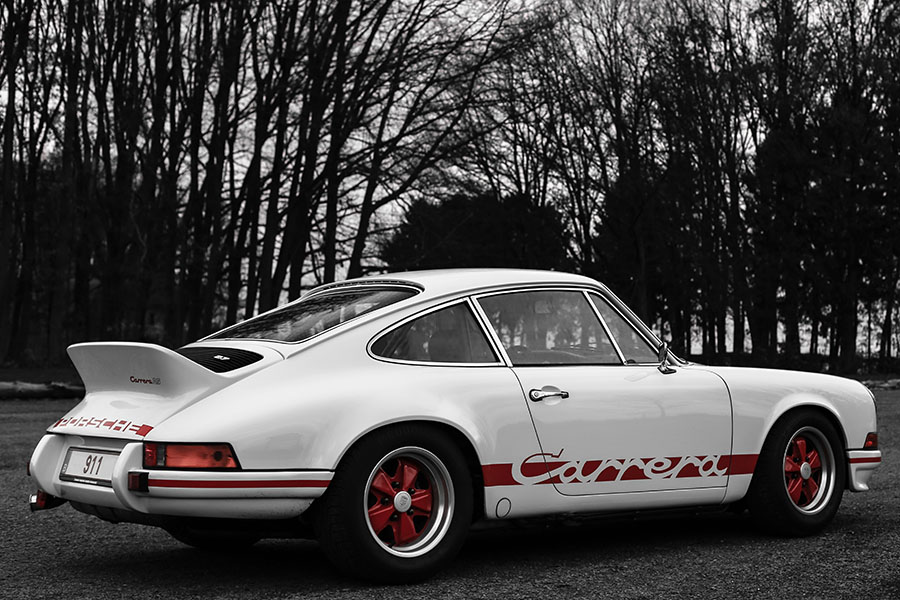
To be precise, our catalogue today holds no print of the Quattro, the 205 T16 or the Delta S4. The quattro name does live on in our Audi E-Tron Quattro at Silverstone print. For the competition spirit of the 911, see the Porsche 911 Carrera RS photograph.
For the room, choose a horizontal format and a restrained hang. In an office or garage, a 75 x 50 cm limited edition print is enough to create a focal point. In a living room, move up to 105 x 70 cm or larger. Finally, the aluminium Dibond finish suits the technical character of these cars. Browse the full classic car prints collection.
FAQ: Group B rally
Why was Group B banned?
After the fatal accidents of 1986 in Portugal and at the Tour de Corse, the FIA judged the cars too fast for roads open to the public. They combined extreme power with limited protection. The class disappeared from the World Rally Championship in 1987.
How many cars were needed to homologate a Group B car?
Manufacturers had to build 200 road cars, against 5,000 for Groups N and A. Evolution models could be limited to 20 cars. As a result, makers could develop very radical cars without mass production.
Is the Lancia Stratos a Group B car?
No. The Stratos raced in Group 4, before Group B existed. However, it anticipated the philosophy of the class: a car designed first to win rallies, then adapted for the road.
Are Cars and Roses prints really limited editions?
Yes. Each fine art photograph is printed in an edition of 200 numbered and signed copies, with a certificate of authenticity, unframed. To understand numbering and retired editions, read What “Limited Edition” Really Means.