


Some cars aren’t built to be reasonable. The Lancia Stratos is one of them — a wedge of metal and passion designed to tear through mountain passes and electrify crowds. Today, it transcends motorsport to become a work of art in its own right, perfect for interiors that refuse the ordinary.
Birth of a Legend: The History of the Lancia Stratos
The Lancia Stratos was born from a single ambition: dominate rally racing. In 1970, the Stratos Zero concept unveiled at the Turin Motor Show stunned the world — a near-ground-level wedge body designed by Marcello Gandini at Bertone. Two years later, the production version retained that radical concept while adopting proven mechanical underpinnings: the mid-mounted Ferrari Dino V6 engine.
Enzo Ferrari agreed to supply drivetrains to Lancia — a rare partnership that spoke to shared ambitions. With just 492 examples built between 1973 and 1978, the Stratos was a rare object from the outset. Its sub-four-metre length, short wheelbase, and mid-engine layout created a machine of blistering agility. Visibility was poor, comfort non-existent — and nobody really cared.
That uncompromising character is precisely what makes the Stratos unforgettable. It doesn’t try to be everything to everyone. It’s built to win, and to fascinate — two qualities that, combined, produce the greatest icons in automotive history.
The Stratos in Rally: Three World Championships
From 1974 to 1976, the Lancia Stratos won three consecutive World Rally Championships. Sandro Munari, Björn Waldegård, Bernard Darniche — the drivers who tamed it are legends of motorsport. On forest stages, on Mediterranean gravel, the Stratos imposed its will with remarkable consistency.
The Alitalia livery — red, green, and white — remains one of the most iconic in rally history. Photographed through the dust of an alpine pass or under the stars of a Monte Carlo night, the Stratos in full race trim is already a painting. Contemporaries called it the Swiss Army knife of rallying: compact, effective, devastating in all conditions.
The Stratos Aesthetic: A Design Built for Photography
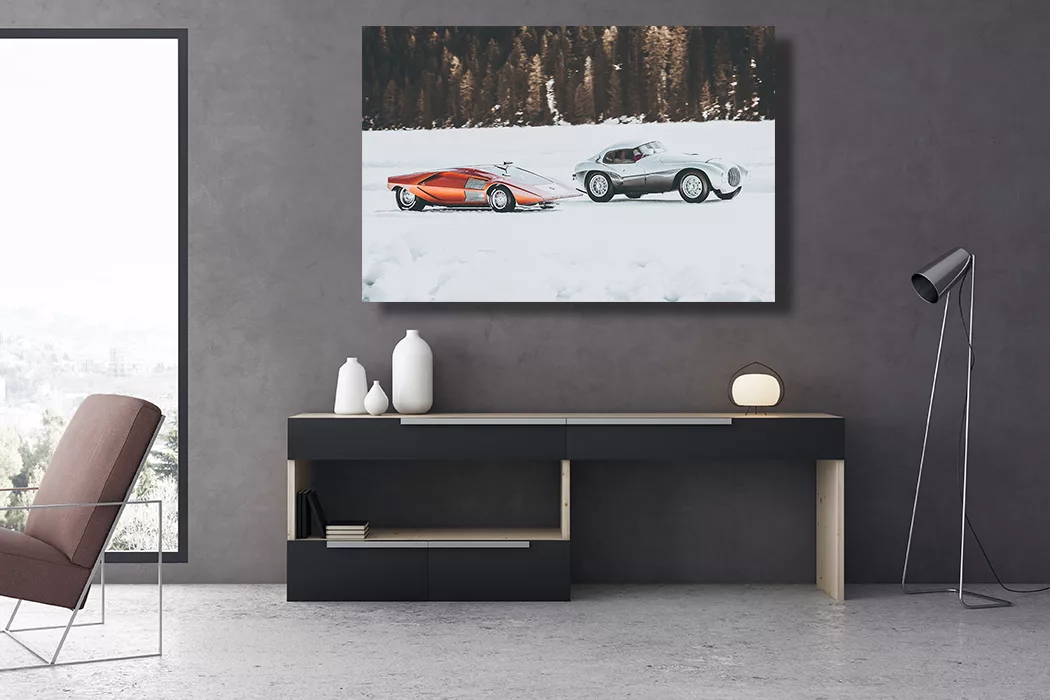
Few cars are as naturally photogenic as the Lancia Stratos. Its design is an accumulation of sharp planes, taut lines, and angles that create permanent plays of shadow and light. The panoramic windshield that almost entirely envelops the driver, the near-vertical hood, the flared arches — every detail contributes to a silhouette that is instantly recognisable.
In black and white, the Stratos becomes almost sculptural. Automotive photographers know it offers exceptional contrast: the smooth bodywork captures light differently at every angle, creating near-abstract compositions. In colour, the original shades — Alitalia red, bright yellow, burnt orange — produce images that immediately assert themselves in any interior.
This intrinsic graphic quality is what makes Lancia Stratos photography a natural choice for fine art decoration. The car is already a mechanical work of art — the photograph simply reveals what was always there.
Fine Art Photography: Capturing the Soul of the Stratos
Fine art automotive photography applied to the Lancia Stratos goes far beyond a simple car portrait. It’s about capturing an era — the 1970s, their stylistic audacity, their absolute faith in machinery as artistic expression. The prints that emerge from this work don’t just represent a car: they tell a philosophy of pushing limits.
Shooting conditions are crucial. A Stratos photographed at dawn on a deserted mountain road, raking light picking out every body crease, produces an image of rare intensity. Fine art photographers typically work with natural golden-hour light or stripped-back studio setups to honour the lines without distraction.
How to Display a Lancia Stratos Photograph in Your Home
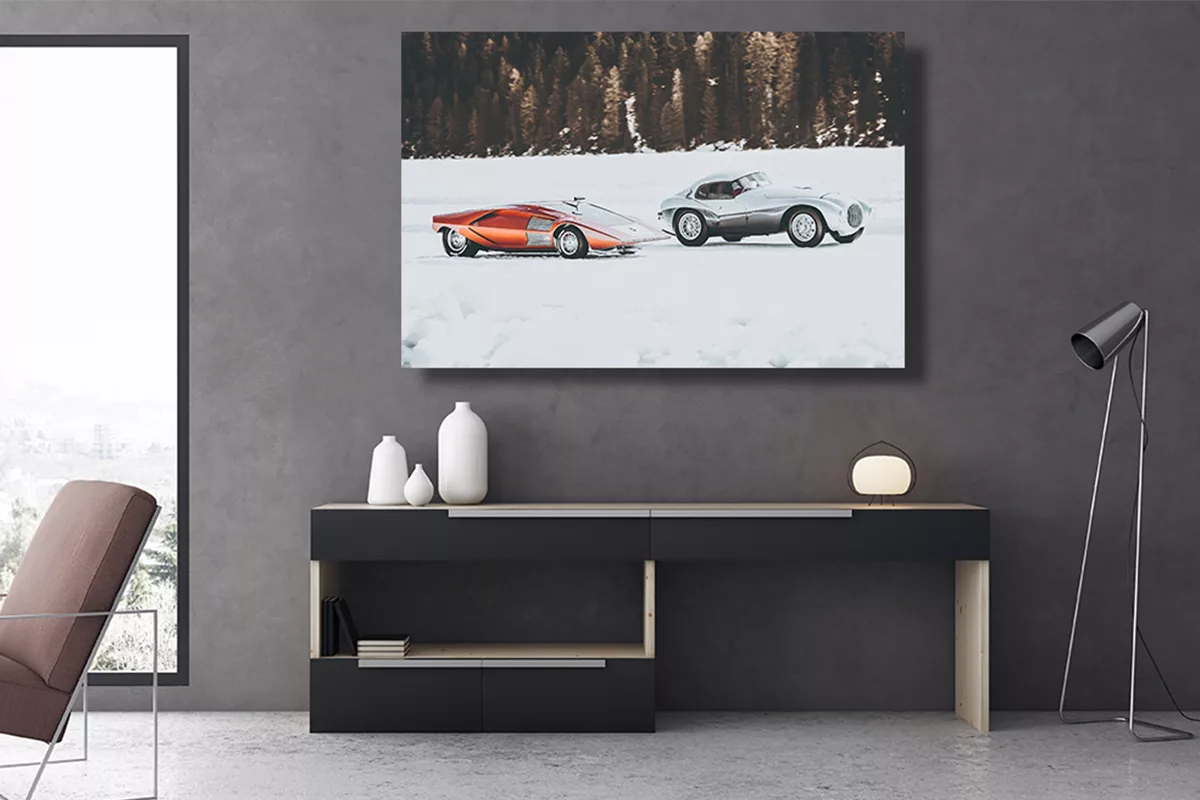
A Lancia Stratos photograph works beautifully in interiors that commit to an aesthetic. In a contemporary living room with white walls, a large black-and-white print creates an immediate focal point. In a study or library with warm tones, a colour print recalling the period liveries brings character and history to the space.
Recommended sizes range from 60×40 cm for intimate settings to 120×80 cm for a more assertive statement. On aluminium dibond, the metallic details of the bodywork take on an extra dimension — a material that dialogues with what it represents. On matt baryta paper, the rendering is more painterly, closer to graphic art than classic photography.
The key is to choose an image that genuinely speaks to you — not simply because it’s a Stratos, but because the composition, the light, and the captured moment resonate with your sensibility. That’s the condition under which an automotive photograph becomes a true collector’s piece.
FAQ — Lancia Stratos Fine Art Photography
- How many Lancia Stratos were produced?
- The Lancia Stratos was built in just 492 examples between 1973 and 1978. This rarity makes it one of the most sought-after and photographed collector cars in the world today.
- What engine did the Lancia Stratos use?
- The Stratos used the Ferrari Dino 2.4-litre V6, producing around 190 hp in road trim and up to 560 hp in full rally specification.
- Why is the Lancia Stratos such a photogenic car?
- Its radical Bertone design, angular lines, and unique proportions create exceptional photographic compositions. The Stratos plays naturally with light, offering striking contrasts in both black-and-white and colour.
- What sizes work best for a Lancia Stratos fine art print?
- 60×40 cm suits more intimate spaces; 100×70 cm or 120×80 cm make a stronger statement. Aluminium dibond is particularly recommended to highlight the metallic reflections of the bodywork.
Explore Our Sports Car Photography Collection
Lancia, Ferrari, Porsche, Bugatti — fine art prints for passionate collectors.