

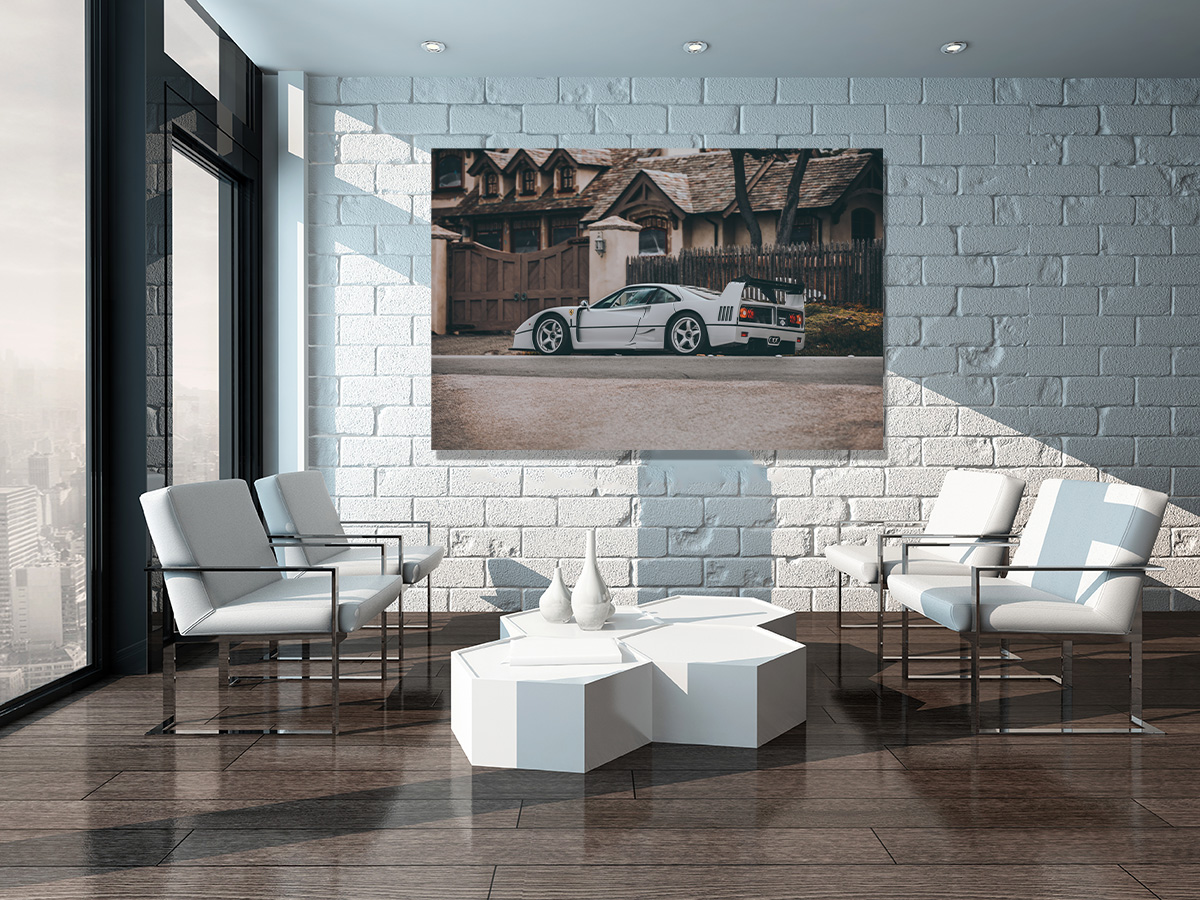
Your office is often the most personal room in your home — and yet the most neglected when it comes to decoration. A carefully chosen fine art car photograph can transform an ordinary workspace into a private gallery: a daily source of inspiration, an expression of identity, and a constant invitation to perform at your best.
Table of Contents
- Why Your Office Deserves Real Art
- Which Car Model to Choose for a Home Office?
- Black and White or Color: Which Works Best?
- Aluminium, Paper, Canvas: Which Medium to Choose?
- Size and Position — Our Practical Recommendations
Why Your Office Deserves Real Art
Studies on workspace psychology are unanimous: a well-decorated environment improves focus, reduces stress and increases productivity. But beyond these rational arguments, there’s something deeper at work. A photograph of an iconic car — a Porsche 911, a Ferrari 250 GTO, a Ford GT40 — creates a productive tension between beauty and performance. It reminds you, every time you glance up, that excellence is a daily choice.
Unlike a poster, a fine art limited-edition print is a unique piece. Numbered, signed, accompanied by its certificate of authenticity, it appreciates in value over time. Decorating your office with such a work is an investment in a workspace that grows with you.
Which Car Model to Choose for a Home Office?
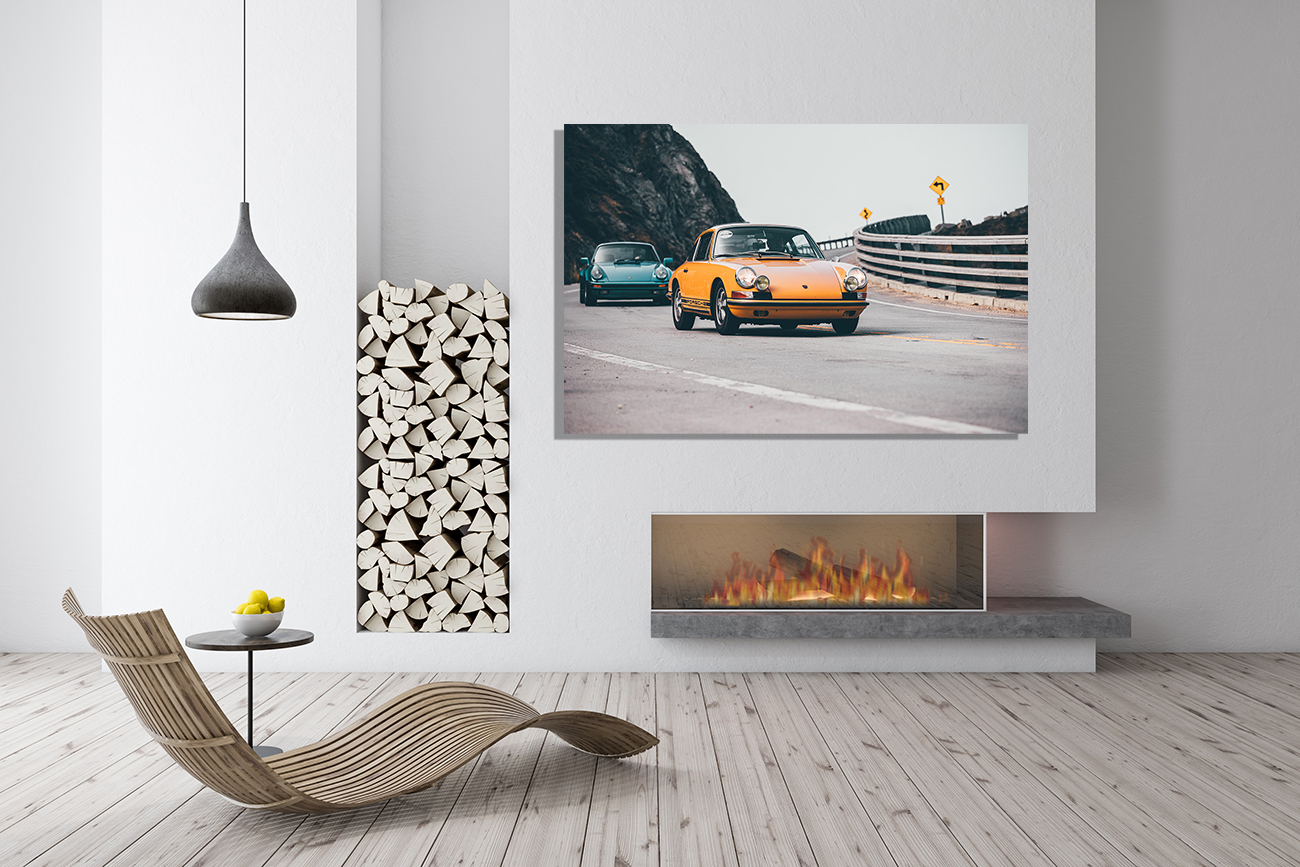
The choice of model depends above all on your personality and the atmosphere you want to create in your office. A few guidelines:
For a director’s office or strongly masculine space: competition classics — Ford GT40, AC Cobra, Ferrari 250 GTO — bring strong energy and historical legitimacy. These are cars that won, that made history. Their presence in an office sends an immediate signal about the ambitions of the person who works there.
For a creative or design-forward space: the Porsche 911, Jaguar E-Type or Mercedes 300 SL, with their sculptural lines, integrate naturally into contemporary environments. Their formal beauty echoes the clean lines of modern furniture.
For a minimalist or Scandinavian office: a black and white photograph — a Bentley, a Rolls-Royce, or a BMW M3 E30 — adds a powerful graphic touch without disrupting the color scheme of the space.
Black and White or Color: Which Works Best?
This is one of the most frequently asked questions. In an office, black and white has a decisive advantage: it integrates into any color palette. Whether your office is white, grey, natural wood or forest green, a B&W print will find its place. It also brings a timelessness that color photographs don’t always have.
Color, on the other hand, can create a focal point of remarkable intensity. The red of a Ferrari F40, the Gulf blue of a Ford GT40, or the Racing Yellow of certain Porsche 911s — these tones become chromatic accents that visually structure the space. The choice depends on your dominant palette: if your office is essentially neutral, a strong color accent may be exactly what’s missing.
Aluminium, Paper, Canvas: Which Medium to Choose?
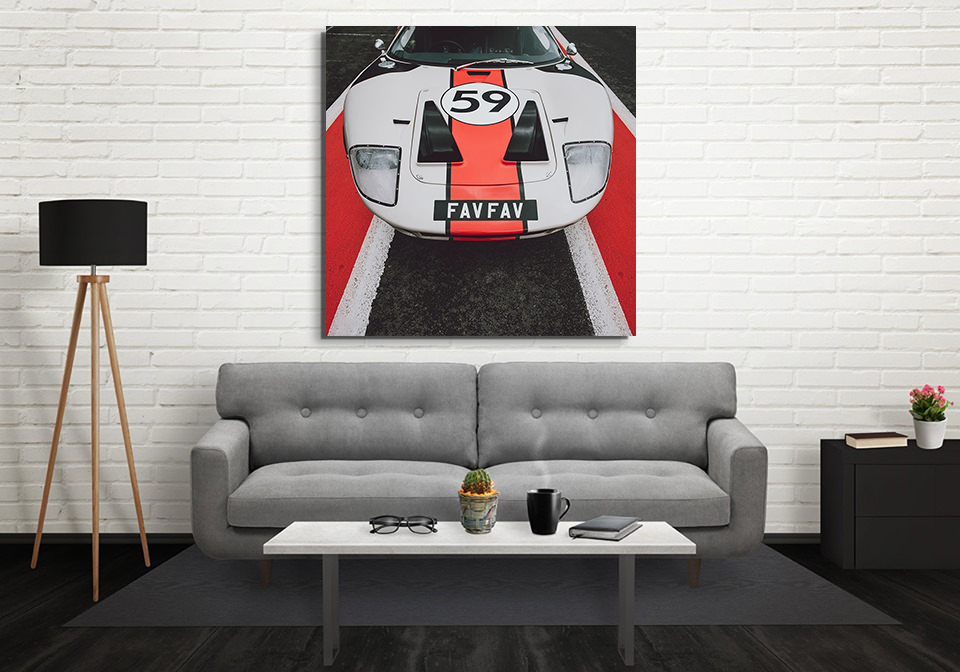
Aluminium Dibond is our primary recommendation for an office. Its slightly glossy surface captures light and gives exceptional depth to bodywork details — chrome reflections, cast shadows, carbon textures. Without frame or glass, it hangs directly on the wall with invisible spacers, for a very contemporary gallery look. It’s also moisture-resistant — an advantage if your office isn’t perfectly climate-controlled.
Fine Art Giclée paper 310 g/m², framed under anti-reflective glass, brings a warmth and texture that metal doesn’t have. It’s the choice of connoisseurs, those who appreciate photography the way they appreciate a drawing or watercolor. In a classic or traditional office, this framed format will impose itself naturally.
Stretched canvas is a more accessible intermediate option, but renders fine details less well — particularly noticeable on car photographs where metal texture and chrome are essential elements.
Size and Position — Our Practical Recommendations
The golden rule in an office: don’t undersize. A small print lost on a large wall has zero impact. Our recommendations by configuration:
The wall behind your desk (most visible on video calls): minimum 80×60 cm, ideally 100×70 cm. This is the highest-impact position — the one your contacts see, the one you look at when you raise your eyes. A quality photograph here sends an immediate signal about your personality and tastes.
Side wall (visible from the side): 60×40 cm to 80×60 cm, possibly as a diptych or triptych to create a visual corridor. Two or three photographs of the same model from different angles — front view, profile, detail — tell a coherent and sophisticated story.
See our complete guide on choosing the right photo print size for detailed recommendations based on your ceiling height and room dimensions.
What car photo works in a lawyer’s or doctor’s office?
For a professional cabinet with a sober, refined atmosphere, favour timeless classics in black and white: a Jaguar E-Type, a Bentley Continental, or a Rolls-Royce Silver Shadow. These models combine prestige and discretion. Recommended format: Fine Art paper, black or walnut wood frame, 70×50 cm or 80×60 cm.
Can I put a car photo in an open-plan office-living room?
Yes — it’s actually an ideal configuration. Fine art automotive photography works just as well in a living space as in a dedicated office. The key is choosing a model whose color palette talks to your furniture. Our article on large wall art for living rooms gives layout ideas equally applicable to an office-living space.
Do fine art prints hold up well under intense artificial office lighting?
Our aluminium Dibond and Fine Art Giclée paper prints are produced with archival inks resistant to fading for over 100 years under normal conditions. Intense LED artificial light does not damage the prints. Avoid direct exposure to UV sunlight on unprotected paper — in that case, aluminium is naturally more resistant.
Fine Art Guide
Transform Your Office Into a Private Gallery
Limited Editions · Fine Art Giclée · Aluminium Dibond · Ships in 5 business days