

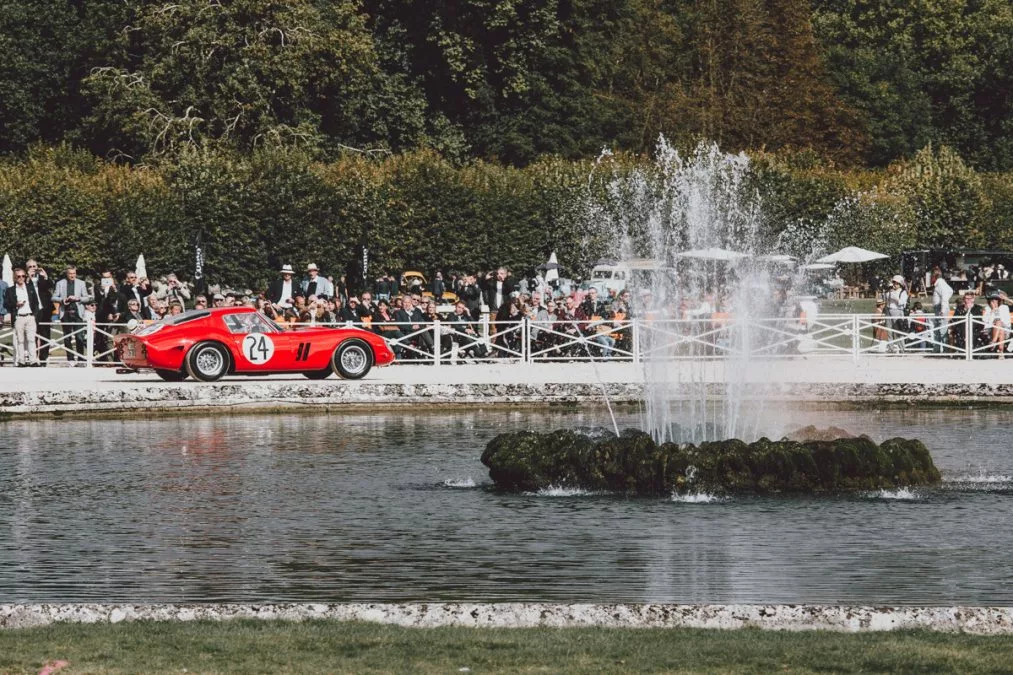
Some cars transcend engineering to become absolute works of art. The Ferrari 250 GTO is one of them — perhaps the only one that reconciles competition-bred mechanics with pure sculpture. To photograph it, or to display it in your home, is to choose a piece of living history.
Contents
- History of the Ferrari 250 GTO
- The 250 GTO Through the Lens
- Composition and Light for Perfect Fine Art Photography
- The 250 GTO in Your Interior
- Rarity and Artistic Value
History of the Ferrari 250 GTO: The Car That Should Never Have Existed
In 1962, the FIA required 100 units to be homologated for Gran Turismo competition. Ferrari declared 39. The rulebook was ignored, the stewards looked the other way, and a myth was born. Only 36 examples left Maranello between 1962 and 1964 — each numbered, each unique.
Powered by a 3-litre V12 producing 300 bhp, the 250 GTO dominated Le Mans, the Mille Miglia and the Tour de France Automobile. Three consecutive World Manufacturers’ Championship titles (1962, 1963, 1964) closed an unrepeatable era. When turbos and modern aerodynamics arrived, this model was already legend.
Today, examples sold at auction fetch between $40 million and $70 million. This is not just a car — it is the most valuable tangible asset in motorsport history. And its silhouette — curves that Scaglietti traced by hand in clay — remains unsurpassed.
The Ferrari 250 GTO Through the Lens: A Major Photographic Challenge
Photographing a 250 GTO is nothing like photographing a modern supercar. Encounters are rare: Concours d’Élégance events such as Chantilly Arts & Élégance, Villa d’Este, or the private paddocks of Pebble Beach. Every appearance is an unrepeatable moment.
The fine art automotive photographer works within a narrow time window. The golden hour at dawn or dusk is the perfect ally: the sinuous flanks of the Berlinetta body catch the raking light and create a play of volumes that no studio flash can replicate.
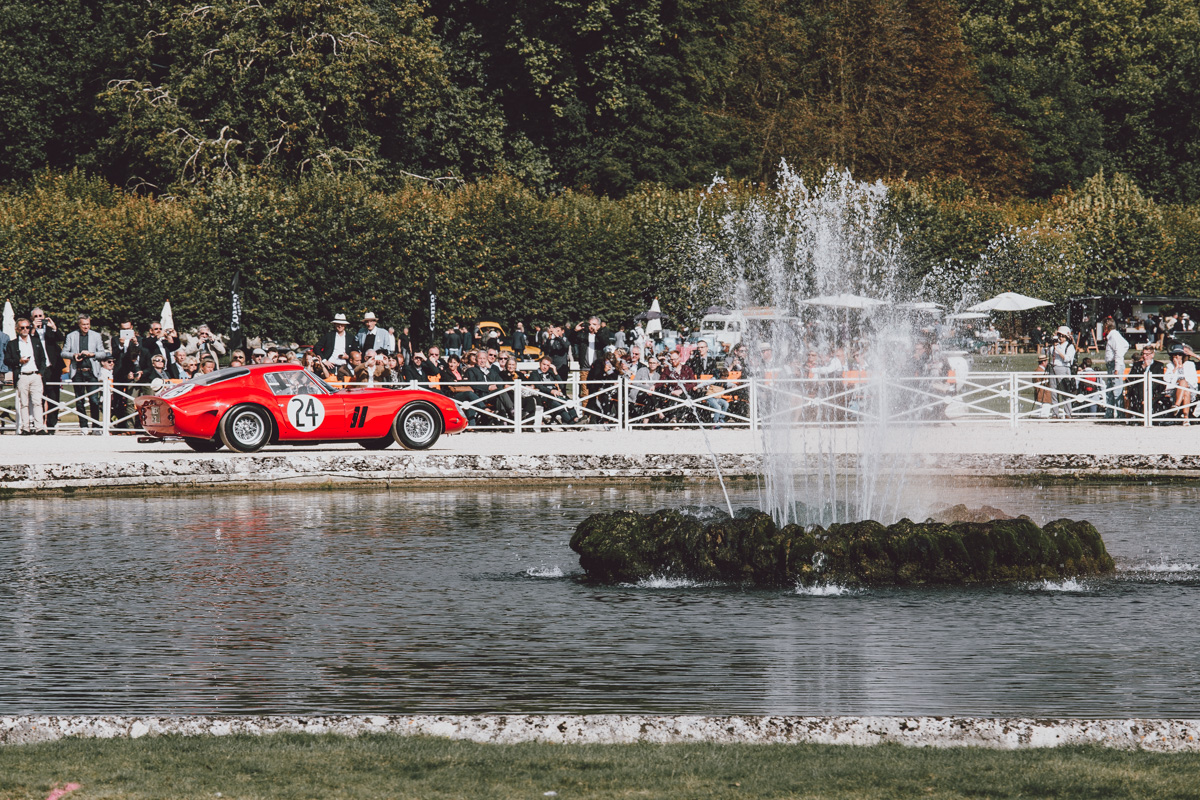
The finest photographers in this genre — including those whose prints you’ll find at Cars and Roses — spend months preparing before an event: studying light by hour and season, selecting angles that emphasise the triple front grille or the three-quarter rear view that makes the model unmistakable.
Composition and Light: The Secrets of Perfect Fine Art Photography
Fine art photography of classic cars follows very different compositional rules from sports reportage. The goal is not to freeze a tenth of a second in a corner — it is to create an image that will endure for decades on a living room wall.
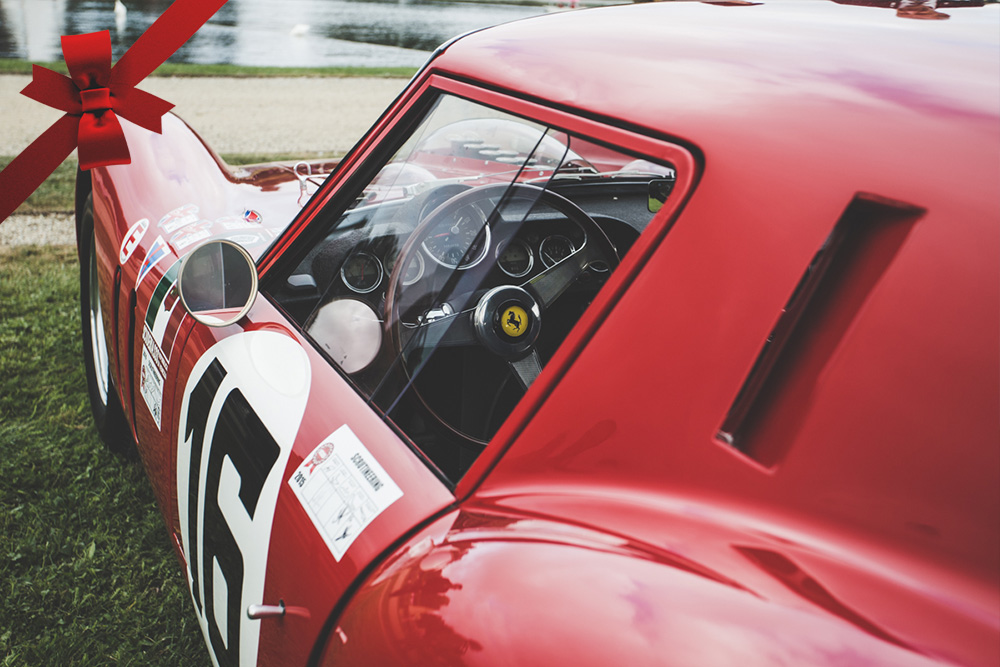
For the 250 GTO, the three most powerful angles are: the front three-quarter view (showcasing the shark nose and air intakes), the pure side profile in contre-jour (turning the silhouette into calligraphy), and the detail of the minimalist cockpit with its wooden steering wheel and Veglia instruments. Each tells a different story.
The choice of medium also forms part of the final composition. A baryta paper print with a matte finish softens specular highlights on the bodywork and adds tonal depth. Dibond aluminium, by contrast, accentuates contrasts and gives the image an almost sculptural presence against stone or concrete walls.
The Ferrari 250 GTO in Your Interior Design
A fine art print of the 250 GTO does not require a collector’s mansion. It works with equal power in an urban loft with white walls, a high-end boardroom, or an architecture studio that sweats every visual detail.
The historic Rosso Corsa red of the model pairs beautifully with warm woods and golden metals. For more neutral or Nordic interiors, black-and-white prints are the definitive choice: they strip away colour and leave only the lines, turning the automobile into pure sculpture.
In large format (100×70 cm or above), the image becomes the focal point of the room. At medium scale (60×40 cm), it integrates perfectly into a mixed gallery wall alongside other fine art prints. From $78, Cars and Roses’ numbered limited-edition prints make a collector’s piece accessible.
Rarity and Value: The 250 GTO as Artistic Investment
The scarcity of the original 250 GTO means that fine art photographs taken under exceptional conditions are, in themselves, unrepeatable historical documents. A photographer who gains exclusive access to an example at Chantilly or Villa d’Este captures something no artificial intelligence can generate: a real moment, real light, a real car.
Numbered, signed limited-edition prints follow the same value logic as the cars they depict: the smaller the edition, the greater the exclusivity. Art collectors and motorsport enthusiasts now compete for the same pieces — a convergence of markets that did not exist ten years ago.
As a reference point, fine art prices for classic racing car photography have followed an upward trajectory parallel to the classic competition car market. The 250 GTO sits at the apex of both hierarchies.
Frequently Asked Questions
How many Ferrari 250 GTOs were built?
Just 36 examples between 1962 and 1964, plus 3 Series II bodies in 1964. Each example carries a unique chassis number. It is the rarest homologated competition car in modern motorsport history.
How much is a Ferrari 250 GTO worth today?
Between $40 million and $70 million at public auction. The all-time record was set in 2018 at $48.4 million USD at RM Sotheby’s — the most expensive car ever sold at auction.
What size should I choose for a Ferrari 250 GTO fine art print?
For large rooms, a panoramic 120×80 cm format on Dibond aluminium delivers sculptural presence. For more intimate interiors, 60×40 cm on matte baryta paper is the classic choice. Black and white emphasises the lines; colour preserves the drama of Rosso Corsa.
Where can I see a Ferrari 250 GTO in person?
At events such as Chantilly Arts & Élégance (France), Goodwood Revival (UK) or Villa d’Este (Italy). The Ferrari Museum in Maranello occasionally displays historic examples. The vast majority remain in private collections that are rarely exhibited publicly.
Fine Art Automotive Photography
Ferrari 250 GTO — Limited Edition Prints
From $78 · Numbered & certified · Worldwide shipping
Read Also
- Ferrari F40 Photography: Limited Edition Fine Art Print
- Bugatti Veyron: Fine Art Photography of the Hypercar
- Mercedes 300 SL Gullwing: The Wings That Defined an Era
Want this holy grail on your wall? Discover our Ferrari 250 GTO fine art print, available in limited edition.