

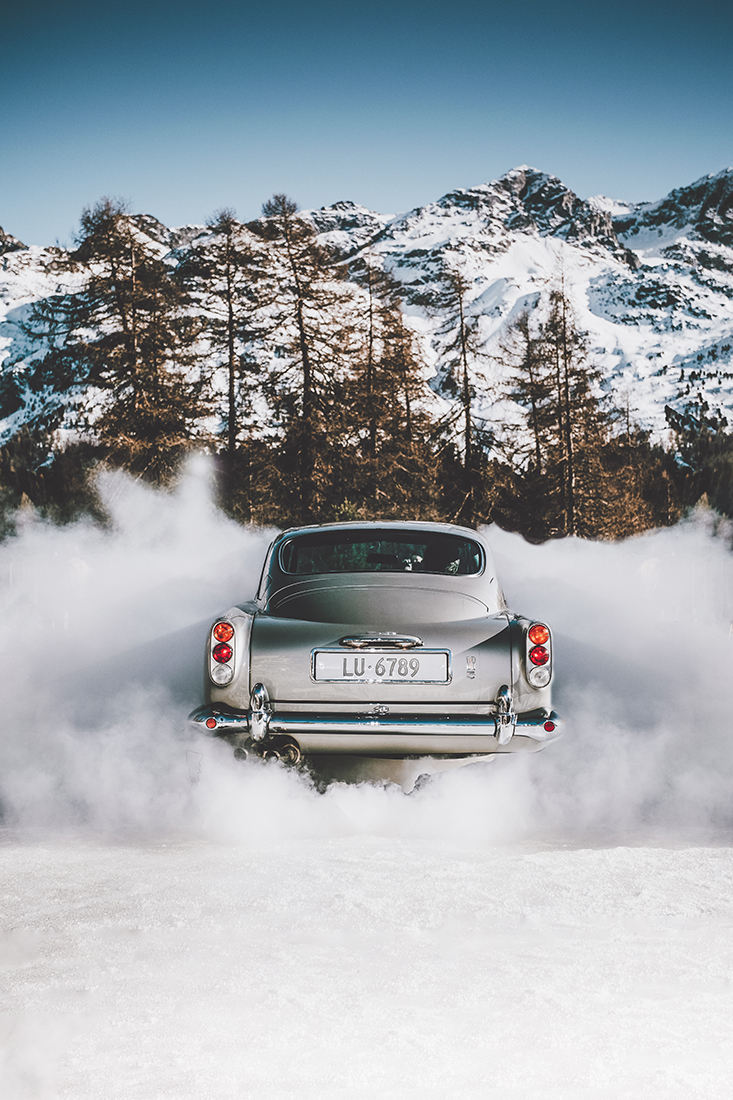
In 1963, Aston Martin unveiled a grand tourer that would outlast its own era. Penned by Ercole Spada, built in just 1,059 examples, it became — through Sean Connery’s hands and the lens of a Bond camera — something beyond an automobile: the definitive symbol of British elegance. Sixty years later, fine art photography has found in the DB5 its most enduring subject.
🛒 Browse the full fine art collection — From €78
Contents
- Why the DB5 Design is Still Untouchable
- The Bond Effect: How a Car Became a Cultural Icon
- What Makes the DB5 So Compelling in Fine Art Photography
- How to Hang an Aston Martin DB5 Print in Any Interior
- The DB5 as a Collector’s Statement
Why the DB5 Design is Still Untouchable
There is a short list of cars whose design has become, over time, a pure form — independent of era, immune to fashion. The Ferrari 250 GTO, the Jaguar E-Type, the first-generation Porsche 911. The Aston Martin DB5 belongs to that circle, and arguably leads it.
What sets it apart is proportion and restraint. The oval grille, the round headlights, the long bonnet tapering into a fastback roofline — every element exists in conversation with the others. Nothing competes. Nothing is excessive. The DB5 is that rare car where the eye finds reward at every angle. The front is confident; the profile is drama; the rear is resolution. Shot with an 85mm lens, it fills the frame as if it were designed specifically to be photographed.
The Bond Effect: How a Car Became a Cultural Icon
Goldfinger (1964) changed everything. The DB5 entered cinema with its now-legendary gadgets, but it was the car’s sheer visual authority that captivated audiences worldwide. Sean Connery drove it as if he’d owned it forever. The Silver Birch grey became, overnight, the colour of masculine elegance at its most absolute.
The DB5 has since appeared in eight Bond films. This is not product placement — it is recognition. The franchise understood that the DB5 has what few cars possess: it is cinematically native. The camera is drawn to it without effort. It commands a scene the way a great actor does — by simply being present.
What Makes the DB5 So Compelling in Fine Art Photography
Among all classic cars, the DB5 transfers to fine art print with unusual fidelity. Its aluminium bodywork catches and distributes light in ways that create natural chiaroscuro — the curves become shadows become highlights in a sequence that rewards a long look.
In black and white, the DB5 becomes almost architectural. The graphic reduction of the grille, the elliptical headlights, the flowing roofline — these are shapes that belong as much in a gallery as on a road. In silver, it recaptures that cinematic authority that made it famous. Either way, a DB5 print carries immediate cultural weight: the viewer needs no caption to understand what they’re looking at, or what it means.

How to Hang an Aston Martin DB5 Print in Any Interior
Above a sofa: a 100×70 cm or 120×80 cm horizontal format. The length of the car plays across the wall in a way that anchors the room without overpowering it. The Silver Birch grey coordinates with almost any palette — from warm ivories to deep charcoals.
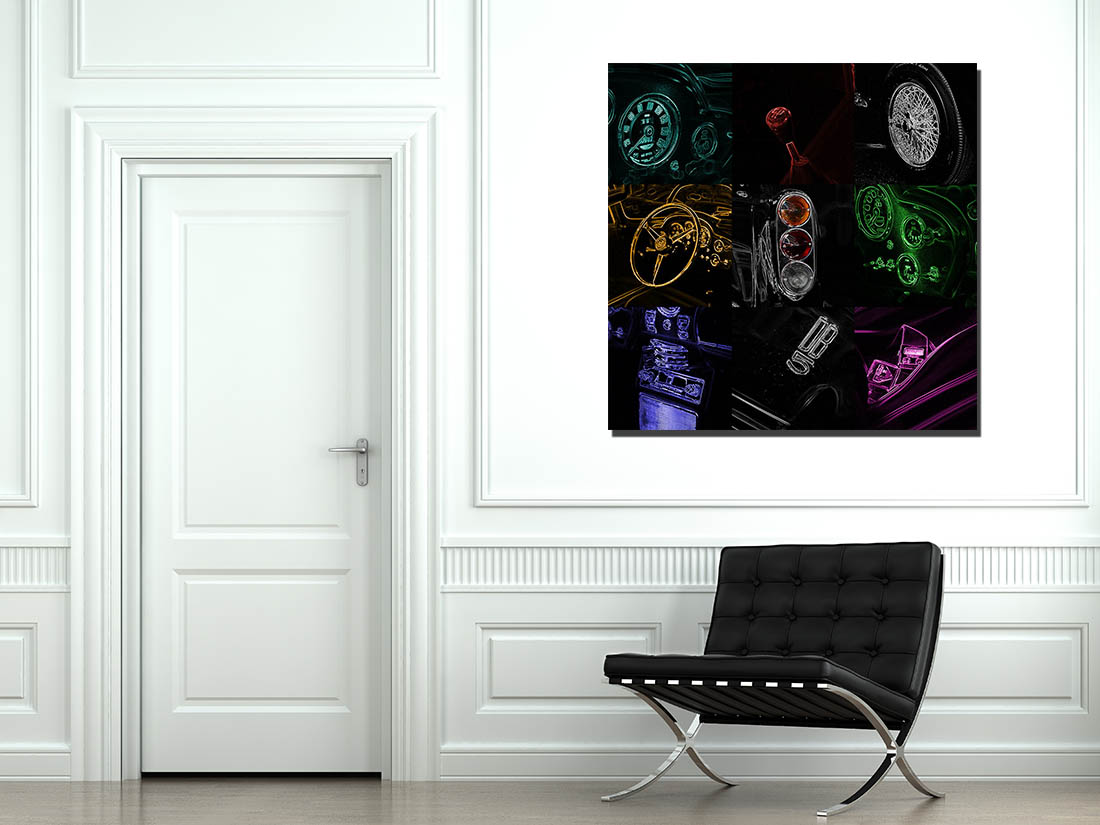
In a home office: a square or vertical crop focusing on the grille, the headlights, or the profile detail. Visible on video calls, it communicates taste and passion without needing an explanation. In an entryway: a large format (160×120 cm) DB5 is one of the most memorable possible ways to greet a guest — it sets the character of a home from the very first moment.
On aluminium dibond, the silver bodywork gains a metallic resonance that deepens the image. Under plexiglass, the blacks are richer and the photograph takes on a cinematic quality. Both approaches work — the choice is one of interior style rather than image quality.
The DB5 as a Collector’s Statement
Only 1,059 DB5s were ever built. Of those, a fraction survive in original condition. The car itself now trades at between €800,000 and €2,000,000+ depending on provenance and history. A limited-edition fine art print of the DB5 offers something the car itself cannot: it is available, it is displayable, and it speaks the same visual language.
A numbered print from an edition of 30 or 50 carries its own rarity logic. It is not a poster. It is not a reproduction. It is a photographic work made with the same editorial care that went into choosing the car, the light, the angle. The DB5 deserves that treatment — and returns it.
🛒 Browse the full collection — From €78
FAQ — Aston Martin DB5
How many Aston Martin DB5s were made?
Between 1963 and 1965, Aston Martin produced 1,059 DB5s, including 123 Volante convertibles. This extremely limited production run makes it one of the rarest British grand tourers of the classic era.
Why is the DB5 associated with James Bond?
The DB5 first appeared in Goldfinger (1964), fitted with now-iconic film gadgets. Its exceptional visual presence and Sean Connery’s effortless ownership of the car created an association that has proved permanent. It has appeared in eight Bond films since.
What is an Aston Martin DB5 worth today?
A well-maintained DB5 now commands between €800,000 and €2,000,000+ depending on configuration, history, and condition. Examples with Bond provenance or factory-correct restoration regularly exceed this range. Values have appreciated steadily for two decades.
What colour was James Bond’s Aston Martin DB5?
The Goldfinger DB5 was painted Silver Birch — a pale silver-grey that has since become the most recognisable colour in classic car history. It remains the most sought-after specification for collectors.
What size DB5 print works best for a living room?
For a standard living room, a 100×70 cm or 120×80 cm horizontal format is ideal above a sofa. For larger open-plan spaces, a 160×120 cm print creates a gallery-level statement. The DB5’s horizontal proportions suit wide formats exceptionally well.