

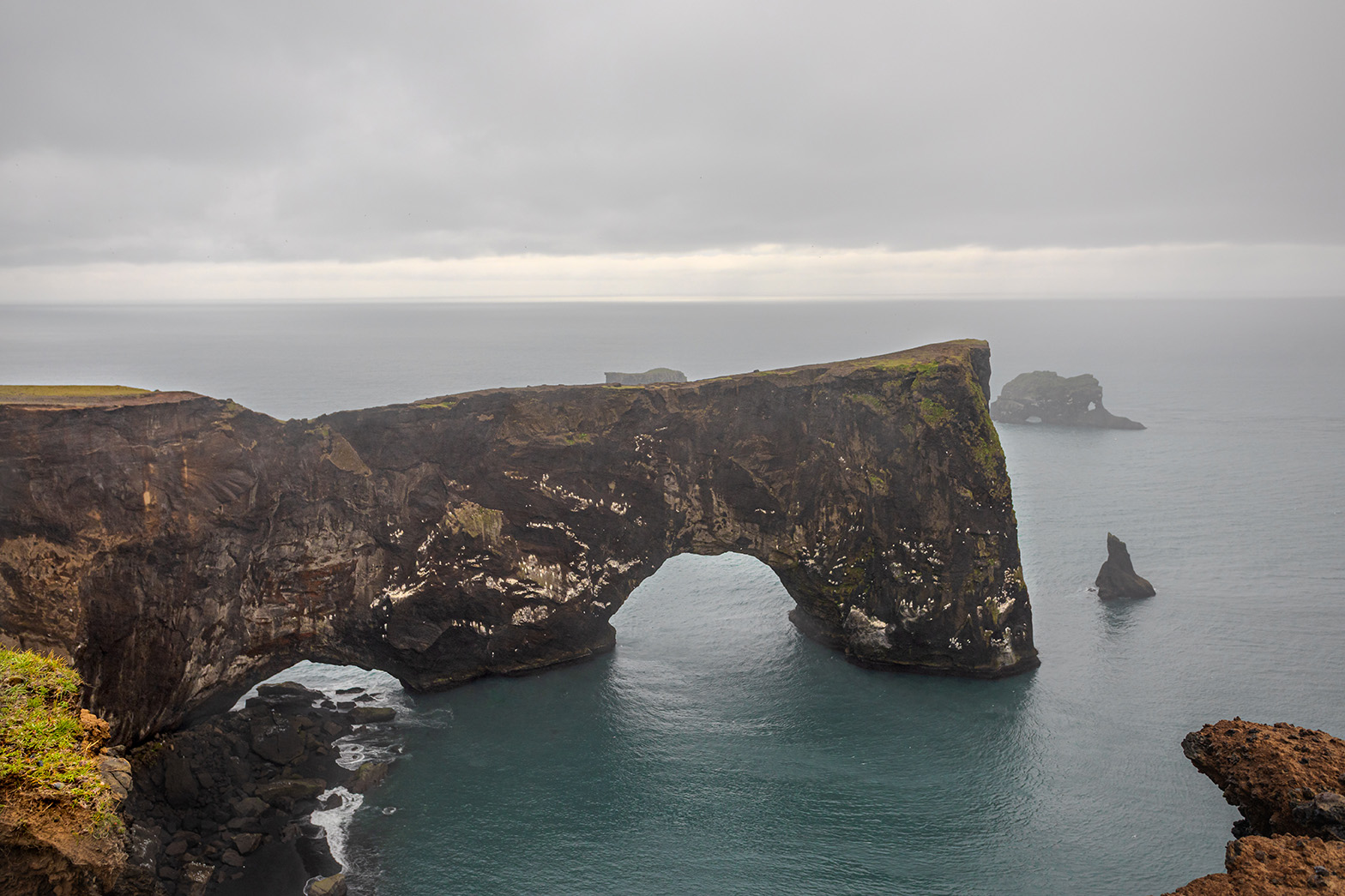
A strong landscape photo rarely happens by accident. It is built through placement, restraint, and an exact reading of subject, light, lines, and edges.
Key composition principles for great landscape photography
Rule of thirds, horizon placement, and focal points
The rule of thirds offers a reliable starting structure. By dividing the frame into nine equal sections, it gives the horizon and the main subject positions that feel stable without becoming rigid.
- Horizon on the lower third: This gives more space to the sky, allowing clouds, shifting light, and open atmosphere to carry the image.
- Horizon on the upper third: This shifts emphasis to the foreground, where texture, pattern, and detail become dominant.
- Power points: The four intersections of the grid are natural resting points for the eye, and research on visual attention shows the viewer tends to settle there first.
- Avoiding centered framing: A centered horizon often weakens balance unless the symmetry is intentional and the angle clearly supports it.
Once that structure is in place, the subject must be unmistakable: a mountain ridge, a stand of trees, a road, or a band of light on water each anchors differently, and the choice determines where the eye ultimately rests.
Placement determines everything else in the frame. For deeper guidance, landscape composition tips from Cars and Roses present clear, visually grounded methods for building stronger landscape photography examples.
Leading lines and depth in landscape composition
Once the subject is established, lines give the image its movement. Some of the clearest landscape photography examples rely on leading lines: a river drawing the viewer toward distant peaks, a road narrowing into the background, or a fence cutting across open land.
The difference lies in direction. Diagonal lines add tension, curved lines feel more natural, and converging lines create depth by pulling the eye toward a vanishing point.
Effective leading lines usually begin near the edges of the frame and travel with purpose toward the subject. By contrast, stray lines in the background distract rather than guide, weakening the composition and the overall framing.
Framing, layering, and visual storytelling techniques
From there, depth depends on structure. A convincing scene in landscape photography often rests on three layers: foreground, middle distance, and background, each carrying enough weight to support the whole without disturbing balance.
- Natural framing: Tree branches, rock arches, mountain forms, or overhanging vegetation can surround the subject and direct the viewer inward.
- Human-scale references: A hiker, a path, or a small cluster of trees gives scale to wide terrain and makes vast spaces legible.
- Angle and vantage point: A low angle enlarges the foreground and intensifies presence, while a higher viewpoint reveals the spread of the land and clarifies composition.
Discipline at capture holds all of it together. When framing, lighting, camera settings, and composition support the same visual idea, the landscape photography collection at Cars and Roses shows how those choices shape work made for lasting display.
How lighting and color transform good landscape photography
Composition gives a landscape photo its structure. Lighting sets its register, and the same subject can shift completely from one exposure to the next depending on the hour, the weather, and the balance between bright and dark areas.
Golden hour and atmospheric light conditions
Once composition is established, light becomes the detail that changes everything. At sunrise and sunset, low-angle lighting softens edges, draws out texture in the foreground, and lets warm tones meet cooler areas in the background with far more nuance than midday light.
- Sunrise: Often brings cleaner air, gentler light, and subtler shadows, which helps reveal surface detail across foreground elements without flattening the scene.
- Cloudy days: A layer of clouds diffuses the light and reduces contrast, an approach well suited to forests, rivers, and quieter forms of landscape photography where even exposure matters.
- Shadows: Cast shadows along ridges, rocks, or vegetation describe form clearly and guide the viewer through the composition with a natural visual rhythm.
- Patience with conditions: Waiting for a break in the clouds or a shift in lighting often turns a technically correct frame into a good landscape photo.
From there, atmospheric perspective strengthens depth without forcing the effect. The foreground remains more defined, while the background falls into softer, cooler tones, a transition that supports what makes good landscape photography when exposure, light, and spatial relationships are handled with precision.
Color balance, tone contrast, and visual hierarchy
That sense of depth continues through color. Creative landscape photography depends on deliberate balance: brighter and warmer elements carry the eye first, while darker or cooler passages recede toward the edges and give the viewer a clear path through the landscape.
Control matters more than intensity: a restrained palette, precisely exposed, reads with greater clarity than saturated colour pushed past the scene’s natural range.
Observation and patience as creative photography tools
Once color and light are understood, timing becomes part of the craft. Allowing 5 to 30 minutes before shooting gives changing shadows, passing clouds, and small shifts across the background time to reveal stronger relationships between elements.
From there, that interval also exposes compositional details invisible at first glance: a foreground line concealed by shadow, or an edge sharpened once passing clouds clear.
Camera settings and locations for landscape photos that hold atmospheric depth and clean tonal range
Technical control and location knowledge belong together. In landscape photography, strong composition and refined lighting achieve little if camera settings soften the frame, or if the place itself offers no convincing foreground, background, or defining elements.
Essential camera settings and tripod use for beginners
Control over exposure is what separates a competent landscape shot from a precise one. Understanding what makes great landscape photos means managing exposure with intention: aperture, shutter speed, ISO, and depth of field determine whether landscape shots retain detail, structure, and clean light from front to back.
- Aperture priority mode: A practical starting point for landscape photography; the photographer selects aperture and ISO, while the camera adjusts shutter speed automatically.
- High f-stop values: An aperture from f/7.1 to f/16 helps extend depth of field, keeping foreground and background in focus across a landscape photograph.
- Tripod use: A tripod remains essential in low light, especially when slower shutter speeds are needed to preserve exposure without camera shake.
- RAW format: RAW preserves maximum image data and gives far greater latitude when refining lighting, color, and tonal balance after capture.
A sturdy tripod should include spiked feet and rubber overshoes for uneven ground. For handheld work, a reliable guideline remains this: shutter speed should be at least double the focal length to maintain sharp lines and stable detail.
The same photography tips apply to dedicated cameras and smartphones, particularly when angle, exposure, and composition need to work together quickly in changing conditions.
| Setting | Recommended value | Purpose |
| Aperture | f/7.1 – f/16 | Maximizes depth of field across the full scene |
| Shutter speed | Varies (tripod recommended) | Controls motion blur and exposure duration |
| ISO | As low as possible | Minimizes digital noise in landscape shots |
| File format | RAW | Full post-processing latitude for light and color |
| Mode | Aperture priority | Balances manual control with automatic shutter selection |
Best landscape photography locations and what makes them special
A location shapes the available light, the visible lines, the relationship between foreground and distance, and the kind of composition a photographer can build with confidence.
- Iceland, Jökulsárlón: Glaciers, volcanoes, and waterfalls define the region, while sunrise often reveals iceberg reflections that reward patience and careful angle selection.
- California, Yosemite: Granite walls, giant sequoias, and the Sierra Nevada offer nature photography on a monumental scale, with shifting light that tests camera settings throughout the day.
- Svalbard: Polar terrain and the Northern Lights create unusual lighting conditions, ideal for photographers seeking atmosphere, clean forms, and landscape photos with real depth.
- Miami, Ocean Drive: Art Deco lines, white sandy beaches, and sunset tones produce a striking meeting of built structure and coastal background.
Focal length, shutter speed, exposure, and aperture must adapt to the land itself, whether the goal is expansive landscape shots, intimate nature photography, or a single landscape photograph built around precise balance.
Beyond the frame, Cars and Roses has curated location-specific guidance on how terrain, season, and available light reshape camera settings and compositional decisions. The landscape photography tips curated by Cars and Roses show how camera settings, light, composition, and patient observation come together in landscape photographs that hold atmospheric depth and clean tonal range.
Frequently asked questions
What makes a successful landscape photo?
A successful landscape photo begins with a clear subject and disciplined composition. The difference lies in how the frame is organised: leading lines, considered framing, and a thoughtful placement of foreground and background give the image structure and depth.
From there, appropriate camera settings, a considered aperture for depth of field, steady support from a tripod, and RAW capture help preserve detail, light, shadows, and tonal contrast across the scene.
What camera settings are best for landscape photography?
For landscape photography, aperture priority mode remains a reliable starting point. An aperture between f/7.1 and f/16 usually keeps both foreground and background sharp, while a low ISO protects fine detail and clean tonal transitions.
From there, shutter speed should follow the available light. A tripod allows slower exposures without blur, and RAW capture preserves flexibility when refining lighting, recovering shadows, or managing bright clouds in post-processing.
How does lighting affect a landscape photo?
Lighting shapes the character of a landscape photo at every stage of capture. Golden hour, around sunrise and sunset, brings soft light that reveals texture, extends shadows, and strengthens separation within the composition.
By contrast, harsh midday light tends to flatten the subject and compress tonal variation. Worth considering when conditions shift: clouds and overcast skies introduce the detail that changes everything.