

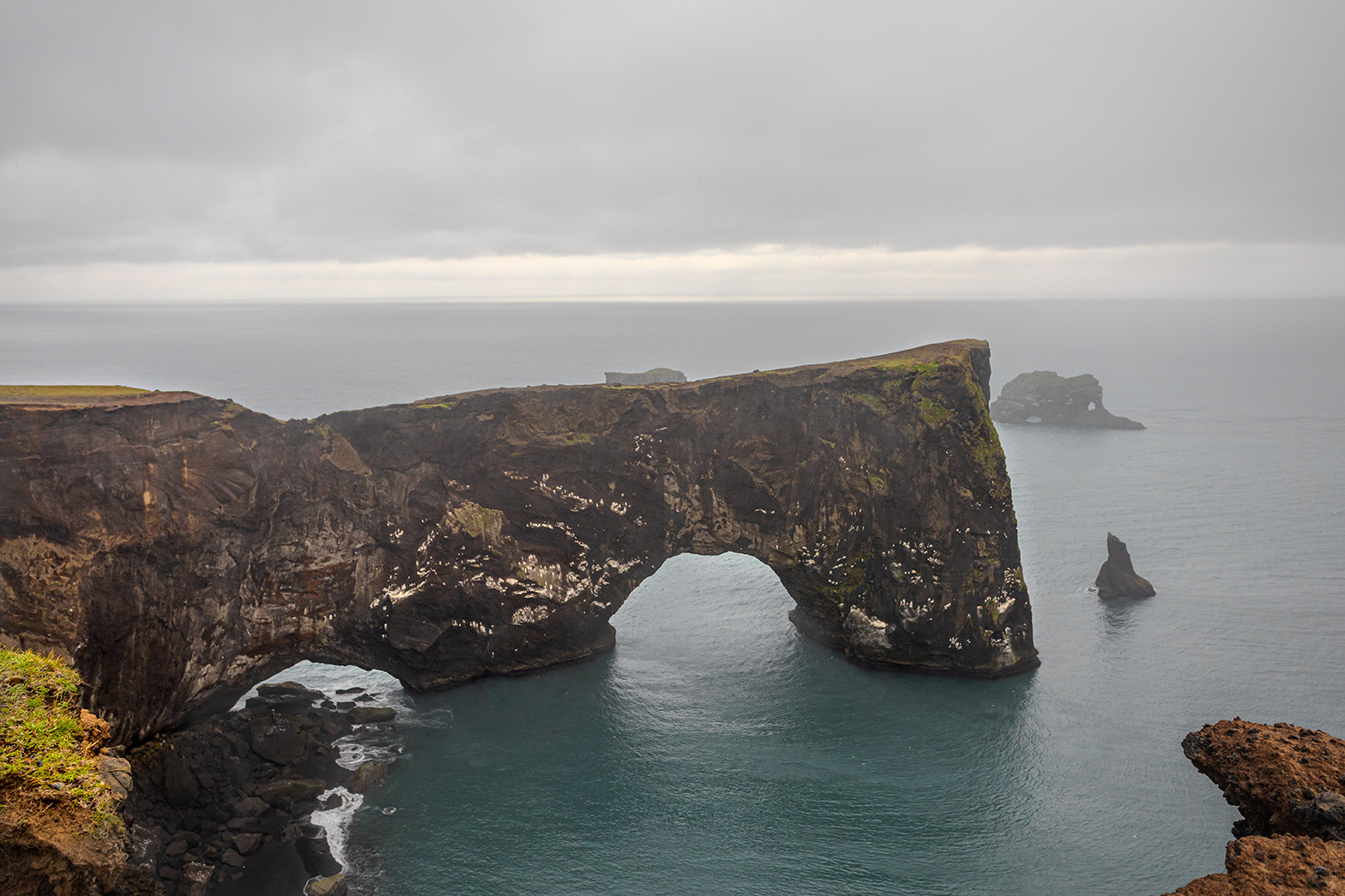
This complete photography guide covers practical landscape photography for beginners: composition fundamentals, essential camera settings, light strategy, and post-processing workflow.
The rule of thirds and golden rules of landscape photography
Before any exposure is made, the frame must decide where the eye will go, how the subject will hold attention, and whether the image reads as considered rather than merely pleasant. The rule of thirds provides a clear structure for those decisions.
What is the rule of 3 in landscape photography?
The rule of 3 in landscape photography divides the viewfinder into nine equal sections with two horizontal and two vertical lines. The four intersections, often called power points, are where the main subject gains the strongest visual focus. Research has shown that viewers tend to spend longer with images arranged this way, suggesting that the grid aligns closely with natural visual processing.
From there, one decision matters immediately: the horizon. In most scenes, composition begins by choosing whether that line sits high or low, because placement determines what receives the greater share of attention.
- Lower-third horizon places the horizon on the bottom grid line, giving the upper two-thirds to cloud structure, changing light, or the color shift that often defines sunrise.
- Upper-third horizon moves the horizon near the top of the frame so the foreground can carry the image: wet sand, rock texture, flowers, or reflections become the primary subject.
- Centered horizon is usually weaker because it splits the frame into equal halves and reduces visual direction, especially when shooting landscape without strong symmetry.
Once the horizon is set, the image still needs an anchor. A tree, boulder, waterfall, or distant summit placed on one of those intersections gives the eye a place to settle; without it, even accurate exposure and careful camera settings can leave the photograph unresolved.
How to apply the golden rule to your compositions
The golden rule of landscape photography is best understood as an order of decisions rather than a single formula. Four decisions, applied in sequence, cover most situations a beginner will encounter in the field.
- Level horizon: use the camera’s electronic level, the grid display, or a tripod with a spirit level to keep the frame straight, correcting later only when necessary.
- Power point placement: set the main subject on one of the four intersections rather than in the center to create stronger movement and clearer hierarchy.
- Negative space: leave room around the subject so the composition can breathe and remain flexible in post-processing.
Cars and Roses recommends treating this as the golden rule of landscape photography: the difference lies in whether the frame simply records a place or actively guides the viewer through it.
Using leading lines and framing to strengthen your shot
Once subject placement is secure, leading lines become essential. Rivers, roads, shorelines, fences, and dune curves can lead from the foreground toward the main subject, reinforcing the rule of thirds and strengthening focus across the frame. Diagonals add momentum. S-curves feel especially natural in landscape photography.
By contrast, framing works by containment. Tree canopies, ridges, or stone arches can surround the subject and hold attention without stealing it, helping light, form, and depth stay coherent within the composition.
Beyond the frame, the same logic applies to camera settings and support. A tripod stabilizes the composition for low-light work at sunrise, helps refine the horizon, and gives a beginner time to assess leading lines, foreground balance, and exposure before committing to the shot.
The 4 pillars and core landscape photography techniques
Landscape photography rewards structure. A strong frame rarely depends on composition alone: light, timing, and post-processing carry equal weight, and a single weak pillar undermines the others.
Composition, light, timing, and post-processing explained
The 4 pillars of landscape photography—composition, light, timing, and post-processing—function as one system, not four separate tasks. Composition gives the image its architecture; light sets tone and clarity; timing decides whether the scenery aligns with the photographer’s intent; post-processing brings the file closer to what the eye perceived through the lens. For a beginner, weakness in one area is rarely concealed by strength in the others.
Depth and layering landscape photography techniques for stunning landscapes
That interdependence becomes clearest in depth. Among practical landscape photography techniques, foreground layering often delivers the fastest improvement because it creates an immediate path into the frame: rocks, wildflowers, dead logs, or tussocks placed close to the camera establish presence at once. From there, the eye moves through a defined middle distance before settling into a softer background.
That three-part structure mirrors natural depth perception. The foreground appears sharp and substantial, the middle ground remains legible, and the distance softens through atmospheric perspective; a photograph earns its place when those zones feel distinct rather than compressed into one flat plane. Even dramatic scenery loses force when tonal separation and clarity remain uniform from front to back.
Once that depth is in place, lines can guide it. Diagonals bring movement across the image, while S-curves in rivers, coastal edges, or mountain paths lend an especially fluid rhythm. A lower shooting position strengthens the foreground and enlarges the apparent scale of distant forms, all without changing focal length or reaching for a different lens.
Creative approaches beyond the wide-angle vista
The same command over depth and line invites a wider range of formats. A beginner benefits from testing other approaches before habits become fixed.
- Intimate landscapes: isolate smaller details within the wider scenery—a frost-covered leaf, sandstone pattern, or cluster of coastal pebbles—for images built on precision and restraint.
- Macro perspectives: a macro lens brings fine natural textures forward, turning detail into subject and giving the foreground unusual authority.
- Aerial perspectives: drone work reveals geometry from above, including field patterns, river meanders, and coastal shapes that disappear at ground level.
- Portrait and square orientations: a vertical frame suits waterfalls, cliff faces, and forest canopies, while a square composition can quiet the image; the right finish depends on whether the subject asks for height, balance, or containment.
Cars and Roses recommends this landscape photography resource for studying how a single location—Iceland’s glacial lagoons, for instance—responds differently to composition choices across changing light.
Essential landscape photography settings and equipment tips
Landscape photography begins with control. Aperture, shutter speed, and ISO form the technical basis for every exposure decision, and a consistent starting point helps a beginner work with more confidence when light changes quickly in the field.
From there, camera settings become easier to judge. A dependable baseline leaves more attention for composition, foreground placement, and the changing character of light.
Aperture, ISO, and shutter speed for sharp landscapes
For a beginner, manual mode remains the clearest place to learn. Use the camera’s built-in meter to set exposure, then begin with an aperture around f/5.6 and stop down to f/8 or f/11 as depth of field demands across foreground and background.
That adjustment has limits. On APS-C cameras, diffraction becomes noticeable beyond f/11; on full-frame bodies, it tends to appear beyond f/16, reducing sharpness no matter how stable the tripod may be. The difference lies in knowing when added depth of field starts to cost fine detail.
ISO should stay at the camera’s base setting: typically ISO 64 or ISO 100. Disable Auto ISO, because low ISO preserves dynamic range and keeps noise under control, which matters especially when photographing landscapes intended for large-format prints.
Shutter speed may remain relatively quick in bright conditions, or extend into longer exposures when water movement, fading light, or deliberate rendering of motion calls for it.
| Setting | Recommended starting value | Notes |
| Aperture | f/5.6 to f/11 | Stop down based on depth of field needs; avoid diffraction beyond f/11 (APS-C) or f/16 (full-frame) |
| ISO | 64 or 100 (base ISO) | Disable Auto ISO; high ISO degrades image quality and reduces dynamic range |
| Shutter speed | Varies by scene | Use longer exposures for moving water; a tripod is mandatory to eliminate camera shake |
| File format | RAW (14-bit preferred) | Lossless Compressed or Uncompressed; preserves full dynamic range for post-processing |
Tripod, lenses, and filters every beginner should know
With those landscape photography settings in place, equipment choices become more precise. A lighter kit is often sufficient, but three tools justify their weight from the first outing.
A tripod is one of them. It slows the process in a way that sharpens compositional attention as much as it eliminates camera shake.
- Wide-angle lenses: a lens of 24mm or wider is a strong starting point for photographing landscapes; it emphasizes the foreground, creates a greater sense of depth, and records the breadth often associated with landscape photography.
- Tripods for landscape photography: choose a model rated for at least twice the weight of the heaviest camera-and-lens combination; stability on uneven ground and in wind matters more than compact size.
- Polarizing filters: these reduce reflections on water and foliage, deepen blue skies, and increase contrast in a way that often looks more natural than heavy post-processing.
- ND and graduated ND filters: standard ND filters make longer exposures possible in bright daylight, while graduated ND filters darken a bright sky without affecting the foreground, helping preserve detail across a broad dynamic range.
With the tripod locked in and base ISO set, two in-camera noise options become relevant. Long Exposure Noise Reduction can be useful at extended shutter speeds, while High ISO Noise Reduction should remain off because disciplined landscape settings avoid high ISO in the first place.
RAW format and exposure bracketing for better results
Beyond the frame, file choice determines how much of the scene remains available later. RAW capture preserves the unprocessed data that JPEG throws away: highlight detail, shadow information, and white balance flexibility all remain intact for editing. Cars and Roses recommends 14-bit RAW whenever the camera allows it, ideally in Lossless Compressed or Uncompressed form.
That latitude becomes especially valuable in difficult light. Exposure bracketing records the same composition at multiple values—such as -1 EV, 0 EV, and +1 EV—so detail can be preserved in shadows and highlights together, whether for blending or HDR work.
A tripod keeps those frames aligned. The histogram then becomes the clearest field reference for exposure: a graph weighted heavily to the left suggests underexposure, while one pushed too far right indicates clipped highlights. A photograph earns its place when technical control supports what the scene actually offers.
Lighting, timing, and visual planning for landscape photography
In landscape photography, light is never incidental. It governs every decision that follows: timing, camera position, foreground placement, and even the choice of gear. A strong composition can still fall flat when the light is wrong, which is why visual planning matters as much as exposure, ISO, or lens selection.

Golden hour and blue hour explained for beginners
That governing role of light is most legible at the edges of the day. Golden hour landscape photography, taken during the first hour after sunrise and the last hour before sunset, is valued for its low-angle light: warmer in tone, directional in character, and far better at revealing texture across rocks, sand, water, and vegetation. Midday light tends to flatten those surfaces; early and late light restores structure.
By contrast, blue hour appears just before sunrise and just after sunset. Its cooler ambient light suits seascapes, mountain silhouettes, and mist-filled valleys, where restraint and atmosphere carry the frame. The difference lies in the color temperature: golden hour reads warm and tactile, while blue hour feels quieter and more distant.
For a beginner, timing alone is not enough. The sun’s direction must also suit the subject, especially when ridgelines, water, or leading lines depend on side light to read clearly. Cars and Roses treats that alignment as the detail that changes everything.
How weather and seasons affect your landscape shots
Once timing is understood, weather becomes the next variable. It changes the behavior of light across the land: mist softens edges, fog isolates forms, and passing rain deepens color while building cloud structure that clear skies rarely provide.
Those conditions matter most in brief transitions. The minutes before sunrise and just after sunset often shift rapidly, leaving little margin for hesitation. Arrive early, with settings, gear, and framing already considered, so the best light is spent photographing rather than adjusting.
From there, the seasons reshape both the light and the subject itself. Winter reveals structure by stripping foliage; autumn saturates forests and hillsides; spring introduces wildflowers and fuller rivers that can transform the foreground entirely. Returning to the same location across the year builds a more precise sense of what each season reveals and what it hides.
Scouting and planning locations before you shoot
That seasonal awareness begins before arrival. A strong landscape composition guide helps identify leading lines, power points, and usable foreground elements before stepping into the field.
Digital tools make that preparation practical. Google Earth and dedicated planning apps allow sun angle, shadow direction, terrain shape, and likely seasonal conditions to be assessed in advance. Preparation of this kind reduces guesswork when the light window is short and the weather is changing.
- Google Earth scouting: use satellite imagery and 3D terrain views to assess composition, locate foreground options, and understand how the geometry of the land will interact with the sun at different times of day.
- Online image research: reviewing existing photographs of a location shows which viewpoints are already familiar and which angles may still feel fresh.
- Scale reference planning: including a person, building, or vehicle in the frame gives immediate scale and adds temporal context through clothing or architecture, worth considering when the size of the landscape is the main subject.
- Weather app integration: track cloud cover, wind direction, and precipitation for the exact location; mist and post-storm clearing light often produce the most distinctive results.
Beyond the frame, finished work reflects the same discipline. The landscape photography collection at Cars and Roses shows how planned light, careful scouting, and seasonal awareness can hold together at any print size. Nothing essential, in Cars and Roses’view, should be left to chance.
Post-processing workflow and developing your landscape photography style
A well-composed, correctly exposed raw file marks the beginning, not the conclusion. Post-processing shapes the camera’s data into an image that reflects both the scene as it appeared in light and the photographer’s intention, and for the beginner, a consistent raw workflow prevents random adjustments from weakening the final result.
RAW editing basics every beginner photographer should master
That foundation starts with the histogram. Before any slider is moved, tonal distribution reveals whether highlight or shadow recovery is needed and how much room remains in the exposure; from there, edits should follow a clear sequence to preserve image quality and maintain control over focus, tone, and color.
- Exposure and white balance: correct global exposure first with the exposure slider, then set white balance to suit the scene—warmer for golden hour, cooler for blue hour, mist, or subdued mountain light.
- Shadow and highlight recovery: reduce highlights to recover sky detail, and lift shadows to restore texture in the foreground; raw files retain far more recoverable information than JPEGs.
- Contrast and clarity: use contrast to separate tonal planes across the frame, while clarity adds micro-contrast to surfaces such as rock, bark, or water; the detail that changes everything is restraint, since heavy-handed use quickly makes landscape photography look processed rather than observed.
- Sharpening and noise reduction: apply sharpening last, with output in mind; at base ISO, noise reduction should remain modest and should address only residual noise introduced by recovering deeply underexposed areas.
From there, color deserves similar discipline. Over-saturation remains one of the most common errors in landscape photography, because exaggerated color strips a scene of visual credibility; increases should be gradual, checked on a calibrated display, then reviewed again after stepping away briefly to reset perception.
Dodging, burning, and tonal adjustments for depth
A beginner learns dodging and burning, since these tools brighten key areas, subdue distractions, and guide the eye without visible intervention. Once installed with care, these adjustments shape attention without announcing themselves.
That control affects depth as much as attention. Bright, warm tones placed near the point of focus tend to advance, while darker, cooler passages recede toward the edges; the difference lies in how naturally the image leads the eye, especially when bright sky, roadside structures, or cluttered margins compete with the subject.
By contrast, flat tonal treatment weakens spatial separation. Deliberate tension between warm and cool color, together with careful management of foreground brightness, gives landscape photographs a greater sense of dimension, even when the original exposure was made under restrained or overcast light.
Finding your creative voice in landscape photography
In the early stages, experimentation matters more than consistency, because chasing a fixed aesthetic too soon usually produces derivative work rather than photographs grounded in genuine curiosity. From there, judgment becomes more precise.
It forms through repeated work across different locations, weather patterns, aspect ratios, and approaches to landscape photography, followed by honest review of which images feel complete; worth considering when refining that direction is that finish and framing should answer the image itself, not a formula imposed in advance.
A photograph earns its place when raw natural presence, atmosphere, or the quiet force of a place is rendered with clarity, and when landscape photography begins from real attention, authenticity is already present.
Frequently asked questions
What is the rule of thirds in landscape photography and how does it work?
In landscape photography, the rule of thirds divides the frame into nine equal sections with two horizontal and two vertical lines. The horizon is usually placed on the upper or lower third rather than in the center, while the main subject sits near one of the four intersection points. The difference lies in placement: this structure gives the image balance, clearer movement, and a more natural reading of space.
What are the best camera settings for landscape photography?
Strong settings for landscape photography usually start with a low ISO: 64 or 100. Aperture often falls between f/5.6 and f/11, depending on the depth of field required, while shutter speed is adjusted for accurate exposure under the available light. Control over these variables precedes any decision about style or mood.
From there, a tripod becomes essential, especially for longer exposures where camera shake can soften fine detail. Shoot in RAW at the highest available bit rate, disable Auto ISO, and check the histogram before changing composition. Cars and Roses recommends Long Exposure Noise Reduction for waterfalls or other scenes that call for longer exposures.
How do I get started in landscape photography as a complete beginner?
For a beginner, the first step is composition. Leading lines, foreground placement, the horizon, and the rule of thirds all deserve attention before any significant investment in gear. A photograph earns its place when the structure is clear, and that remains true regardless of camera price.
Once those foundations are in place, a practical kit is enough: a wide-angle lens of 24mm or wider, a stable tripod, and a camera that records RAW files. Early landscape photography tips should also include attention to light, simple camera settings, and depth of field, since these shape the scene more than accessories do.
That same kit, used without prior knowledge of a location, limits the result: research destinations with mapping tools and photography resources, then plan for softer light. Worth considering when conditions change, preparation often matters as much as equipment.