

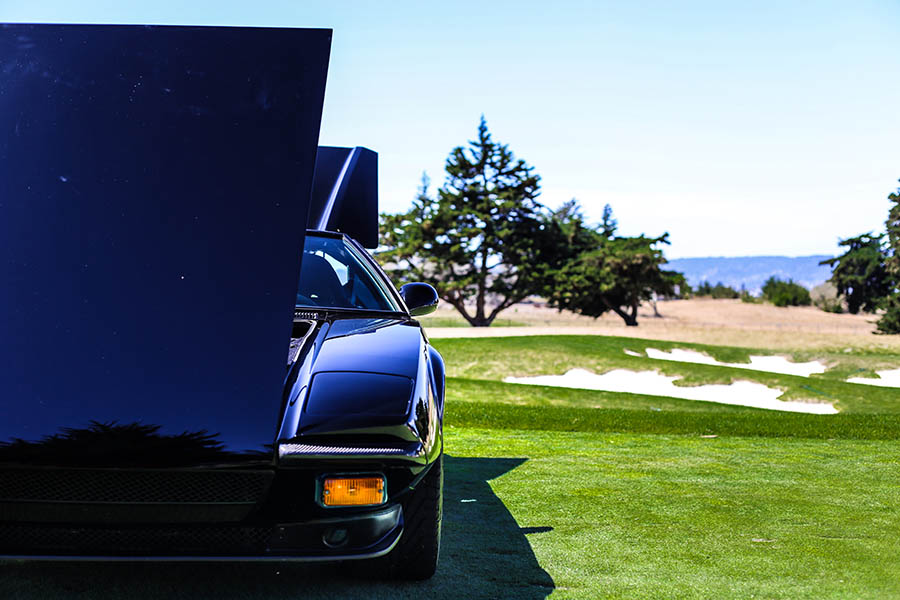
Some cars don’t just exist — they make a statement. The De Tomaso Pantera is one of them. Born from a transatlantic ambition, powered by an American heart, clothed by the hands of Ghia — it embodies that rare moment when eccentricity becomes genius.
The Pantera: born from a transatlantic dream
In 1971, Alejandro de Tomaso introduced a car that shouldn’t have existed. Argentine by birth, settled in Modena, he had convinced Ford to invest in his vision. The result: a supercar sold through Lincoln-Mercury dealerships across the United States. A commercial oddity as much as an automotive one.
The Pantera — Italian for panther — arrives at a pivotal moment. European supercars are out of reach for most. De Tomaso offers the same thrill at an almost reasonable price. More than 10,000 examples would be built between 1971 and 1992, an unthinkable figure for a car of this nature.
Ghia design, Ford engine: the perfect alliance
Tom Tjaarda, designer at Ghia, created a body that resists time with rare elegance. Taut lines, a plunging hood, a characteristic side air intake — every detail combines aerodynamics with desire. The Pantera is beautiful before it is fast.
Under that sculpted bodywork beats a Ford 351 Cleveland V8. Not the most expected element in an Italian supercar — and yet, that is precisely what makes the Pantera. Reliable, powerful, accessible. An engine that reassures where Ferrari or Lamborghini might intimidate.

The Pantera in collection and on track
The Pantera has always had two lives. On the road, it impresses. On the circuit, it surprises. GTS, GT5, and GT5-S versions followed — with wings, flared arches, and uprated engines that gave the Pantera the air of a race car homologated for the street.
Today, well-preserved examples trade between €60,000 and €200,000 depending on the series and condition. The GT5 and GT5-S reach the highest auction prices. The Pantera has become what it should have been from the start: a collector’s piece.
Why the Pantera fascinates photographers
Few cars lend themselves to fine art photography as naturally as the Pantera. Its bodywork plays with light in an almost unpredictable way — Ghia’s lines create sharp shadows, clean reflections, a sculpture the lens never tires of exploring.
Its rarity adds to the appeal. Unlike Ferraris or Porsches ubiquitous at concours events, the Pantera remains a discovery. To photograph it is to reveal something that few people have truly looked at.

Putting the De Tomaso Pantera on your walls
A Pantera photograph in an interior says something. Not the obvious supercar. Not the one everyone immediately recognizes. The Pantera speaks to connoisseurs — those who know, those who have searched.
Our fine art prints are produced in limited editions of 30 numbered copies, on Hahnemühle paper or Dibond aluminum. Each print comes with a certificate of authenticity. A work that stands the test of time, like the car it portrays.
How much is a De Tomaso Pantera worth today?
Depending on the series and condition, Panteras trade between €60,000 and €200,000. GT5 and GT5-S versions, rarer and more sporting, command the highest values. Original, unmodified examples are particularly sought after.
How many De Tomaso Panteras were built?
More than 10,000 Panteras were built between 1971 and 1992, making it one of the highest-volume supercars of its era. This unusual volume was made possible by distribution through Ford dealerships in the United States.
What engine did the De Tomaso Pantera use?
The original Pantera was equipped with a Ford 351 Cleveland V8 of 5.7 litres, producing between 266 and 330 horsepower depending on the version. GT5 models of the late 1980s could reach 350 horsepower or more with factory modifications.