

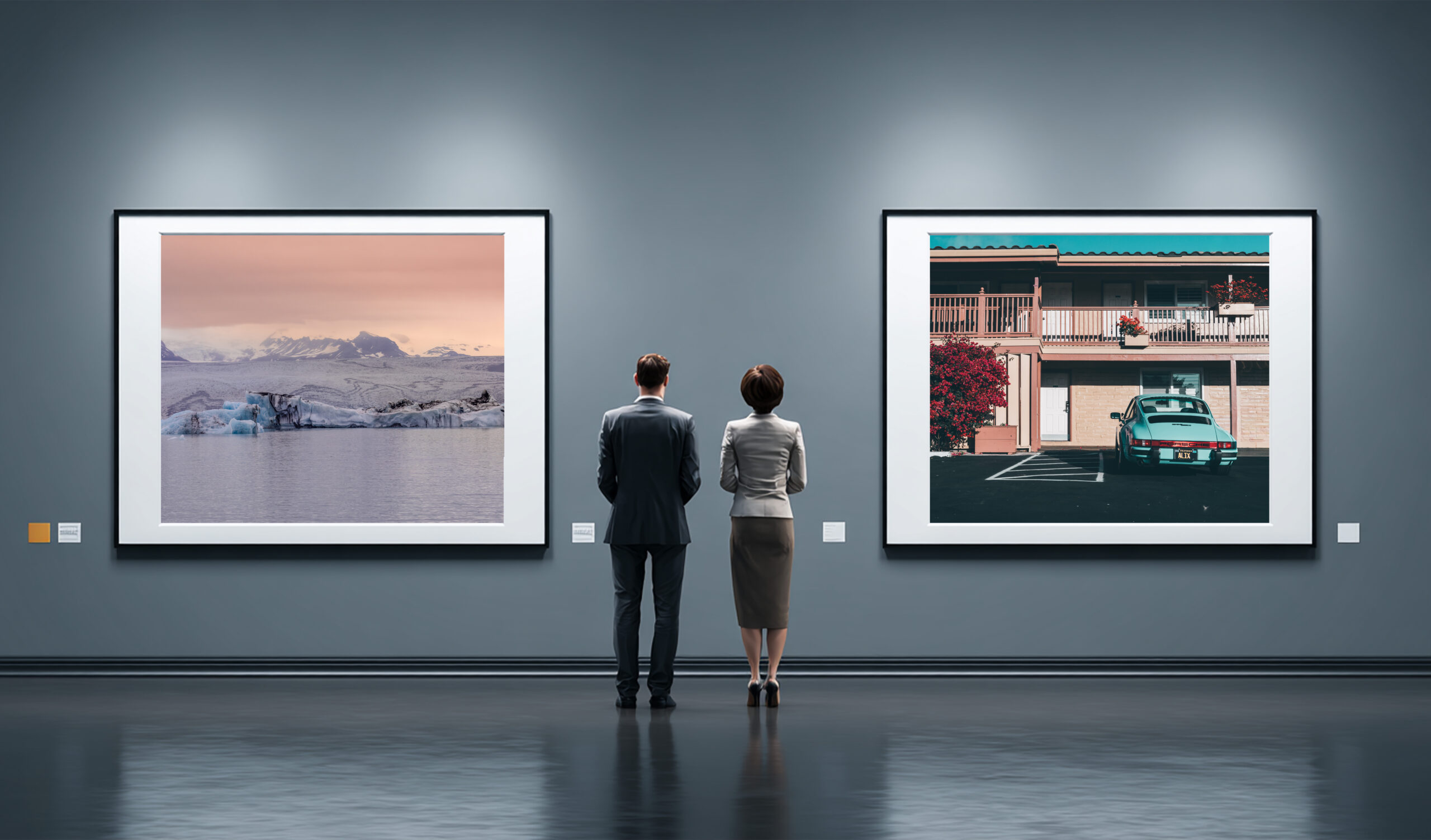
This tutorial covers everything you need to hang multiple pictures with lasting precision. A 100 × 150 cm aluminum print shifts the visual weight of a room the moment it meets the wall. We rely on the 57-inch height standard and the two-thirds balance rule to establish a layout that holds.
Core rules for hanging pictures at the right height
Wall space requires a measured approach before you drive a single nail. Collectors frequently misjudge placement, yet the method demands only a tape measure and a clear standard. The 57-inch level positions the visual center of a picture in direct alignment with the average human eye.
What is the 57 rule for hanging pictures
What is the 57 rule for hanging pictures? It establishes that the center of any picture must sit exactly 57 inches from the floor. This wall art hanging guide begins with measuring the precise distance from the top of the frame down to the wire under tension.
- Standard rooms: Place the artwork center at exactly 57 inches from the floor to serve standing viewers.
- Dining rooms: Lower the piece by 8 to 12 inches to align with a seated line of sight.
- High-ceiling rooms: Raise the frame slightly to address the vertical space without isolating the subject from the room below.
- Low-ceiling rooms: Lower the arrangement to preserve proportion and avoid visual compression near the ceiling.
Before committing to a nail position, evaluate your prints through a camera lens from a normal viewing distance. A photograph reads the gallery wall layout with useful objectivity. This step confirms the balance of the arrangement before it is finalized.
The 2/3 rule and furniture proportions
Understanding how to hang pictures on a wall means accounting for scale relative to the furniture below. The two-thirds rule requires that your wall art span roughly 65 percent of the supporting piece beneath it. A 2.20-metre sofa calls for a 100 × 150 cm print to achieve proper visual anchorage.
Measure the underlying furniture before deciding on placement in any given area. When multiple pictures are grouped as a single unit, apply the proportion rule to the total width of the arrangement. This approach anchors a gallery wall more reliably than scaling each frame independently.
Clearance, ceilings, and viewing context adjustments
Keep six to ten inches of clearance between the top of the furniture and the lower edge of the frame. A smaller distance visually crushes the print against the console or sofa beneath it. Exceeding ten inches breaks the spatial connection between the prints and the furniture they address.
In seated environments, the 57-inch standard reads noticeably high: shift the center to approximately 45 inches instead. The primary function of the space must determine the final height, not the rule in isolation. At this scale, the decision shifts toward the viewer’s position rather than any fixed measure.
How to plan and level a gallery wall layout
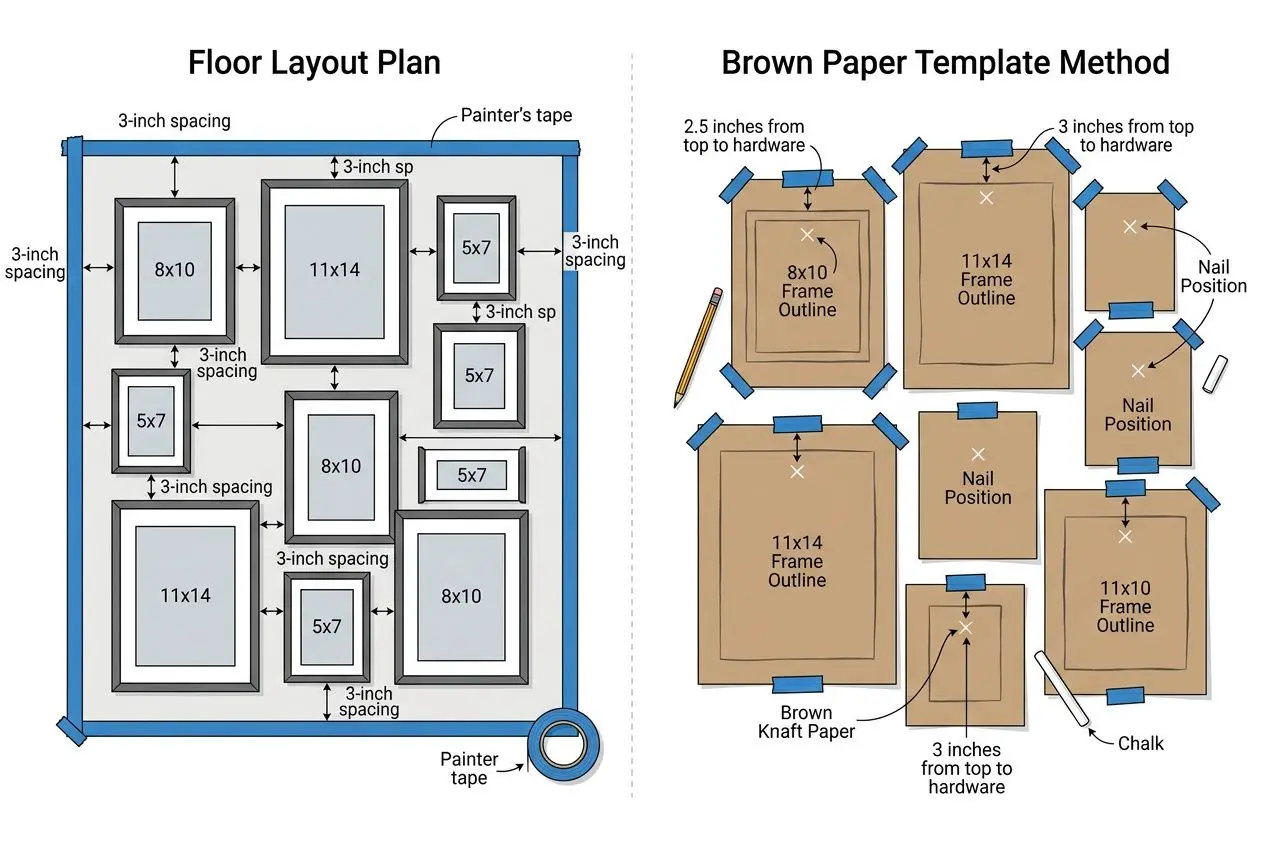
A gallery wall demands precise calculation before the first nail enters the plaster. Two techniques guarantee strict accuracy: the floor layout and the brown paper template method. Both require painter’s tape, a pencil, and a reference photograph. The positions established on the floor directly dictate final placement on the wall.
Floor planning methods for different picture sizes
To hang multiple pictures of varying dimensions, calculation begins on the floor rather than the wall. Outline the wall measurements using painter’s tape, positioning each frame with exactly three inches of space between them. Photograph this arrangement immediately. That image becomes the definitive reference for transferring placement to the vertical surface.
- Floor layout method: Map a wall-sized perimeter on the floor, place all frames with equal gaps, and document the layout before installation.
- Brown paper template method: Trace frames onto paper, cut the shapes, and mark exact nail positions. Apply these templates to the wall with tape to transfer positions securely.
- Anchor placement first: Position the largest piece off-centre or in an outer corner, then set the second-largest picture diagonally to establish structural balance.
- Mixed orientations: Alternate vertical and horizontal formats throughout the arrangement to maintain visual tension and avoid rigid uniformity.
I would choose to review the floor layout over several days before committing to the wall. A layout that appears balanced on Tuesday often reveals uneven distribution by Thursday. This method permits necessary adjustments at no cost to the surface.
Tools and techniques to hang multiple pictures level
To hang multiple pictures so they sit straight across a wide span, a laser level provides the definitive baseline. A green laser level projects a continuous line across the entire wall. Measure the endpoints of this line and mark them with painter’s tape to establish reliable reference points. Each frame then aligns to this precise horizontal axis.
- Laser level: Project a continuous line across the wall and mark endpoints with a pencil before removing the tool.
- Pocket spirit level: Rest a small level atop every frame after mounting; a two-degree deviation remains clearly visible from a distance.
- Hardware distance verification: Measure the distance from the top of the frame to its hanging hardware, as this figure dictates the ultimate placement.
In practice, the hardware distance requires individual verification because it shifts even between apparently identical frames. Measure each picture separately to ensure absolute accuracy. Neglecting this specific distance causes frames to drift from the intended straight alignment across the gallery wall.
Spacing standards that unify the whole arrangement
Consistent spacing remains the primary technique for unifying a diverse collection of prints into a coherent display. Maintain gaps of five to six centimetres evenly between every frame. An inconsistent space disrupts the visual logic and reads as an error from across the room.
Rectangular prints often require slightly wider vertical gaps than horizontal ones to improve visual flow. Square formats hold balance securely with equal spacing in all directions. In my view, the chosen interval must remain strict throughout the gallery wall; altering it to accommodate a difficult frame dismantles the entire arrangement.
Gallery wall arrangement styles, hardware, and design cohesion
A 120 × 80 cm print mounted on aluminum carries a specific visual weight that governs the surrounding geometry. The gallery wall arrangement you select determines whether a room reads as a curated space or a scattered collection of objects. The choice of hanging system and layout must be resolved together, matching hardware to the actual load.
Choosing a gallery wall layout that suits your space
Before drilling the first nail hole, apply the 2/3 rule for hanging pictures to the entire composition: the collective width of the frames should span 60 to 75 percent of the furniture placed below. This precise measure prevents the arrangement from overwhelming the room. It establishes a baseline balance whether vous are hanging uniform prints or a varied salon-style collection.
- Grid layout: matching sizes with evenly spaced gaps demand absolute precision, yielding the most controlled visual result for a formal space.
- Salon style: mixed dimensions unified by a shared color temperature suit eclectic rooms holding photography, painting, and framed art.
- Triangular cluster: three pieces anchored together provide structure for a compact wall space where a full gallery wall feels forced.
- Chronological frieze: a linear progression mounted at a constant height guides the eye along a hallway line.
In my view, the salon style offers the architectural flexibility a growing collection requires. It absorbs a newly acquired picture without demanding a complete recalibration of the surrounding wall space. The grid, by contrast, fractures the moment a mismatched dimension is introduced.
| Layout style | Best room type | Frame sizes | Spacing |
| Grid | Formal living room, office | Uniform | Equal, 5–6 cm |
| Salon style | Eclectic living room, studio | Mixed | Varied, 3–8 cm |
| Triangular cluster | Compact wall, bedroom corner | Mixed, 3 pieces | Intimate, 3–5 cm |
| Chronological frieze | Hallway, staircase | Consistent height | Equal horizontal |
Hardware options for every wall type and picture weight
A 100 × 70 cm aluminum Dibond piece exerts a distinct downward force that a stretched canvas does not. In practice, vous must match the hardware to the structural reality of the wall, not merely the size of the frame. The fixing method dictates the long-term safety of the piece.
- Drywall, under 20 pounds: a standard picture hanger and a single nail suffice; no anchor is required for light pieces on a sound surface.
- Drywall, over 20 pounds: French cleats anchored directly into studs distribute the weight evenly across the surface.
- Brick walls: insert masonry fixings strictly into the mortar joints rather than the brick face itself.
To preserve full flexibility without driving a single nail into plaster, I recommend a track-based hanging system with suspended steel cables. The initial investment is higher, but the ability to adjust vertical positions without repairing drywall earns its place in any considered interior.
D-rings offer superior torsional stability over traditional wire when hanging pictures of significant weight. Measure the exact distance from the top edge of the frame to the D-ring before marking the wall. This single measurement prevents the vast majority of alignment failures.
Design tips for a cohesive and visually unified picture display
Repeating a single frame profile establishes immediate visual authority across an otherwise disparate layout. An unbroken run of black aluminum mounts unifies a collection regardless of the underlying subjects or eras. This is the finish that earns its place in a brightly lit space.
Monochrome imagery actively reduces visual tension across multiple pieces. When grouping a 1967 Ford GT40 with a classic Porsche 911, removing color data allows the geometry of the bodywork to carry the visual weight. This reduction produces a cohesion that competing color palettes rarely achieve.
When the context calls for it, Cars and Roses provides consistent sizing across aluminum, canvas, and acrylic glass formats. At this scale, the decision shifts toward structural consistency: a Ferrari wall picture mounted beside a landscape print of the exact same dimension secures the spatial balance that endures.
Frequently asked questions
What is the 2/3 rule for hanging pictures?
The 2/3 rule for hanging pictures holds that a picture or arrangement should span approximately two-thirds of the width of the furniture positioned beneath it. In practice, above a 180 cm sofa, the arrangement should measure between 108 and 135 cm across. Measure the furniture first, then select prints that satisfy this proportion exactly.
How do you hang a group of four pictures evenly on the same wall?
Approach the four pieces as a single picture: define the total width and height of the combined arrangement before committing to any nail positions. Place the exact centre of this unit at 57 inches from the floor. Use a paper template method to mark each frame’s fixing point; this is how you distribute the framed art evenly without repeated adjustments to the wall.
What is the correct method for picture hanging on brick walls?
The correct method for picture hanging on brick requires drilling into the mortar joints rather than the brick face itself. Mortar accepts fixings cleanly and simplifies any repair work when repositioning becomes necessary. For heavy framed art, fit a masonry drill bit and a dedicated wall plug before securing the hanging hardware.